

Table of Contents
- Quick Comparison: Top 5 Compact Entryway Storage Solutions
- Wall-Mounted Entryway Storage: Floating Shelves and Hooks
- Multipurpose Furniture: Benches with Hidden Storage
- Shoe Storage and Organization for Narrow Spaces
- Entryway Organization Ideas for Small Spaces
- How to Declutter an Entryway: A Step-by-Step Guide
- Seasonal Storage Rotation and Maintenance Tips
- Conclusion: Choosing the Right Compact Entryway Storage
- Frequently Asked Questions
Last Updated: September 16, 2026
Quick Comparison: Top 5 Compact Entryway Storage Solutions
The best compact entryway storage solutions solve a problem most homes have: too much stuff, too little floor space. This guide ranks the five options that actually work in tight hallways, from wall-mounted entryway storage to benches with hidden compartments.
The real issue isn't lack of storage.
Here's how the five options stack up:
| Solution | Footprint | Best For | Renter-Friendly |
|---|---|---|---|
| Wall-mounted shelves and hooks | Zero floor space | Narrow hallways | Yes |
| Bench with hidden storage | 30-45 cm deep | Seating plus footwear storage | Sometimes |
| Vertical shoe rack | 25-30 cm deep | Footwear storage | Yes |
| Over-door organizer | Door width | Renters with no wall space | Yes |
| Modular cube system | 30-60 cm | Growing households | Usually |
Wall-Mounted Entryway Storage: Floating Shelves and Hooks
Wall-mounted entryway storage frees up every inch of floor space, which matters most in a hallway under a metre wide. Floating shelves hold keys, mail, and small storage baskets, while coat hooks take bags and jackets off the floor entirely.
Multipurpose Furniture: Benches with Hidden Storage
An entryway bench with hidden storage does two jobs at once: somewhere to sit while tying shoes, and a place to stash footwear, bags, or seasonal gear out of sight. For a narrow entryway, look for benches 30-40 cm deep and no wider than your wall allows with clearance to open the lid.
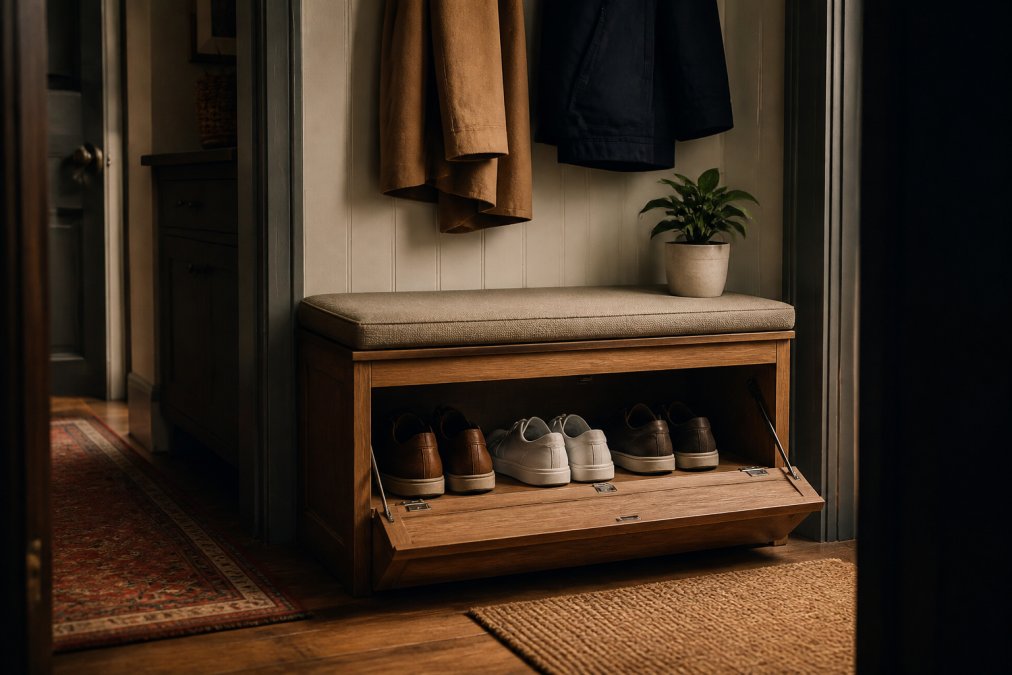
Match the lid mechanism to the household
Lift-top benches suit households that want concealed storage for bulky items, but the hinge type matters more than the finish:
- Soft-close gas-lift hinges hold the lid open hands-free, which matters when you're balancing a toddler or grocery bags.
- Standard piano hinges are cheaper but require one hand to hold the lid while the other loads the bench.
- Removable-top benches (the lid lifts off entirely) are the easiest for kids and for anyone with limited grip strength, because there's no hinge to fight.
Accessibility: the angle most guides skip
If anyone in the household uses a cane, walker, wheelchair, or has limited reach or grip, a standard 18-inch bench is the wrong height. A seated surface around 17-19 inches from the floor is the common range for comfortable transfer from a wheelchair, and it should sit flush against a wall with clear floor space beside it for a mobility aid.
Renter-friendly bench options
If you're renting, a freestanding bench you can move beats anything bolted down. Two renter-safe approaches:
- Freestanding storage bench with a back panel, no wall attachment needed, and the back panel stops items from sliding off the rear.
- Two cube organizers pushed together with a cushion on top, modular, cheap, and you can split them apart later for a closet or mudroom.
Shoe Storage and Organization for Narrow Spaces
Shoe storage fails in narrow spaces when it's designed for a closet, not a hallway. A vertical shoe rack 25-30 cm deep holds 12-18 pairs without blocking the walkway, and stackable units let you add capacity as your household grows.
Entryway Organization Ideas for Small Spaces
Entryway organization ideas for small spaces all share one principle: use vertical storage before you use floor space. Shelves above the bench, hooks above the shelf, and a slim console against the wall create layers of storage without eating into the walkway.
The vertical layering map
Think of your entryway wall as four horizontal bands, each with a job:
- 0-15 inches (floor to knee): shoe racks, boot trays, and a low cubby for kids' shoes. This is the bend-down zone.
- 15-48 inches (knee to shoulder): the daily-use band. Hooks for keys and leashes, a shallow shelf for mail, a bench seat, and the most-worn shoes. Keep this band clear of clutter so it stays functional.
- 48-72 inches (shoulder to overhead reach): coats, bags, and a shelf for out-of-season items or a storage basket.
- 72 inches and up: long-term or seasonal storage only. Anything here needs a step stool, so don't put daily items there.
Renter-friendly, no-drill vertical storage
Most "vertical storage" advice assumes you can drill. Renters often can't. These options hold real weight without a single hole:
- Over-the-door hooks and racks, rated capacity varies widely; check the door thickness and the weight rating before loading it with coats.
- Tension-rod shelving in a narrow alcove or between two walls, works for lightweight baskets, not for heavy bags.
- Freestanding leaning ladder shelves, no wall contact needed, and they add four to five tiers of vertical storage in about 18 inches of floor depth.
- Adhesive hooks rated for the weight, fine for keys, leashes, and light bags; not for coats or backpacks. Follow the cure time on the package before hanging anything.
- Command-style strips and clips, good for lightweight, frequently moved items like reusable bags and umbrellas.
Accessibility in a small entryway
A compact entryway can still be accessible. Two adjustments matter most:
- Keep a clear turning radius. A wheelchair or walker needs roughly a 5-foot circle to turn around. In a narrow hallway, that often means choosing wall-mounted storage over floor-standing pieces, and keeping the floor completely clear.
- Lower the daily-use items. If someone in the household is seated, move keys, leashes, and daily shoes into the 15-48 inch band and out of the overhead zone.
Quick wins that actually hold up
- Add a slim entryway console with a lower shelf for storage baskets
- Hang a wall-mounted rack for leashes, umbrellas, and reusable bags
- Use a lidded storage bin for items that don't belong to anyone specifically
- Keep a single tray for keys so they stop scattering across surfaces
- Put a boot tray under the shoe zone to contain mud and salt
The goal is a place for everything, so nothing piles up on the floor, and a layout that works whether you're standing, seated, or carrying a toddler.
How to Declutter an Entryway: A Step-by-Step Guide
Decluttering an entryway takes about 45 minutes and works best in five steps. Do it in order, and don't skip the last one, because that's the step that makes it stick.
- Empty the space completely. Clear the floor, bench, and shelves. Seeing the bare space shows you how much you've been storing.
- Sort into four piles. Keep at the entry, relocate to another room, donate, and trash.
- Set a keep limit. Two to three pairs of shoes and one bag per person is a workable cap for most narrow entryways.
- Clean before you reload. Wipe shelves and vacuum the floor while it's empty.
- Assign a home for every item. Anything without a spot becomes clutter again within a week.
Seasonal Storage Rotation and Maintenance Tips
Seasonal rotation keeps a compact entryway functional year-round. Twice a year, swap heavy coats and boots for lighter layers, storing the off-season items in labeled bins elsewhere in the home.
- Wipe bench surfaces weekly and shake out shoe trays
- Check hooks and shelf brackets every few months for loosening
- Vacuum under benches and behind shoe racks monthly
- Replace worn liners or mats before they stain the surface beneath
Conclusion: Choosing the Right Compact Entryway Storage
The hardest part of compact entryway storage isn't finding products. It's matching the system to your actual space and keeping it up once the novelty fades. Pick wall-mounted solutions for the tightest hallways, a storage bench if you need seating, and a vertical rack for footwear. Then build the rotation and maintenance habits that keep it working.
Frequently Asked Questions
How do you organize a small entryway without a closet?
Use wall-mounted entryway storage like floating shelves and hooks to keep items off the floor. A slim shoe rack or over-the-door organizer can hold footwear. Add a compact bench with hidden storage for bags and accessories. Keep only daily essentials in the entryway and rotate seasonal items to reduce clutter. These compact entryway storage solutions maximize vertical space and keep the area functional.
What are the best space-saving ideas for narrow hallways?
For narrow hallways, choose vertical storage such as tall, shallow cabinets or stackable bins. Wall-mounted hooks and fold-down benches save floor space. Use over-the-door racks for shoes and coats. Mirrors can create an illusion of more space. Focus on slim, multipurpose furniture that fits tight areas and keeps the hallway clutter-free.
How can I add storage to a tiny entryway?
Install floating shelves above eye level for baskets and decor. Use a wall-mounted coat rack with hooks for bags and keys. A shoe bench with storage underneath provides seating and hides clutter. Consider a narrow console table with drawers. These compact entryway storage solutions add function without taking up much room, making the most of your small space.
How do you keep a small entryway from looking cluttered?
Limit items to essentials and use hidden storage like baskets or bins. Choose furniture with clean lines and neutral colors. Implement a daily reset routine to put items back in their place. Use wall-mounted entryway storage to keep floors clear. Rotate seasonal items and donate unused belongings to maintain a clutter-free entryway.
A neat entryway isn't about buying more. It's about choosing storage that fits the room you actually live in. The Reset Aisle offers curated, space-saving solutions that turn chaotic drop zones into calm, functional spaces, with products built to keep every room neat and under control. Start your reset with The Reset Aisle and build an entryway that stays organized.