

Table of Contents
- Quick Comparison: Best Closet Systems for Reach-In Closets
- How to Measure and Fit a Closet System Before You Buy
- Affordable Closet Systems That Actually Hold Up
- Closet Systems With Drawers: When Built-In Storage Makes Sense
- How to Maximize Reach-In Closet Space With Hangers and Rods
- Closet System Installation: What You Can Do Without a Contractor
- Which Closet System Fits Your Space? A Buying Framework
- Frequently Asked Questions
Last Updated: October 14, 2026
Quick Comparison: Best Closet Systems for Reach-In Closets
A reach-in closet system is a storage setup for shallow, wall-recessed closets, typically 24 inches deep or less, combining hanging rods, shelves, and drawers to organize clothing in a compact footprint.
At The Reset Aisle, we build recommendations around that reality. Most reach-in closets waste vertical space, force long garments into short-hang zones, and leave drawers a tangled pile. The systems that work fix your weakest point first.

Here's the short version before we get into the details:
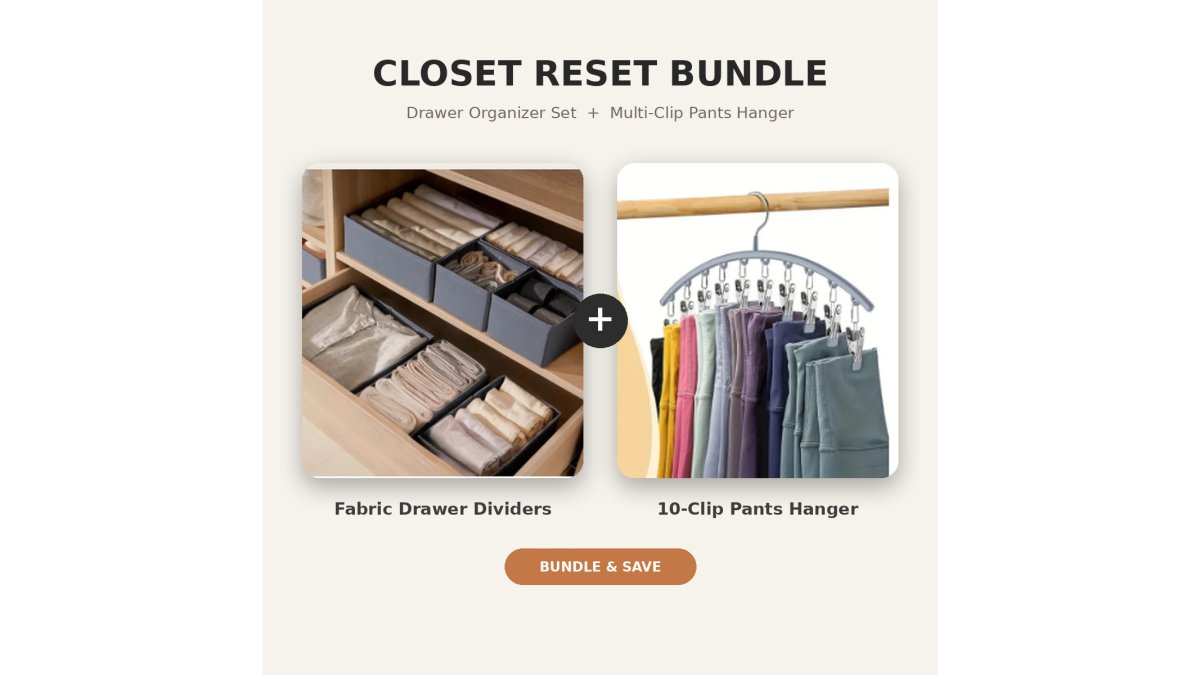
- Best overall for most reach-in closets: The Closet Reset Bundle, which pairs a 40-pair pant hanger with a compartmented drawer organizer for $36.99.
- Best for pants and leggings overload: the Space Saving Pant Hanger at $19.99.
- Best for shirts and lightweight accessories: the 5-Hole Rotating Closet Organizer at $24.99.
- Best for drawer chaos: the Fabric Drawer Organizer at $22.99.
Below, we'll show you how to measure your closet, what holds up, and which setup fits your space.
How to Measure and Fit a Closet System Before You Buy
Measure your closet's width, depth, and height before buying anything, and note where the rod sits.
Start with six measurements, not four:
- Width: measure wall to wall at the widest point, not at the door frame. Note the narrowest point too, since a door jamb or return wall can pinch the opening.
- Depth: measure from the back wall to the front edge of the shelf or rod. Standard reach-in depth is 24 inches, but older homes often run 22 inches or less.
- Height: measure floor to ceiling, then subtract 2 to 3 inches of clearance so tall items and the rod bracket itself have room.
- Rod height: measure from the floor to the center of the existing rod. Standard single-hang is around 60 inches, but yours may differ.
- Door clearance: with the door open, measure from the door face to the back wall. This is the number that tells you whether a deep organizer will block the swing.
- Obstructions: note outlet plates, light switches, HVAC registers, and any angled ceiling or soffit that cuts into usable height.
Write the numbers down in inches and keep them on your phone while you shop.
The U.S. Department of Housing and Urban Development design standards treat closet space as a functional requirement in housing, which is a useful reminder that fit matters more than style.
Once you have numbers, match components to zones using these thresholds:
- Double-hang: needs roughly 40 inches of vertical clearance for two rows of shirts. If you have 40 inches or more above the floor, a second rod is usually the single biggest capacity gain available.
- Long-hang: dresses, coats, and long garments need about 60 inches of drop from rod to floor. If your closet can't do both long-hang and double-hang, pick the one that matches most of your wardrobe.
- Shelf depth: a shelf above the rod typically runs 12 to 16 inches deep. Anything deeper than 16 inches in a 24-inch closet starts to crowd the hanging space below.
- Drawer depth: built-in drawer boxes generally need 14 to 18 inches of depth to slide without hitting the door. In a shallow reach-in, that is often the constraint that rules out full drawer stacks.
A quick sanity check before you buy: add up the linear feet of rod you need.
If the math says you cannot fit everything, do not force it.
Affordable Closet Systems That Actually Hold Up
Affordable closet systems work when they target one failure point instead of rebuilding the whole closet. You don't need a full custom install, just the right two or three components.
Here's how the options compare on price and purpose:
| Product | Price | Best For | Key Spec |
|---|---|---|---|
| The Closet Reset Bundle | $36.99 | Most reach-in closets | 40-pair hanger + drawer organizer |
| Space Saving Pant Hanger | $19.99 | Pants and leggings | Holds 40 pairs on 10 clips |
| 5-Hole Rotating Organizer | $24.99 | Shirts and accessories | Five rotating hanging positions |
| Fabric Drawer Organizer | $22.99 | Sock and underwear drawers | Small, medium, large; folds flat |
The bundle is our pick for most people because it fixes rod crowding and drawer digging at once. Bought separately, the pant hanger and drawer organizer cost more than the bundle price.

What most guides miss is that one well-chosen hanger can free up more rod space than a whole shelf reconfiguration.
Closet Systems With Drawers: When Built-In Storage Makes Sense
Built-in drawers make sense when your closet has dead space below the hanging rod and folded items keep ending up in a heap.
Reach-in closets rarely have room for full drawer stacks, the depth isn't there.
The Fabric Drawer Organizer divides a drawer into sections so each category gets its own compartment. Internal supports keep the walls upright even when the drawer is full, so dividers hold their shape.
For a busy household, fabric organizers tend to outlast rigid plastic dividers because they don't crack when a drawer gets slammed.
How to Maximize Reach-In Closet Space With Hangers and Rods
Maximizing reach-in closet space comes down to one principle: match the hanger to the garment, and stop letting one category eat the whole rod. Pants and leggings are usually the worst offenders.
Three moves that free up the most space:
The Closet Reset Bundle | Pant Hanger + Drawer Organizer →
- Consolidate pants and leggings. The Space Saving Pant Hanger holds up to 40 pairs on 10 strong clips, replacing a stack of individual hangers with one.
- Rotate your shirts. The 5-Hole Rotating Closet Organizer gives five hanging positions on a single hanger and rotates so you can reach what's in back.
- Use the upper shelf. Store off-season items up high and keep daily wear at eye level.
A double-hang configuration roughly doubles usable rod length in the same footprint, but only with the vertical clearance. If you don't have it, consolidation is your next best lever.

Closet System Installation: What You Can Do Without a Contractor
Most closet system installation for reach-in closets is DIY if you stick to hangers, organizers, and wall-mounted rods.
There are three mounting styles to compare, and they behave very differently:
Freestanding and tension-mounted systems. These lean on the floor and against the wall, or wedge between two walls with tension. Tools needed: none beyond a level. Wall type: works on drywall, plaster, tile, and paneling because nothing is anchored. Reversibility: fully reversible, you lift it out and the wall is untouched. Install time: usually 15 to 30 minutes. Trade-off: lower load capacity than anchored systems, and the footprint eats a few inches of floor space, which matters in a 24-inch-deep closet.
Wall-mounted rods and shelves. These anchor into studs or use heavy-duty anchors. Tools needed: drill, stud finder, level, screwdriver, and a pencil.
Modular panel and bracket systems. These use vertical standards or panels that accept brackets at adjustable heights.
Renter-friendly options matter here. A wall-mounted rod or shelf usually requires drilling into studs, which most leases restrict. Freestanding organizers and hanging components don't, and they move with you.
What you can install yourself:
- Multi-clip and rotating hangers: no tools, no drilling
- Fabric drawer organizers: drop-in, no installation
- Adjustable shelving on existing brackets: a screwdriver and a level
- Additional rods on existing mounting points: usually straightforward
- Freestanding and tension-mounted units: a level and 15 to 30 minutes
What to hand off:
- Custom built-in cabinetry
- Anything requiring new wall anchors in plaster or tile
- Electrical additions like closet lighting
- Any install where you cannot find two studs in the span you need
A practical sequencing tip: install the highest-load item first. If you're adding both a second rod and a shelf, set the rod brackets before the shelf brackets so you're not working around a shelf already in the way. And if you're drilling into a wall you cannot patch, choose a freestanding option instead, the 15 minutes you save isn't worth a lease dispute.
Which Closet System Fits Your Space? A Buying Framework
Use this framework to pick a closet system in under five minutes. Answer three questions, and the choice becomes obvious.
Question 1: What's your closet's weakest point?
- Rod is packed, drawers are fine: start with a space-saving hanger.
- Drawers are a mess, rod is okay: start with a drawer organizer.
- Both are bad: start with the bundle.
Question 2: How much vertical space do you have?
- Under 40 inches of clearance: single-hang only, consolidate instead of doubling.
- 40 inches or more: consider a double-hang configuration.
Question 3: Do you rent?
- Yes: stick to hanging components and drop-in organizers.
- No: adjustable shelving and wall-mounted rods are fair game.
For most people, the answer lands on the bundle. It's $36.99, fixes the two most common reach-in closet problems, and costs less than buying the pieces separately.
Frequently Asked Questions
How much does a custom reach-in closet cost?
Custom reach-in closet systems typically run from a few hundred dollars for a single-wall design to several thousand for a full build with drawers, shelving, and professional installation. The price climbs with materials, drawer count, and whether a contractor handles the work. A modular or component-based approach costs far less because you skip the design fee and install it yourself. If budget is the deciding factor, start with the pieces that solve your biggest daily annoyance, like hanging capacity or drawer chaos, and add on later.
What should you measure before buying a reach-in closet system?
Measure the closet's width, depth, and height at three points each, since walls are rarely square. Note the rod height and shelf height if you plan to keep them. For reach-in closets, depth usually falls between 24 and 30 inches, and that number decides whether standard drawers fit without blocking the door swing. Also check for outlet placement, baseboards, and door trim. Write every number down and bring the list with you, because guessing leads to gaps and returns.
Are wall-mounted or freestanding closet systems better for reach-in closets?
Wall-mounted systems free up floor space and let you set shelf and rod heights exactly where you need them, which matters in a shallow reach-in closet. Freestanding organizers are easier to move and need no drilling, so they suit renters or anyone who wants a reversible setup. Many people combine both: a wall-mounted rod and shelf for hanging, plus a freestanding or modular drawer unit below. Pick based on whether you can drill into the wall and how long you plan to stay.
Can you install a closet system without drilling into the wall?
Yes. Tension rods, freestanding shelving units, over-the-door racks, and modular organizers that rest on existing shelves need no drilling at all. Space-saving hangers like a 40-pair pant hanger or a 5-hole rotating organizer hang on the existing rod and add capacity without touching the wall. These options work well for renters or anyone hesitant about patching holes later. The trade-off is load limits: no-drill solutions hold less weight than anchored shelving, so keep heavy items on the floor or on existing shelves.
How do you maximize space in a reach-in closet without replacing the whole system?
Start with the rod. A single space-saving pant hanger can hold up to 40 pairs of pants on 10 clips while taking the space of one hanger, which frees a surprising amount of rod length. Add a 5-hole rotating organizer for shirts and scarves, then sort socks, underwear, and ties into fabric drawer organizers so nothing piles up. Raise or lower the rod if your closet allows it, and use the shelf above for items you reach for less often. Small component swaps often recover more usable space than a full rebuild.
Reach-in closets don't fail because they're small. They fail because the wrong components are doing the wrong jobs. The Reset Aisle builds practical, space-saving solutions that make the items you already own work harder, from a 40-pair pant hanger to fabric drawer organizers that hold their shape. Start with your closet's weakest point, and the rest gets easier. Start Your Reset with The Reset Aisle and turn a crowded closet into a calmer daily routine.