

Table of Contents
- Why Small Kitchen Drawers Need the Right Dividers
- Adjustable Drawer Dividers: Flexibility for Awkward Spaces
- Expandable Kitchen Drawer Organizers: Fit Any Width
- Solutions for Narrow Drawer Organizer Needs
- DIY Drawer Dividers: Budget-Friendly Custom Options
- Measuring Your Drawer: The Foundation of Smart Organization
- Materials That Last: Durability and Maintenance
- Frequently Asked Questions
Last Updated: October 6, 2026
Why Small Kitchen Drawers Need the Right Dividers
Small kitchen drawers are deceptively difficult to organize: limited space, awkward dimensions, and items that refuse to stay put.
The difference between a drawer that stays organized and one that reverts to chaos comes down to choosing dividers that work with your drawer's actual dimensions, not against them.
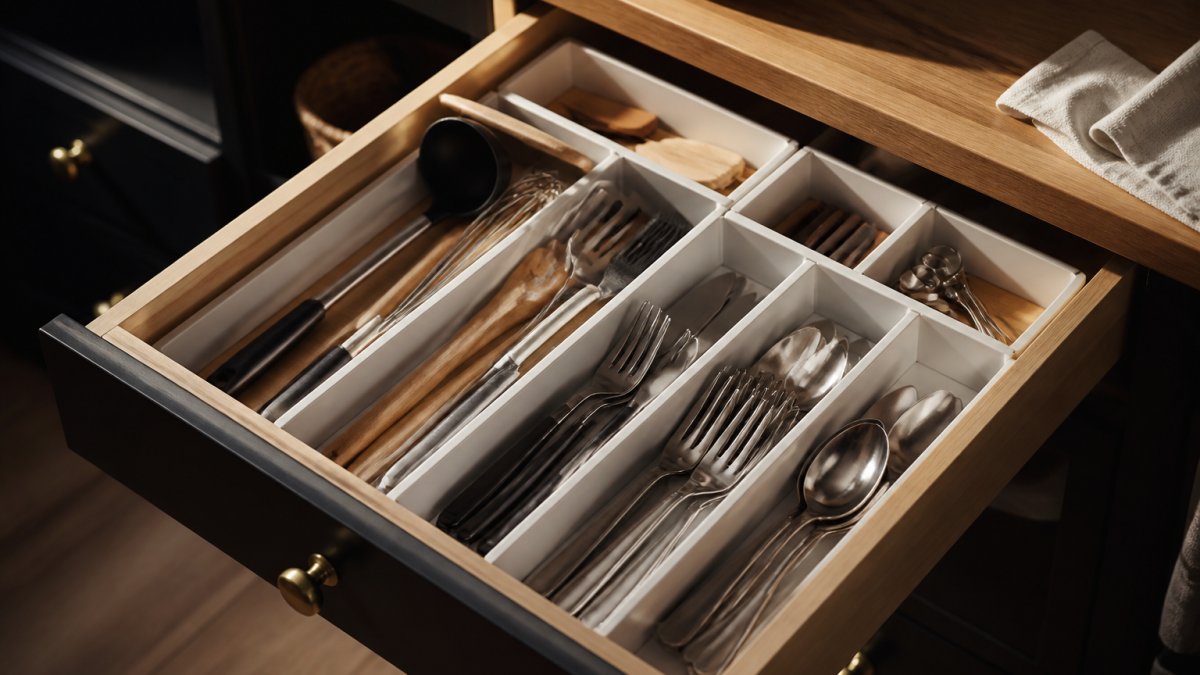
A cluttered drawer wastes time every morning and creates visual stress in a space you use constantly.
Small drawers come in infinite variations, shallow, oddly shaped, or with slanted ceilings above them. Standard organizers often leave gaps or don't expand enough to fit the full width, which is where customizable and adjustable dividers become essential.
Adjustable Drawer Dividers: Flexibility for Awkward Spaces
Adjustable drawer dividers are the most versatile option for small kitchens because they adapt to your drawer size rather than forcing you to adapt to them. They expand and contract, letting you customize compartment width and create sections exactly where you need them.
One organizer works across multiple drawer sizes, moves with you, and grows with your needs as your kitchen storage requirements change.
The Expandable Drawer Organizer from The Reset Aisle ($59.99) exemplifies this approach, with customizable compartments and removable dividers for cutlery, utensils, and small kitchen accessories. It fits a variety of standard drawer sizes, and the smooth PET plastic construction makes it simple to clean.

Look for adjustable dividers with these features:
- Spring-loaded or tension mechanisms that hold position without sliding
- Removable dividers so you can reconfigure as needed
- Non-slip bases to prevent the organizer from shifting when you open and close the drawer
- Smooth, easy-to-clean surfaces that resist staining
Expandable Kitchen Drawer Organizers: Fit Any Width
Expandable kitchen drawer organizers apply adjustability specifically to width. They telescope or accordion-fold to match your drawer's exact width, eliminating wasted side space that typically gets filled with junk.
The difference is subtle but important: expandable organizers focus on width adjustment, while adjustable organizers let you customize compartment size from side to side.
Expandable organizers are particularly useful for utensils, flatware, and kitchen tools. Their distinct compartments keep forks separate from spoons and specialty utensils in their own space, preventing everything from getting jumbled together.
When shopping for expandable options, verify these specifications:
- Maximum and minimum width capacity (make sure it covers your drawer's exact width)
- Compartment depth (deeper compartments work better for longer utensils)
- Material durability (bamboo and polypropylene both work well; choose based on your maintenance preferences)
- Tension mechanism quality (cheap spring-loaded systems fail within months)
One practical consideration: expandable organizers work best in drawers that are at least 12 inches wide. Narrower drawers may not give you enough room to create meaningful compartments.
Solutions for Narrow Drawer Organizer Needs
Narrow drawers present a specific challenge: standard organizers are often too wide, leaving unused space or no fit at all. Understanding your drawer's actual dimensions is critical.
For narrow drawer organizer situations, you have three realistic options. First, look for slender, single-row organizers designed specifically for tight spaces. These typically accommodate 4-6 compartments and work well for storing utensils or small kitchen accessories. Second, consider DIY solutions using dividers you can customize to exact dimensions. Third, stack multiple narrow organizers vertically if your drawer depth allows it.
Measure the usable width of your drawer carefully. Account for any hardware, handles, or internal ridges that reduce available space. A drawer that appears to be 10 inches wide might only have 9 inches of usable width once you factor in these details.
DIY Drawer Dividers: Budget-Friendly Custom Options
DIY drawer dividers appeal to people who want complete control. You can build custom dividers from wood, acrylic, or even cardboard, creating exactly the compartment sizes and shapes your drawer needs.
The advantage is flexibility: you're not limited to what manufacturers offer, so you can build for oddly shaped drawers or specific utensil configurations. The cost is typically lower than pre-made organizers, especially with recycled materials.
Common approaches include foam board, acrylic sheets, or thin wood secured with hot glue, wood glue, or double-sided tape; repurposed small boxes; or tension rods and dowels for adjustable sections.
The trade-off is time and durability: DIY solutions take longer to build and may not last as long as commercial organizers.
Expandable Drawer Organizer – Adjustable Cutlery Tray for Spoons & Forks →
If you choose the DIY route, consider these practical tips:
- Use materials that can withstand moisture and won't stain your items
- Test your design with a prototype before committing to the final version
- Secure dividers firmly so they don't shift when you access items
- Plan for easy cleaning and maintenance of whatever materials you choose
DIY dividers make sense when your drawer dimensions are unusual or when you're testing an organization system before investing in commercial products.
Measuring Your Drawer: The Foundation of Smart Organization
You cannot choose the right dividers without accurate measurements, this step determines whether your organizer fits or sits unused in a closet. Most guides stop at "measure width, depth, and height."
Start with the three basics: use a tape measure, record each dimension twice, measure the interior space rather than the external frame, and account for handles, hardware, or internal ridges that reduce usable space.
- Width determines whether an expandable or adjustable organizer will fit. Measure at the front, middle, and back of the drawer, many drawers taper slightly, and the narrowest point is your true usable width.
- Depth (front-to-back) matters for storing longer utensils and for how many compartments you can create. A 12-inch-deep drawer holds a very different layout than an 18-inch one.
- Height is where most people get it wrong. This is your clearance measurement, and it has two parts.
The clearance measurement nobody tells you about
Drawer dividers have a physical height, typically 2 to 3 inches for standard expandable units, up to 4 inches for deeper modular inserts, that must fit inside the drawer with room to spare, or the drawer won't close.
Measure two clearances:
- Interior drawer height, from the drawer bottom to the top edge of the drawer side. If your drawer is 3 inches deep and your organizer is 3 inches tall, the drawer will not close once you add utensils that stick up above the rim.
- Overhead clearance, the gap between the top of the closed drawer and whatever sits above it (countertop overhang, upper cabinet, another drawer). This matters if you plan to stack organizers or store tall items upright.
Match divider height to what you're storing
Use this as a working rule of thumb:
- Shallow drawers (under 3 inches interior height): choose low-profile dividers, 2 inches or less, and reserve the drawer for flatware, measuring spoons, and small tools.
- Standard drawers (3 to 5 inches): most expandable and adjustable dividers fit comfortably. This is the sweet spot for utensil and silverware organization.
- Deep drawers (over 5 inches): you can stack a shallow organizer on top of a deeper one, or use tall modular inserts for knife blocks and spice jars.
Don't forget the contents
Before you buy, pull everything out and group items by how often you use them and how much space they need. A drawer that looks empty fills up fast once you account for a knife block, spice jar row, or bulky garlic press. Measuring the drawer tells you what fits; measuring the contents tells you what layout makes sense.
Write your numbers down and keep them on your phone when you shop. Comparing your drawer's real dimensions against an organizer's listed specs, especially its height, is the single most reliable way to avoid a return.
Materials That Last: Durability and Maintenance
Drawer dividers come in materials with distinct durability, cleaning, and environmental characteristics. Understanding the differences helps you choose an organizer that lasts years rather than months in a space where crumbs and grease accumulate fast.
Bamboo and wood
Bamboo dividers look attractive and feel substantial, and bamboo is naturally durable and resists moisture reasonably well. The trade-offs: it can stain, needs occasional food-safe mineral oil to prevent drying and cracking, and may warp in very humid kitchens. Wood and bamboo also have seams and grain where grease and crumbs collect.
Cleaning wood and bamboo: wipe with a damp cloth and mild dish soap, then dry immediately, never soak them or run them through a dishwasher. For stuck-on grease, a paste of baking soda and water applied with a soft brush lifts residue without scratching the finish. Re-oil every few months to keep the surface sealed.
Plastic: polypropylene and PET
Polypropylene and PET plastic dividers are the most practical choice for most kitchens: they resist moisture, don't stain easily, clean with a wipe-down, and last years without degradation. They lack wood's aesthetic appeal but are functional and reliable.
Cleaning plastic: warm water, mild dish soap, and a soft sponge handle almost everything. For grease buildup in compartment corners, a small bottle brush reaches where a sponge can't. Most solid plastic dividers are dishwasher-safe on the top rack, check the manufacturer's label, since tension-spring mechanisms and non-slip feet can degrade in high heat.
Acrylic
Acrylic dividers are transparent and look clean and modern, but they scratch more easily than plastic. Avoid abrasive sponges and ammonia-based cleaners, which cloud the surface. Acrylic works if appearance matters as much as function, but it's the least forgiving material for a high-traffic drawer.
The maintenance difference, side by side
| Material | Cleaning effort | Dishwasher-safe? | Longevity in a humid kitchen |
|---|---|---|---|
| Bamboo / wood | Moderate, hand wash, re-oil | No | Can warp or crack |
| Polypropylene / PET | Low, wipe or top-rack wash | Usually | High |
| Acrylic | Moderate, hand wash, no abrasives | No | High, but scratches |
For small kitchens, durability and easy cleaning matter more than aesthetics.
A note on eco-friendly options
If sustainability matters, "bamboo" isn't the only answer. Look for recycled polypropylene or recycled PET (rPET) dividers, which reuse post-consumer plastic and are increasingly common. Also check for non-toxic finishes, food-safe mineral oil or beeswax on wood, BPA-free labeling on plastic. Bamboo is fast-renewing, but confirm it's sourced responsibly.
Frequently Asked Questions
How do I measure my kitchen drawer for the right dividers?
Measure the drawer's interior length, width, and depth with a tape measure. Note any obstructions like drawer guides or hinges that reduce usable space. For adjustable dividers, you only need the length; for modular systems, record all three dimensions. Write down whether your drawer is shallow (under 4 inches) or standard depth, as this affects which organizers fit. Many small kitchens have non-standard depths, so verify before ordering.
Are adjustable drawer dividers better than fixed ones for small spaces?
Adjustable dividers are typically superior for small kitchens because they adapt to your drawer's exact width and your changing storage needs. Fixed dividers waste space if they don't match your drawer perfectly. Adjustable options like the Expandable Drawer Organizer allow you to reconfigure compartments as your needs shift, making them more versatile long-term. This flexibility prevents the gaps and wasted space that frustrate many homeowners with smaller or oddly-shaped drawers.
What materials work best for drawer dividers in busy households?
Durable plastic like PET plastic resists moisture, doesn't splinter, and cleans easily with a damp cloth, critical for households with kids or frequent drawer access. Bamboo and acacia wood offer aesthetic appeal but require more maintenance and can warp with humidity. Plastic dividers are also non-slip when designed with textured bases, keeping contents stable during drawer movement. For durability in active homes, plastic organizers with smooth, easy-to-clean surfaces outperform materials that need special care.
Can drawer dividers actually help organization stick long-term?
Yes, when dividers create clear compartments for specific items. The key is matching your divider system to how you actually use your drawer, not forcing items into predetermined slots. Expandable, customizable organizers work better than rigid systems because they adapt as your needs change. Cheap or poorly-fitting dividers fail because they create frustration; quality, well-fitted organizers remove friction from the organizing process.