

Table of Contents
- What Makes Toy Storage Non-Toxic?
- Non-Toxic Toy Storage Bins: Plastic vs. Fabric vs. Wood
- Natural Toy Storage Baskets: Breathable, Flexible, and Child-Friendly
- Toy Storage for Small Spaces: Smart Solutions That Fit
- Safety Risks Specific to Toy Storage Furniture
- Cleaning, Maintenance, and Indoor Air Quality
- How to Choose the Best Non-Toxic Toy Storage for Your Home
- Conclusion
- Frequently Asked Questions
Last Updated: October 17, 2026
What Makes Toy Storage Non-Toxic?
Non-toxic toy storage is furniture and containers designed to limit chemical exposure through off-gassing, leaching, and contact with a child's skin or mouth. We treat "non-toxic" as a chain with four links: raw material, adhesive, finish, and hardware. A product is only as safe as its weakest link, and most roundups evaluate just the first one.
Here is how to assess each link instead of trusting a label.
Link 1: The Raw Material
- Solid wood (birch, pine, maple) is the lowest-risk substrate because it uses no binder adhesives. The risk shifts to the finish.
- Engineered wood (particleboard, MDF, plywood) depends on the binder. Urea-formaldehyde adhesives are the concern; look for explicitly labeled formaldehyde-free or no-added-formaldehyde (NAF) construction. Plywood is generally lower-risk than particleboard because it uses less adhesive by volume.
- Plastics vary widely. Rigid polypropylene and polyethylene bins are common and generally low-odor. Avoid unlabeled recycled content and soft PVC, which can contain plasticizers. "BPA-free" is a starting point, not a guarantee, it says nothing about other additives.
- Textiles carry risk in dyes, finishes, and flame retardants. Untreated cotton and canvas are the baseline; anything labeled stain-resistant or flame-retardant deserves a closer look at what treatment was applied.
- Natural fibers (seagrass, wicker, cotton rope) are low-risk when untreated. Dyed or sealed versions reintroduce the finish question.
Link 2: The Adhesive
This is the most overlooked link. A solid wood box joined with a formaldehyde-based glue is not meaningfully safer than labeled low-emission plywood. Ask what adhesive was used, or look for a no-added-formaldehyde claim tied to a named standard. Finger joints and mechanical fasteners reduce adhesive volume; heavily glued mitered corners increase it.
Link 3: The Finish
Water-based finishes and natural oils (linseed, tung, beeswax) are the lower-risk choices. Solvent-based lacquers and polyurethanes off-gas longer. A finish that is still off-gassing after days is a signal, not a quirk. For painted pieces, confirm the paint is labeled low-VOC; older or imported paints are a lead-risk concern, particularly on surfaces a child may chew.
Link 4: The Hardware and Trim
Hinges, screws, edge banding, and decorative trim can introduce sharp edges, small detachable parts, or plated metals. For young children, favor recessed hardware, rounded edges, and trim that cannot be picked off.
What Certifications Do, and Do Not, Establish
Certifications are useful because they replace a brand's self-assessment with a defined test, but each one covers a narrow slice.
- GREENGUARD Gold tests volatile organic compound emissions in a chamber and sets limits intended to protect sensitive populations, including children. It addresses indoor air emissions from the finished product, not contact toxicity, not durability, and not every chemical.
- OEKO-TEX Standard 100 screens textiles for harmful substances across defined test parameters. It applies to fabric, not to the frame or hardware it is attached to.
- CARB Phase 2 / TSCA Title VI compliance addresses formaldehyde emissions from composite wood. A product can be compliant and still use other finishes or adhesives of concern.
- CPSIA requirements cover children's product safety, including lead and phthalate limits, but they are a floor, not a non-toxic guarantee for furniture emissions.
A third-party seal beats a brand's own "eco-friendly" badge every time, but no single seal covers the whole chain. If a product page cannot name its certification or link to a test report, treat the claim as unverified. The GREENGUARD certification program overview explains what the Gold tier actually tests for, and it is narrower than most shoppers assume.
Non-Toxic Toy Storage Bins: Plastic vs. Fabric vs. Wood
Each material wins in a different situation, and the honest answer is that none is universally best. What most comparisons miss is a consistent set of criteria. Below, we compare non-toxic toy storage bins on the dimensions that actually drive the decision: material risk, safety features, capacity and configuration, cleaning, assembly, and cost.
Side-by-Side Comparison
| Criterion | Plastic bins | Fabric bins | Solid wood |
|---|---|---|---|
| Primary material risk | Off-gassing, additives in recycled or soft plastic | Dyes, finishes, flame retardants | Adhesives and finish |
| Verifiable claim to look for | BPA-free plus named resin; low-odor | OEKO-TEX Standard 100 | GREENGUARD Gold or NAF adhesive |
| Safety features | Rounded edges; avoid brittle cracked plastic | Soft edges; check for loose trim or zipper pulls | Safety hinges or lid-free; rounded corners |
| Capacity and configuration | Stackable, nestable; fixed sizes | Flexible; collapses when empty | Fixed volume; modular cubbies common |
| Cleaning | Wipe clean; scratches trap grime | Vacuum; some liners washable | Damp cloth and mild soap; dry immediately |
| Assembly | Usually none | Usually none | Often flat-pack; check hardware and anchors |
| Relative cost | Lowest | Low to moderate | Highest |
| Best for | Small pieces, blocks, craft supplies | Toddlers, soft toys, dress-up | Long-term use, heirloom intent |
Plastic Bins
Plastic is the practical choice for building blocks, small figures, and anything with many pieces. It wipes clean and stacks predictably. The catch is that cheap plastic can carry a new-bin odor that signals off-gassing, and scratched plastic hides grime in the grooves. Look for BPA-free labeling plus a named resin, avoid unlabeled recycled content, and let new bins air out before loading them. Rigid polypropylene and polyethylene are the common lower-risk choices; soft PVC is the one to avoid.
Fabric Bins
Fabric wins for toddlers because there are no hard edges and the bin is light enough for a child to lift. The risk sits in the dye and any flame-retardant or stain-resistant treatment. OEKO-TEX Standard 100 is the textile certification to look for. Check seams, trim, and zipper pulls for anything a child could detach, and confirm whether the liner is removable and washable, an unremovable liner limits how clean the bin stays over years of use.
Solid Wood
Wood is the long game: heavier, more expensive, but it holds its shape through multiple children. The risk is not the wood but the adhesive and finish, so favor no-added-formaldehyde construction and a water-based or natural-oil finish. For young children, choose lid-free designs or lids with safety hinges that stay open. Wood units are the most likely to require assembly and wall anchoring, so budget time and hardware for both.
How to Decide
Match the material to the toy and the child, not to a single "best" label. Small pieces and craft supplies favor plastic; soft toys and dress-up favor fabric; long-term, shared playroom storage favors wood. In every case, apply the same four checks: a traceable material list, a named third-party certification where one exists, no sharp chemical odor out of the box, and safety features appropriate to the child's age.
Natural Toy Storage Baskets: Breathable, Flexible, and Child-Friendly
Natural toy storage baskets solve a problem rigid bins can't: they flex. A woven basket absorbs a shove from a toddler and springs back.
Seagrass, wicker, and cotton rope are the workhorses here. They're lightweight, so a child can drag one across the floor without help, and they're soft enough that a tipped-over basket doesn't end in tears.
What most guides miss: check the weave for snag points and loose ends. A cheap basket with protruding strands becomes a scratching hazard. Run a hand around the rim before you commit.
Toy Storage for Small Spaces: Smart Solutions That Fit
Toy storage for small spaces comes down to vertical use and multi-purpose furniture.
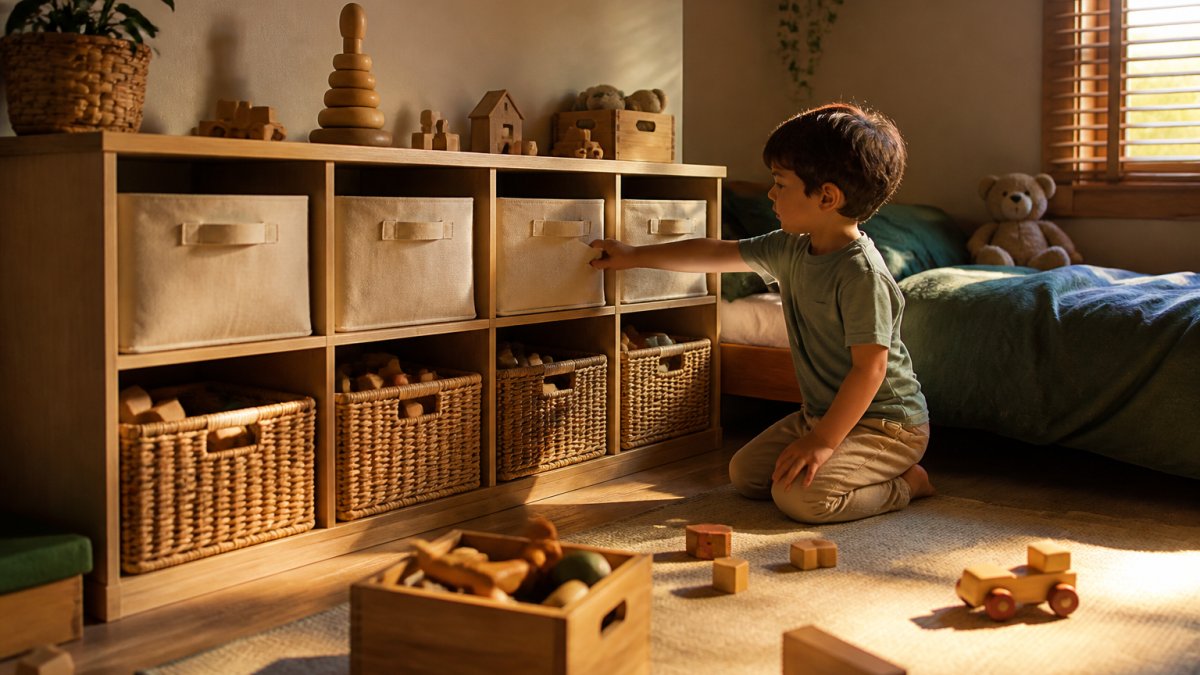
Measure twice, and measure the awkward spots. Slanted ceilings, deep closets, and narrow walls break most off-the-shelf systems. We recommend sketching your actual footprint first, then matching bins to the gaps rather than forcing a standard unit into a non-standard space.
For changing needs, favor modular pieces. A toddler's low open shelf becomes a school-age kid's labeled cubby system with a few swapped bins. Buy once, reconfigure often.
Safety Risks Specific to Toy Storage Furniture
The furniture itself is the risk most roundups ignore. A heavy toy chest with a free-swinging lid is a known hazard: lids that slam can injure small fingers and heads.
Then there's tip-over. The U.S. Consumer Product Safety Commission guidance on furniture tip-over covers anchoring and stability, and it's worth a read before you assemble anything.
A third risk is entrapment. Deep lidded boxes with no ventilation are a concern for young children. Open storage and lid-free bins remove that worry entirely.
Cleaning, Maintenance, and Indoor Air Quality
Dust and indoor air quality are linked more than people realize. Fabric bins trap dust, and a playroom full of dusty soft storage quietly worsens the air your child breathes. Vacuum fabric bins monthly and wash removable liners on a gentle cycle.
Wood needs little: a damp cloth and mild soap, then dry immediately. Avoid harsh sprays, which can strip a water-based finish and leave raw wood exposed. Plastic wipes clean but scratches, and scratched plastic hides grime in the grooves.
Here's the maintenance schedule we'd actually follow:
- Weekly: wipe hard surfaces, spot-clean spills
- Monthly: vacuum fabric bins and baskets, check hinges and anchors
- Seasonally: empty and deep-clean, rotate outgrown toys, re-check wall anchors
How to Choose the Best Non-Toxic Toy Storage for Your Home
Choosing the best non-toxic toy storage solutions means matching material to room, kid, and habit. Use this checklist before you buy:
- Material named and traceable (solid wood, organic cotton, BPA-free plastic)
- Third-party certification listed (GREENGUARD Gold, OEKO-TEX)
- No sharp chemical smell out of the box
- Lid-free or safety-hinged if young children are involved
- Tall units anchor to the wall
- Light enough for a child to lift, or low enough to reach
- Modular so it grows with your child
- Easy to wipe or wash
That last point is where we'd push back on the "buy the cheapest bin" instinct. A bin that survives three years of daily use beats three bins that crack and get replaced. Our curation focuses on fewer, better pieces that make the toys you already own work harder.
Conclusion
The hard part isn't finding storage. It's cutting through vague "eco-friendly" claims to find pieces that are genuinely safe, durable, and easy for a child to use. Start with materials and certifications, anchor anything tall, and favor open, reachable bins over heavy lidded chests.
Our curated organization products focus on space-saving designs, durable construction, and simple systems that keep a playroom calm instead of chaotic. If you're ready to turn cluttered corners into a space your child can actually use, start your reset with us and build storage that grows alongside your family.
Frequently Asked Questions
What materials are safest for toy storage?
Solid wood (like birch or pine) with water-based finishes, organic cotton or linen baskets, and food-grade silicone are among the safest choices. Avoid pressed wood that may contain formaldehyde, and look for GREENGUARD Gold certification for low indoor emissions. For plastic bins, choose BPA-free and phthalate-free options. Always check for third-party testing labels rather than relying on vague 'non-toxic' claims. The best non-toxic toy storage combines safe materials with practical design for daily use.
Are fabric toy bins safer than plastic bins?
It depends on the fabric and the plastic. Organic cotton or linen bins with no synthetic dyes or coatings are generally safer than soft PVC or vinyl bins, which can off-gas. However, some fabric bins use chemical flame retardants or adhesives. Look for OEKO-TEX certified fabrics or GREENGUARD Gold certified products. Rigid plastic bins made from BPA-free, phthalate-free polypropylene are also a low-risk option. The key is verifying certifications rather than assuming fabric is always better.
How can I tell whether a toy storage product contains harmful chemicals?
Check for independent certifications like GREENGUARD Gold (for low VOC emissions), OEKO-TEX (for textiles), and CPSIA compliance (required for children's products in the U.S.). Avoid products with strong chemical odors, which may indicate off-gassing. Look for water-based finishes and solid wood instead of composite wood with unknown binders. If a manufacturer does not disclose materials or certifications, treat it as a red flag. Reputable brands list this information openly.