

Table of Contents
- Custom Pantry Organization vs Modular Systems: What's the Real Difference
- Side-by-Side Comparison: Custom vs Modular Pantry Storage
- Understanding Custom Pantry Cost and Total Investment
- Modular Pantry Organizers: Flexibility Without the Price Tag
- Small Pantry Storage Solutions That Actually Fit Your Space
- Adjustable Pantry Shelves: The Middle Ground Between Custom and Modular
- Which System Wins: Making Your Choice
- Frequently Asked Questions
Last Updated: October 10, 2026
Custom Pantry Organization vs Modular Systems: What's the Real Difference
Custom pantry modular systems and modular organizers represent two fundamentally different philosophies. The right choice depends on your space, budget, and commitment to maintaining order long-term.
Custom solutions promise a perfect fit tailored to your specific space. Modular systems offer flexibility, affordability, and the ability to adjust as your needs change. Understanding these differences separates a pantry that stays organized from one that slides back into chaos.
Side-by-Side Comparison: Custom vs Modular Pantry Storage
Custom pantry organization means built-in shelving and drawers designed for your space's dimensions. Modular organizers are freestanding systems, baskets, bins, expandable shelves, rotating racks, that you arrange and rearrange as needed.
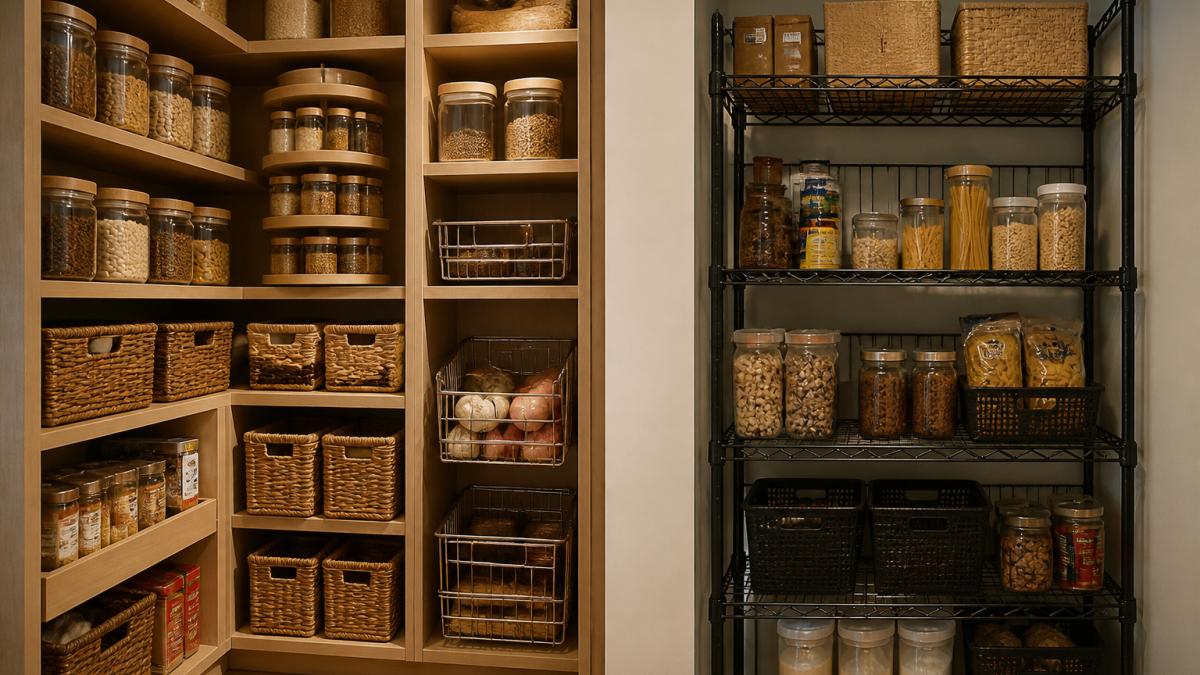
Custom solutions maximize every inch, eliminate wasted space, and create a seamless look. The downside: they're permanent. If your needs change or you move, the system stays behind.
Modular systems adapt as your needs change and move with you if you relocate. The trade-off: they rarely use space as efficiently as custom builds and look less polished.
| Aspect | Custom Pantry | Modular Systems |
|---|---|---|
| Installation | Professional, permanent | DIY, rearrangeable |
| Cost | $1,500-$5,000+ | $100-$500 |
| Space efficiency | Maximized | Good, not perfect |
| Flexibility | None | High |
| Aesthetics | Built-in, seamless | Functional, visible |
| Time to implement | Weeks | Days |
| Portability | Not portable | Fully portable |
Understanding Custom Pantry Cost and Total Investment
Understanding what you're paying for is essential to making the right choice.
Breaking Down Custom System Costs
Total Cost of Ownership: The Long View
Over the same period, modular replacements cost $100-$200 annually, making long-term costs comparable.
Durability depends on material. Premium systems handle 50-75 pounds per shelf; budget systems max out at 30-40 pounds.
Hidden Costs and Constraints
Custom systems lock you in. If you move, the system stays behind. Household changes force you to work within a fixed footprint, constraints modular systems avoid.
Modular systems cost $100-$500 initially. Incremental upgrades, $50 every few months, total $1,200-$1,500 over five years. You only buy what you use and spread costs over time rather than one large payment.
When Custom Makes Financial Sense
Custom systems make sense if you're staying 10+ years, have unusual dimensions, high storage loads, and know your ideal layout. Modular systems are better if you're renting, move frequently, or are unsure organization will stick.
Modular Pantry Organizers: Flexibility Without the Price Tag
Modular pantry organizers work because they meet you where you are. The Expandable Kitchen Storage Shelf at The Reset Aisle ($29.99) is a perfect example, it adjusts from 36 centimeters to 69 centimeters wide, fitting whatever cabinet space you have. No custom measurements needed. No installation. You place it, adjust it, and fill it.
The Double-Layer Rotating Spice Rack ($24.99) solves a specific problem that every cook faces: the back row of spices you forget exists. A 360-degree turntable brings every jar to the front. Two tiers double your storage footprint without taking up additional cabinet space. It's freestanding, so it works on a countertop, in a cabinet, or in the pantry itself.
For under-sink chaos, tangled pipes, wasted space, cleaning supplies everywhere, The Kitchen Reset ($52.99) pairs a rotating spice rack with an under-sink organizer featuring sliding shelves. Both pieces are modular; you can use them separately or together.

The strength of modular systems is their adaptability. Your household grows, your pantry needs change, and modular solutions grow with you. The weakness is that they require active maintenance. A custom system forces organization by its design. A modular system requires you to use it correctly, and to resist the temptation to just stack things on top of it when you're in a hurry.
Small Pantry Storage Solutions That Actually Fit Your Space
Small pantries demand ruthless efficiency. You can't afford wasted space, and you can't install a full custom system without eating into your entire pantry footprint. This is where modular solutions genuinely outperform custom builds.
The Magnetic Refrigerator Side Storage Rack ($34.99) from The Reset Aisle uses vertical space you probably haven't considered. It attaches magnetically to the side of your refrigerator, turning dead space into functional storage for spices, seasonings, or small bottles. No drilling, no installation, no permanent commitment. If it doesn't work, you remove it and try something else.
Expandable shelves are essential for small pantries. They create a second tier within your existing shelf space, effectively doubling your storage capacity without adding footprint. The Expandable Kitchen Storage Shelf adjusts to fit whatever gap you have, whether your pantry is a narrow closet or an awkwardly shaped cabinet.

For small spaces, the modular approach wins because it lets you experiment. You're not paying thousands upfront for a solution that might not work. You're testing ideas incrementally, keeping what works, and adjusting what doesn't. That's how real pantries get organized, not through perfect planning, but through iteration.
Adjustable Pantry Shelves: The Middle Ground Between Custom and Modular
Adjustable pantry shelves occupy a practical middle ground between freestanding modular systems and permanent custom cabinetry. They're more durable and space-efficient than baskets and bins, but far less expensive and invasive than full custom builds. Understanding when they're worth the installation effort is key to choosing the right approach for your pantry.
How Adjustable Shelves Work and What They Cost
Adjustable shelves use metal brackets inserted into pre-drilled holes or slots in your cabinet sides. You set the height once based on what you're storing, tall cereal boxes on one shelf, stacked containers on another, spice jars on a third, and the system stays put.
Cost ranges from $40-$150 per shelf, depending on material and load capacity. Basic wire shelves run $40-$60 and handle 25-35 pounds per shelf. Solid wood or laminate shelves cost $80-$150 and safely support 40-60 pounds. Metal shelves run $100-$200 and handle 50-75 pounds, making them ideal for heavy items like canned goods or bulk dry goods.
Installation Complexity: When DIY Makes Sense
Adjustable shelf installation is achievable for most homeowners if you have basic tools. The challenge is precision. Holes must be level and evenly spaced, or shelves will sag or look crooked. If your cabinet sides are uneven, you'll need to shim or account for the variation.
When to hire a professional: If your pantry has more than four shelves, if you're uncertain about drilling into walls or cabinetry, if your cabinet sides are significantly uneven, or if you're installing heavy-duty shelves rated for 60+ pounds.
Adjustable vs. Modular: Load Capacity and Durability
This is where adjustable shelves pull ahead of pure modular systems. Expandable modular shelves typically max out at 25-35 pounds before sagging. If you're a bulk buyer, preserve food, or stock large quantities, adjustable shelves are more reliable long-term.
Durability also favors adjustable systems. Modular expandable shelves (plastic or thin metal) often sag after 3-5 years of heavy use, requiring replacement. Over a decade, you might replace modular shelves twice, adding $100-$200 in replacement costs.
Customization and Reconfiguration
Adjustable shelves offer flexibility within limits. You can change shelf height by moving brackets to different holes, useful if your storage needs shift. But you can't add or remove shelves without drilling new holes, and you can't take the system with you if you move.
If you're renting, adjustable shelves are risky because drilling holes requires landlord permission and may violate your lease. Modular systems are safer for renters. If you own your home and plan to stay 5+ years, adjustable shelves are worth the installation effort, especially in cabinets where you store heavy items.
Use-Case Recommendations
Choose adjustable shelves if: (1) you're storing heavy items (canned goods, bulk dry goods, heavy cookware), (2) you own your home and plan to stay at least 5 years, (3) your pantry cabinets have solid sides (not open shelving), and (4) you want durability without the cost and permanence of custom cabinetry.
Stick with modular systems if: (1) you're renting, (2) you move frequently, (3) you want to avoid drilling holes, or (4) your pantry is small and you're still experimenting with layout.
The middle ground works best when you've lived in your space long enough to know your storage patterns and you're confident the layout won't need major changes. If you're still figuring out what works, start modular and upgrade to adjustable shelves once you've proven the system works for your household.
Which System Wins: Making Your Choice
Choose custom pantry organization if you're staying in your home long-term, your pantry layout is unusual or challenging, and you want maximum space efficiency and a finished, professional look. Custom systems are an investment in your home's value and your daily quality of life. They work best when you've lived in the space long enough to understand exactly what you need.
Choose modular pantry modular systems if you're renting, you move frequently, your pantry is small or standard-sized, or you want to start organizing without a major financial commitment. Modular systems let you test ideas, adjust as your household changes, and take your organization with you. They're especially smart if you're skeptical that organization will actually stick, and it's worth acknowledging that skepticism is valid. Many people try organizing, see initial success, then watch everything slide back into chaos within weeks.
The difference isn't the products themselves. It's whether the system matches your behavior. A perfectly designed custom pantry fails if you don't maintain it. A simple set of modular baskets succeeds if they're positioned where you naturally reach for things and if the system is flexible enough to adapt when life gets messy.
The Reset Aisle's approach focuses on making your existing belongings work better for your lifestyle. Start with modular solutions that fit your space and budget. Add pieces as you understand what actually works for your household. If you find yourself consistently maintaining a modular system over months, then you've proven that organization sticks for you, and that's when a custom investment makes sense.
Frequently Asked Questions
What is the difference between custom pantry organization and modular systems?
Custom pantry organization is built specifically for your space with fixed shelving, drawers, and compartments designed to fit exact dimensions and your lifestyle. Modular systems use freestanding or expandable pieces like shelves, baskets, and organizers that you arrange yourself. Custom systems offer permanent, tailored solutions; modular systems offer flexibility to adjust, move, or reconfigure as needs change. Custom typically costs more upfront but uses every inch of space. Modular costs less initially and adapts if you move or reorganize.
How much does a custom pantry system cost compared to modular organizers?
Modular organizers from The Reset Aisle start at $24.99 for individual pieces like the Double-Layer Rotating Spice Rack, with expandable shelves at $29.99 and larger systems like The Kitchen Reset at $52.99. Modular pieces require no tools and can be assembled in hours.
Can modular pantry organizers fit awkward or small pantry spaces?
Yes. Modular organizers are designed for flexibility. Expandable shelves adjust from 36 cm to 69 cm wide, and freestanding pieces like rotating racks and magnetic storage racks require no drilling or permanent installation. They work in small spaces, odd shelf heights, and sloped ceilings because you choose what goes where. If a piece doesn't fit, you remove it without damage. Custom systems require built-in modifications, making them risky for awkward layouts unless professionally measured first.
Which pantry storage system lasts longer, custom or modular?
Modular systems vary by material: plastic organizers last 5-10 years with regular use, while stainless steel options like the Pull-Out Pots & Pans Organizer ($89.99) last 10-15+ years. Durability depends on weight load and care. Modular systems can be replaced or upgraded piece by piece as items wear out.
Can you combine custom shelving with modular pantry organizers?
Yes. Many households use custom built-in shelves as the foundation, then add modular organizers inside for flexibility. For example, custom shelves provide structure and maximize vertical space, while expandable shelves, rotating racks, and baskets organize items within those shelves. This hybrid approach gives you the durability and space efficiency of custom systems with the flexibility and lower cost of modular pieces. The Kitchen Reset bundle ($52.99) works well in custom pantries to organize the most cluttered areas.
The real barrier to an organized pantry isn't choosing the right system, it's maintaining it once you've set it up. Start with The Reset Aisle's curated modular solutions, which are designed to adapt as your needs change. Our Expandable Kitchen Storage Shelf, rotating spice racks, and pull-out organizers work together to create order without requiring permanent commitment. Get started with The Reset Aisle and transform your pantry into a space that actually works for your life.