

Table of Contents
- How to Declutter Desk Drawers Before You Organize
- The Best Desk Drawer Organizers for Beginners
- DIY Desk Drawer Dividers Using Items You Already Own
-
10 Simple Desk Drawer Organization Ideas
- 1. Give Every Category Its Own Zone
- 2. Use Drawer Liners to Protect and Define
- 3. Stack Vertically to Double Your Space
- 4. Label Everything So It Stays Put
- 5. Corral Cables Before They Tangle
- 6. File Loose Papers Immediately
- 7. Keep Only Essentials in Reach
- 8. Adjust Your Setup for Comfort
- 9. Clear Digital Clutter Alongside the Physical
- 10. Set a Monthly Reset Routine
- Common Beginner Mistakes That Undo Your Progress
- A Simple Monthly Maintenance Schedule for Desk Drawers
- Frequently Asked Questions
Last Updated: September 17, 2026
How to Declutter Desk Drawers Before You Organize
Most people try to organize a messy drawer without emptying it first. That never works, and it's the number one reason desk drawer organization fails before it starts.
Here's the fix: take everything out. All of it. Then sort each item into one of four piles:
- Keep, you used it in the last month
- Relocate, it belongs somewhere else
- Donate, it works, but you don't need it
- Toss, dead pens, dried-out glue, mystery keys
A common mistake is skipping the toss pile out of guilt. Be ruthless. If you haven't touched a pen in a year, it's not coming back to life.
This step takes about 15 minutes per drawer. Do one drawer at a time so you don't end up with a desk covered in chaos.
The Best Desk Drawer Organizers for Beginners
The best desk drawer organizers for beginners are modular, sized to your actual drawer, and cheap enough that you can test a layout before committing. Skip anything with a fixed footprint, a six-compartment tray that doesn't match your drawer width wastes more space than it creates.
Here's how the common options actually compare:
| Organizer Type | Typical Cost | Best For | Watch Out For |
|---|---|---|---|
| Interlocking dividers (plastic or bamboo) | $10-$25 | Drawers with odd dimensions | Slip if the base isn't gripped; measure the interior, not the exterior |
| Stackable trays | $8-$20 each | Deep drawers with wasted height | Short trays leave 2-3 inches of dead air above them |
| Fabric bins with rigid inserts | $6-$15 each | Cables, chargers, small accessories | Thin walls collapse when packed; check for internal supports |
| Clear acrylic modular sets | $15-$40 | Visual inventory of small items | Show every speck of dust; scratch easily |
| Drawer liners (grip or felt) | $5-$15 per roll | Every drawer, every setup | Cheap vinyl curls at the edges within weeks |
| Expandable utensil-style dividers | $12-$30 | Kitchen-drawer conversions | Springs lose tension over time |
Measure your drawer first. Write down the inside width, depth, and height, not the outside dimensions.
A few specifics worth knowing before you spend:
- Depth matters more than width. A drawer 18 inches deep and 12 inches wide needs two rows of shallow bins, not one deep one.
- Height caps what you can stack. If your drawer is 3 inches tall, stackable trays are useless, go flat and wide instead.
- Grip liners beat smooth ones. Felt or rubberized liners keep dividers from sliding when you open the drawer fast.
- Clear beats opaque for beginners. You'll actually see what's in each zone, which means you'll maintain it longer.
DIY Desk Drawer Dividers Using Items You Already Own
You don't need to spend anything to get a working drawer divider. Look around your kitchen and recycling bin first.
Try these:
- Shoebox lids, perfect for shallow drawers
- Cut-down cereal boxes, trim to height, tape the edges
- Mason jar lids, great for paper clips and rubber bands
- Ice cube trays, instant small-item compartments
- Cardboard strips, interlock them into a grid
10 Simple Desk Drawer Organization Ideas
Start with a clean, empty drawer and work through these ten ideas in order. Each one builds on the last, so the setup stays functional instead of falling apart in a week.
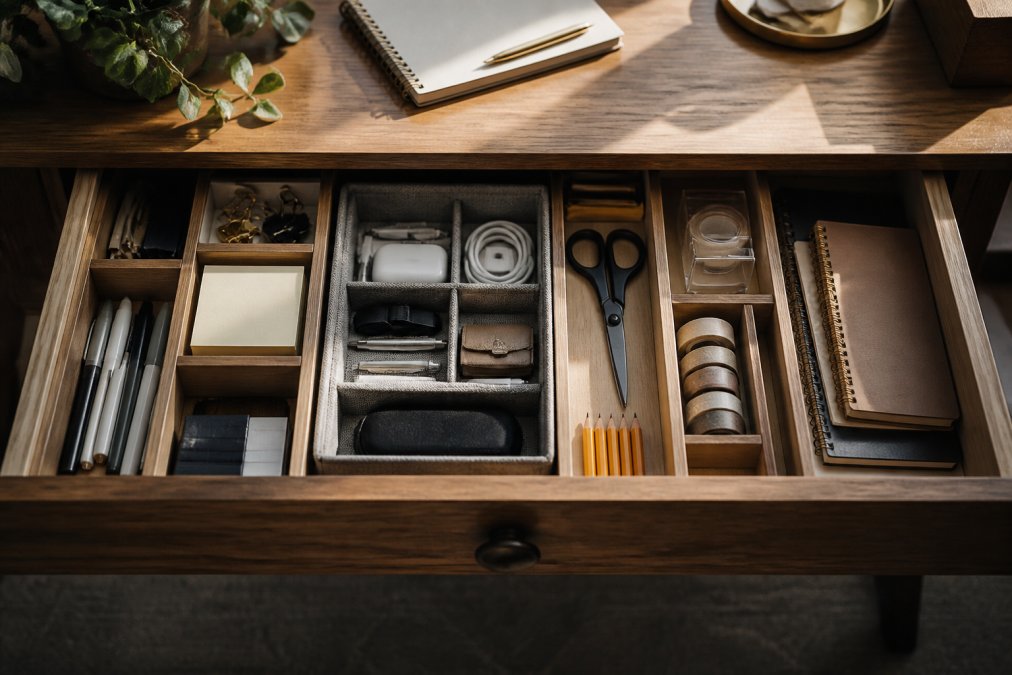
1. Give Every Category Its Own Zone
Assign one home to each category. Pens in one zone. Chargers in another. Sticky notes in a third.
2. Use Drawer Liners to Protect and Define
Drawer liners do two jobs. They protect the drawer surface from scratches and ink leaks. They also visually define each zone, which makes it easier to keep things in place.
3. Stack Vertically to Double Your Space
Deep drawers waste the top half. Add a stackable tray or a small riser to create a second layer.
4. Label Everything So It Stays Put
A labeling system is what keeps a drawer organized after the novelty wears off. Labels remove the guesswork.
5. Corral Cables Before They Tangle
Cable management starts with containment. Use a small bin, a zip pouch, or a binder clip to keep each cable separate.
6. File Loose Papers Immediately
Loose papers pile up fast. Give them a dedicated file pocket or a slim tray inside the drawer.
7. Keep Only Essentials in Reach
Your top drawer should hold only what you use daily. Everything else moves down or out.
8. Adjust Your Setup for Comfort
Drawer height affects your posture. A drawer that sits too low forces you to bend and twist every time you reach for a pen.
9. Clear Digital Clutter Alongside the Physical
Digital and physical clutter feed each other. A messy desktop full of files mirrors a messy drawer full of junk.
10. Set a Monthly Reset Routine
A reset routine is the only thing that makes organization last. Pick one day a month. Empty each drawer, toss what's broken, and put everything back.
Common Beginner Mistakes That Undo Your Progress
The biggest beginner mistake is buying containers before measuring the drawer. You end up with gaps, wasted space, and a setup that never quite fits.
Other mistakes to avoid:
- Organizing all drawers at once, start with one, finish it, then move on
- Keeping "just in case" items, if you can't name a use, let it go
- Skipping labels, unlabeled zones drift back into chaos
- Ignoring drawer height, tall items in a shallow drawer block the whole thing
- Forgetting maintenance, no routine means no lasting order
A Simple Monthly Maintenance Schedule for Desk Drawers
Most organization guides stop at the setup and never tell you how to keep it. That's why drawers slide back into chaos within a month. A maintenance schedule is the difference between a one-time cleanout and a system that actually holds.
| When | Task | Time | Why This Interval |
|---|---|---|---|
| Daily (end of workday) | Return stray items to their zones; toss obvious trash | 30 seconds | Prevents the "I'll deal with it later" pile from forming |
| Weekly (pick a day) | Empty the top drawer, wipe it out, put everything back | 5 minutes | Catches crumbs, dead pens, and misplaced items before they multiply |
| Monthly | Full reset of one drawer: empty, sort, wipe, relabel if needed | 15 minutes | Rotates through drawers so no single one gets neglected |
| Quarterly | Review labels, replace worn liners, check dividers for cracks | 20 minutes | Addresses the slow decay that labels and liners hide |
| Yearly | Full desk audit: donate unused items, reassess zones | 1 hour | Your needs change; the drawer should change with them |
A few mechanisms worth understanding:
- The weekly reset is the load-bearing habit. Skip it and the monthly reset becomes a two-hour excavation. Keep it and the monthly reset takes 15 minutes.
- Wipe, don't just tidy. Dust and ink residue build up in drawer corners and make everything feel grimy, which makes you less likely to put things back neatly.
- Relabel when zones shift. A label that says "Chargers" when the drawer now holds batteries is worse than no label, it trains you to ignore labels entirely.
- Rotate the order. If you always reset the top drawer and never the bottom one, the bottom one becomes a junk drawer by month three.
Frequently Asked Questions
How do I organize a messy desk drawer without buying anything?
Start by emptying the drawer completely, then sort every item into keep, relocate, or discard. Use small boxes, jar lids, or cut cardboard as free DIY desk drawer dividers to create zones for pens, clips, and notes. A shoebox lid works well for loose items. Once sorted, place frequently used items near the front and label each section with masking tape and a marker.
What are the best desk drawer organizers for small spaces?
For narrow or shallow drawers, collapsible fabric organizers work well because they hold their shape but fold flat when not in use. Look for modular pieces you can rearrange as your needs change. A fabric drawer organizer with internal supports keeps dividers upright even when full, which matters in small drawers where everything presses together. Measure your drawer's interior before buying anything.
How do you categorize items in a desk drawer?
Group by how often you use each item, not by type alone. Keep daily items like pens and sticky notes in the top drawer, weekly items like tape and scissors in the second, and backup supplies in the bottom. Within each drawer, assign a zone per category: writing tools, paper clips, chargers, and personal items. This sorting method reduces clutter and makes retrieval faster.
How do I keep my desk drawers organized long-term?
Set a five-minute reset at the end of each week to return stray items to their zones. Once a month, do a quick purge of anything you have not used, wipe out drawer liners, and restock supplies. A labeling system makes it obvious when something is out of place. This maintenance schedule prevents the slow buildup that turns an organized drawer back into a junk pile.
Desk drawer organization only sticks when the system is simple enough to maintain. That's the whole point: fewer decisions, less digging, more calm. The Reset Aisle helps you get there with space-saving organizers designed to make the items you already own work better. Explore our fabric drawer organizers, drawer liners, and modular storage options, then start your reset today.