

Table of Contents
- Start with Materials: Plastic vs Glass Food Storage Containers
- Match Food Storage Container Sizes for Pantry Staples
- The Best Flour Containers for Pantry Storage
- How to Store Bulk Rice and Beans
- Test Airtightness and Seal Integrity Before You Buy
- Calculate Bulk-Buying Capacity and Cost Per Usable Space
- Conclusion: Make Airtight Food Storage Work for Your Pantry
- Frequently Asked Questions
Last Updated: October 15, 2026
Start with Materials: Plastic vs Glass Food Storage Containers
The material you pick decides how long your food stays fresh, how easy cleanup is, and how much you spend. This guide from The Reset Aisle walks through that choice first, because everything else follows from it.
Choosing airtight food storage containers for bulk buying starts with three materials: plastic, glass, and stainless steel. Each one handles pantry life differently.
Plastic containers are the lightest and cheapest. Food-grade plastic resists cracking when dropped, and most versions are dishwasher-safe. The trade-off: plastic can hold onto smells and stains from oily foods over time.
Glass containers cost more but do not absorb odors or stains. They move from freezer to microwave without warping. The weight is the catch, especially in large sizes.
Stainless steel canisters block light completely, which helps dry goods keep longer. You cannot see inside, so labeling matters more.
Here is how they stack up:
| Material | Best For | Watch Out For |
|---|---|---|
| Plastic | Light weight, tight budgets | Stains and odors over time |
| Glass | Oils, sauces, reheating | Heavy in large sizes |
| Stainless steel | Light-sensitive dry goods | No visibility |
If you want one rule: pick glass for anything oily or acidic, plastic for light dry goods, and steel for long-term pantry storage.
Match Food Storage Container Sizes for Pantry Staples
Size is where most bulk-buying setups fall apart. A container that is too big wastes shelf space; one that is too small leaves half a bag of flour sitting open.
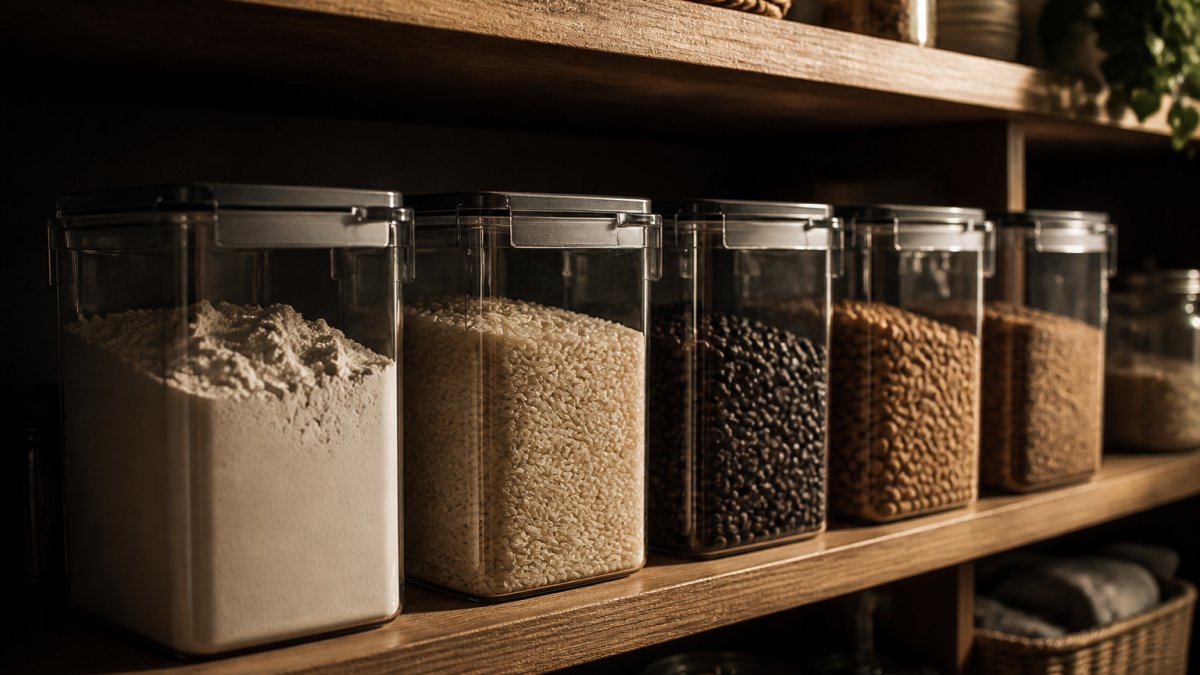
A common mistake is buying a matching set before measuring your shelves. Measure first, then buy.
For food storage container sizes for pantry staples, think in three tiers:
- Small (1-2 quarts): spices, nuts, dried fruit, coffee
- Medium (3-6 quarts): sugar, oats, pasta, lentils
- Large (8 quarts and up): flour, rice, bulk beans
Deep shelves need square or rectangular containers, not round ones. Round shapes leave curved gaps you cannot use.
Stackable designs help here. Square containers line up with no wasted corners, which matters most in narrow cabinets.
The Best Flour Containers for Pantry Storage
Flour is the hardest staple to store well. It is fine, it clumps, and it picks up moisture fast. The best flour containers for pantry storage seal tight and hold a full bag without a second container.
A 5-pound bag of flour fits in a container around 4 to 6 quarts. A 25-pound bulk bag needs a much larger bin, often 20 quarts or more.
What to look for:
- A gasket or silicone ring inside the lid
- A locking lid with clips or a lever
- A wide opening so you can scoop without a funnel
- Food-grade material that will not react with the flour
Glass works well for flour because you can see the level drop. Clear plastic does the same job for less money.
One insider note: flour stored in a truly airtight container holds its quality far longer than flour left in the paper bag. The bag is not moisture protection, no matter how tightly you fold it.
How to Store Bulk Rice and Beans
Rice and beans are the backbone of bulk buying, and they store well when you get three things right: moisture, pests, and rotation. Most guides stop at "use an airtight container." The details below are what actually keep a 25-pound bag good for a year or more.
Start with the right container volume. White rice runs about 1.5 to 1.8 pounds per quart, so a 25-pound bag needs roughly 14 to 17 quarts of container space. Dry beans are bulkier, about 1.2 to 1.5 pounds per quart, so the same 25-pound bag needs closer to 17 to 21 quarts.
Match the storage method to the food:
- White rice: pantry, cool and dark, 12 to 24 months in a truly airtight container
- Brown rice: pantry short-term, or refrigerator/freezer for longer holds because the bran oil turns rancid
- Dried beans and lentils: pantry, 12 to 24 months; older beans still cook but take longer and stay firmer
- Split peas and small lentils: pantry, 12 months; they lose flavor before they lose safety
Freeze first if you bought in bulk from a bin or open sack. Pantry moths and beetles often arrive already in the bag. Put the sealed bag or container in the freezer for about four days, then move it to the pantry.
Rotate with a first-in, first-out system:
- Label each container with the date you filled it and the food inside
- Put new rice or beans behind the old on the shelf
- Use the oldest container first
- Refill only when a container is nearly empty
Prevent cross-contamination. Keep a dedicated scoop in each container rather than dipping one scoop into rice and then into beans. If you find pests in one container, isolate it immediately, discard the infested food in an outdoor bin, wash the container with hot soapy water, and check every neighboring container before restocking.
Mini USB Rechargeable Bag Sealer – Handheld Heat Sealing Machine for Food →
For very large quantities, split a bulk bag across two or three medium containers rather than one giant bin. Smaller containers are easier to lift, easier to rotate, easier to freeze, and easier to clean when something goes wrong.
Test Airtightness and Seal Integrity Before You Buy
You can check a container's seal in about a minute, and it will save you from a shelf full of stale food. Most product pages claim "airtight" without defining it. Here is how to verify the claim yourself, in the store or at home.
The four checks that matter:
- The press test: close the empty container and press down firmly on the lid. A good seal resists the push and pushes back slightly. If the lid sinks with no resistance, air is moving freely.
- The water test: fill the container about halfway with water, seal it, and turn it upside down over a sink for 30 seconds. Any drip means the seal is not watertight, and if it is not watertight it will not hold out moisture or pantry pests.
- The gasket check: open the lid and inspect the silicone or rubber ring. It should sit flush in its channel with no twists, no gaps, and no visible cracks. A gasket that has dried out, stretched, or come loose is the most common cause of a failed seal on an otherwise good container.
- The lid fit: clips, levers, or screw bands should snap or turn firmly, not loosely. If the lid rocks when you press one corner, the seal is uneven and will leak at the opposite edge.
Diagnose a failed seal before you blame the container. A leak usually comes from one of four places: a gasket that is missing, twisted, or worn; food debris caught in the gasket channel; a lid that is warped from heat (dishwasher top rack or hot leftovers); or a container body with a cracked rim.
At-home verification for containers you already own. Fill the container with dry rice or flour, seal it, and leave it on its side overnight on a shelf. In the morning, check for a fine dusting of powder outside the seal.
What "airtight" actually means in practice. A truly airtight container holds a vacuum when you press the lid down and release it, you may hear a soft pop when you open it later. A container that merely closes snugly is airtight enough for short-term pantry use but will not protect flour, brown rice, or pet food through a humid summer. If long-term storage is the goal, look for a gasket plus a locking mechanism, not just a snap-on lid.
For resealing the original bags that do not fit in a container, a handheld sealer helps. Our Mini USB Rechargeable Bag Sealer seals compatible PP, PE, and PVC bags with controlled heat, so opened snack, cookie, and pet food bags stay closed.

Calculate Bulk-Buying Capacity and Cost Per Usable Space
Buying in bulk only saves money when your containers actually hold what you buy. This is the step most shoppers skip.
Use this simple capacity check before you buy anything:
Capacity you need = total pounds of food ÷ pounds per quart
Most dry goods run about 1 to 1.5 pounds per quart. So a 25-pound bag of rice needs roughly 17 to 25 quarts of container space.
Then figure cost per usable space:
Cost per quart = container price ÷ usable quarts
A container that costs more but holds twice the food can be the cheaper choice per quart. Round containers lose usable space in square cabinets, so a square container often wins on cost per usable quart even at a higher sticker price.
Replacement cost matters too. Cheap lids crack, and a cracked lid means a whole container of food at risk. Buying once, well, usually costs less over a few years than replacing bargain bins every season.
Conclusion: Make Airtight Food Storage Work for Your Pantry
Getting bulk storage right comes down to a few decisions: pick the material for the food, size the container to the shelf and the bag, and test the seal before you commit. Do that, and your pantry stops being a source of daily friction.
At The Reset Aisle, we build our picks around practical, space-saving solutions that make the items you already own work harder. Our curated organization products focus on keeping every room neat and bringing control to cluttered spaces, without adding more stuff to manage. If your pantry needs a reset, start with the containers that fit your food and your shelves.
USDA food storage and safety guidance
Frequently Asked Questions
What is an airtight container for food storage?
An airtight container has a tight-fitting lid with a gasket or locking mechanism that blocks air and moisture. This keeps dry goods like flour, rice, and beans fresh and protects them from pests. Look for a watertight seal and a lid that snaps or locks firmly. The Mini USB Rechargeable Bag Sealer at $19.99 helps reseal original plastic bags, but for bulk staples, a dedicated airtight container with a verified seal is your best bet.
Is it better to store food in plastic or glass containers?
Both work, but they suit different needs. Plastic containers are lightweight, stackable, and less likely to break, which helps in tight pantries. Glass containers are non-porous, don't absorb odors or stains, and let you see contents clearly. For bulk buying, choose food-grade plastic for large volumes and glass for smaller, frequently used items. Whichever you pick, confirm the lid has a gasket and passes a simple airtightness test.
How do you choose the right size container for bulk food?
Start by measuring your shelf height and depth, then match the container capacity to how much you buy. A 5-pound bag of flour needs about a 4-quart container. For rice and beans, a 10-pound bag fits in a 6- to 8-quart container. Leave 1 to 2 inches of headspace for scoops. If you buy in bulk, choose stackable, transparent containers so you can see levels without opening lids.
How can you tell whether a food storage container seals tightly?
Fill the container halfway with water, seal the lid, and turn it upside down over a sink for 30 seconds. If no water leaks, the seal is watertight. Also check the gasket for cracks and make sure the lid locks evenly. For dry goods, a tight seal keeps moisture out. If your container fails this test, return it or use it for non-perishable items only.
A cluttered pantry makes every meal feel harder than it should. The Reset Aisle can help you fix that with space-saving storage and simple, functional organization tools built to reduce overwhelm. Start Your Reset and turn a chaotic shelf into a calm, working system.