

Table of Contents
- Start with a Wardrobe Edit and Declutter
- Vertical Closet Organization: Use Every Inch of Wall Space
- Tiny House Storage Hacks That Actually Work
- Build a Capsule Wardrobe for Small Spaces
- Moisture, Ventilation, and Load-Bearing: What Most Guides Skip
- DIY vs. Professional Installation and Accessibility
- Conclusion
- Frequently Asked Questions
Last Updated: September 10, 2026
Start with a Wardrobe Edit and Declutter
Learning how to maximize closet space in a tiny house starts with subtraction, not storage. Every organizer, rail, and bin you buy works better on a smaller pile of clothes, so the first step is a full wardrobe edit: pull everything out, sort it into keep, donate, and toss, and put back only what you actually wear. The Reset Aisle built its closet line around this idea, because no bin system can rescue a closet that holds twice what it should.

A common mistake is buying containers before decluttering. You end up organizing clothes you never wear, and the closet stays just as crowded.
Try the four-box method:
- Keep - worn in the last year and fits well
- Donate - good condition, wrong size or style
- Repair - needs a button, hem, or cleaning
- Toss - stained, stretched, or worn out
Be honest with the keep box. If you hesitate, it goes. A closet that holds only what you wear is the foundation for every storage hack below.
Vertical Closet Organization: Use Every Inch of Wall Space
Vertical closet organization means treating wall height, not floor area, as your main resource. In a tiny house, the rod is usually hung low and the top two feet of the closet sit empty. Raising the rod and adding a second one above it can roughly double hanging capacity without adding a single square foot of footprint.
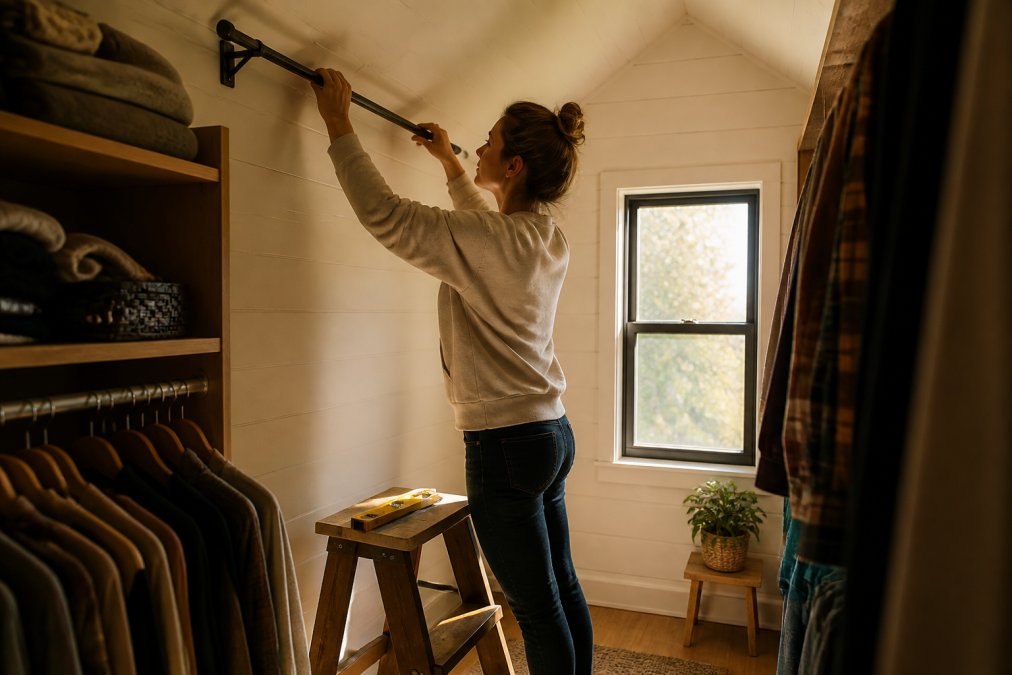
The mechanics matter more than the idea. Standard closet rods sit around 66 to 68 inches off the floor, which wastes the space above them (hunker.com). A double-hang setup typically places the upper rod at about 80 inches and the lower rod at about 40 inches, giving you two tiers of roughly 40 inches each. That works for shirts, blouses, and folded-over pants, but not for long dresses or coats, which need a single full-height run of 60 inches or more. Measure your longest hanging item before you drill anything.
Here is how to work the wall from top to bottom:
- Top shelf (above 84 inches): out-of-season clothes, luggage, and bins you touch twice a year
- Upper rail (around 80 inches): shirts, blouses, and jackets
- Lower rail (around 40 inches): pants, skirts, and shorts
- Floor: shoes and a slim drawer unit
A space-saving pant hanger earns its place here. One hanger holding 40 pairs of pants replaces five standard hangers that each hold a single pair, and that reclaimed rod space is exactly what makes a double-rail setup possible.

Hardware is where most DIY double-rail projects fail. A rod and bracket rated for 25 pounds will sag under a full load of winter coats, which can easily run 30 to 50 pounds. Look for heavy-duty rod brackets rated for at least 50 pounds, and anchor them into wall studs rather than drywall anchors. In a tiny house, studs may be 16 or 24 inches on center, and exterior walls are often thinner than in a conventional home, so a stud finder and a pilot bit are not optional. If you cannot find a stud, a cleat board screwed across two studs gives you a solid mounting surface for the brackets.
Slanted ceilings and loft walls add a wrinkle. On a sloped wall, a fixed horizontal rod leaves a triangular dead zone at the low end. A rod mounted parallel to the slope, or a series of short rails stepped down the wall, uses that wedge instead of wasting it. The trade-off is that sloped rails hold fewer hangers per foot, so reserve them for lightweight items like scarves, belts, or folded tees on S-hooks.
Tiny House Storage Hacks That Actually Work
Tiny house storage hacks work when they use space you already have rather than adding furniture you do not. The best ones combine multi-purpose pieces with spots that go unnoticed: under the bed, inside the stairs, and up near the ceiling. What separates a hack that lasts from one that fails is whether it accounts for weight, moisture, and access.
Multi-Purpose Furniture and Hidden Compartments
Multi-purpose furniture turns one object into two. A storage ottoman holds blankets and doubles as a seat. A bed frame with drawers replaces a dresser. Hidden compartments inside a bench, a coffee table, or a hollow stair riser absorb the overflow that a closet cannot.
Look for pieces with built-in compartments rather than open shelves, since closed storage keeps a small room calm. Two practical checks before you buy:
- Weight rating: A platform bed with drawers should be rated for the mattress plus sleepers plus stored contents. A queen mattress and two adults can run 400 to 500 pounds before you add a single bin (sleepfoundation.org).
- Drawer clearance: Pull-out drawers need 18 to 24 inches of open floor to extend fully. In a narrow tiny house, a drawer that cannot open is dead space.
Under-Bed, Under-Stair, and Loft Storage
Under-bed storage is the largest unused volume in most tiny homes. A queen platform bed leaves roughly 20 to 30 cubic feet beneath it, enough for several seasons of clothing in compression bags. Low-profile bins on casters slide under a platform bed and hold off-season clothing in compression bags. Under-stair storage makes use of the wedge of space beneath each step; pull-out drawers fit the deeper bottom steps, while the shallow top steps suit shoes or folded linens. Loft storage near the ceiling takes bins for items you rarely need.
| Space | Best For | Watch Out For |
|---|---|---|
| Under-bed | Off-season clothes, bedding | Dust and moisture buildup |
| Under-stair | Shoes, linens, tools | Awkward angles on top steps |
| Loft | Holiday items, keepsakes | Hard to reach without a ladder |
Two realities most guides skip:
Moisture. A mattress sitting directly on a platform traps humid air against the underside, and in a tightly sealed tiny home that moisture has nowhere to go. Use bins with vented lids or leave a 1- to 2-inch gap between the mattress base and the storage below. A reusable desiccant pack in each bin absorbs what ventilation cannot. Check bins quarterly; musty fabric is easier to catch early than to rescue.
Load limits. Under-stair drawers and loft shelves carry more weight than people expect. A full bin of books can weigh 40 to 50 pounds (move.org). Confirm that drawer slides are rated for the load (look for a per-pair rating, often 75 to 100 pounds for full-extension slides) and that loft shelving is anchored into studs or blocking, not just paneling. In a tiny house, floor joists and loft framing may be lighter than in a conventional build, so keep the heaviest items low and centered over supports.
Build a Capsule Wardrobe for Small Spaces
A capsule wardrobe for small spaces is a small set of interchangeable pieces that all work together, usually 30 to 40 items per season. Fewer clothes means each one needs less room, and a hanging rail with a dozen well-chosen pieces stays tidy far longer than one crammed with forty.
Build yours in four steps:
- Pick a neutral base (two or three colors)
- Choose tops that match every bottom
- Add two or three layers for weather
- Finish with shoes that cover daily needs
Rotate by season instead of storing everything at once. Keep the current season on the rail and pack the rest into compression bags under the bed.
Moisture, Ventilation, and Load-Bearing: What Most Guides Skip
Two things quietly wreck tiny house closets: trapped moisture and too much weight. Most organizing guides ignore both, and that is where real problems start.
Tiny homes are tightly sealed, so damp air lingers. Clothes stored against a cold exterior wall can grow musty, and condensation forms where warm indoor air meets a cool surface. Leave a gap between hanging clothes and the wall, avoid packing bins tight against the exterior, and let air move. Small vented bins and a periodic airing-out keep fabric fresh.
Weight matters just as much. A rod rated for light loads will sag or pull free once you hang a full rack of coats on it, and shelves carry more than people expect. Anchor heavy rails into studs, not just drywall, and check the load rating on any wall-mounted system before you fill it.
DIY vs. Professional Installation and Accessibility
Deciding between DIY and professional installation comes down to three things: your tools, your comfort with drilling into studs, and how custom the job is. A basic rail swap or a set of drawer dividers is a weekend DIY project. A full floor-to-ceiling built-in with custom cabinetry usually calls for a professional, especially in a tiny house where walls may be thin or oddly angled.
A practical way to choose:
- DIY if you are adding rails, bins, or drawer organizers to existing structure
- Professional if you are cutting into walls, building custom shelving, or unsure where the studs are
- Hybrid if you buy modular systems and hire help only for the anchoring
Accessibility deserves the same planning. If anyone in the home is aging or has limited mobility, keep daily items between waist and shoulder height, use pull-out drawers instead of deep reach-in shelves, and choose smooth-glide hardware over tight clips. A closet that works for every body in the house is a closet that stays organized.
Conclusion
The real challenge with a tiny house closet is not fitting more in. It is building a system that holds up to daily use without turning back into a pile. Start with the edit, work the walls, and choose organizers that make the clothes you already own easier to reach.
That is what The Reset Aisle is for. The Closet Reset pairs the Space Saving Pant Hanger, which holds 40 pairs on one hanger, with Fabric Drawer Organizers that give socks and underwear their own compartments instead of one tangled heap. Get started with The Reset Aisle and turn a cramped closet into a calm, workable space.
Frequently Asked Questions
How to make more space in a tiny closet?
Start by removing anything you have not worn in a year. Then move storage upward: install a second hanging rail near the ceiling and use slim hangers to cut bulk. A space-saving pant hanger can hold up to 40 pairs of pants on one rod position, freeing the rest of the rod for shirts. Add a fabric drawer organizer underneath so small items do not spill into the hanging area. Finally, use the back of the door for hooks or a shoe rack.
What are the common mistakes in tiny house storage design?
The biggest mistake is treating storage as an afterthought and buying bins before measuring. Another is ignoring weight limits: overloaded shelves can pull out of thin walls. People also forget airflow, which leads to musty clothes. And many skip a seasonal rotation plan, so off-season items crowd the closet year-round. Measure first, distribute weight to the floor or studs, leave gaps for air, and store out-of-season clothes in compression bags under the bed.
How can I maximize vertical storage space in a tiny house?
Look at the wall from floor to ceiling. Install floor-to-ceiling shelving on one narrow wall, using the top shelves for rarely used items and the bottom for daily access. Use the space above the door for a wall-mounted bin or basket. In the closet, add a second rod at a lower height for short items like skirts, or use a retractable rod that pulls down. Stackable modular bins let you adjust as your needs change without new furniture.
What are the best organization tools for small closets?
Slim velvet hangers save about half the rod space of wooden ones. A space-saving pant hanger with multiple clips condenses 40 pairs into one hanger footprint. Fabric drawer organizers with rigid sides keep socks and underwear separated. Compression bags flatten bulky sweaters for under-bed storage. Wall-mounted rails and over-the-door hooks add hanging space without using floor area. Choose tools that fit your measured space and can be reconfigured as seasons change.