

Table of Contents
- Start with a Blank Slate: Decluttering Small Spaces First
- Vertical Storage Solutions That Do Not Require Furniture
- How to Hide Clutter in Plain Sight
- Furniture Placement and Layout Optimization for Small Living Rooms
- Cord and Cable Management Without Built-Ins
- The Psychological Impact of Clutter in Small Spaces
- Frequently Asked Questions
Last Updated: September 12, 2026
Start with a Blank Slate: Decluttering Small Spaces First
The fastest way to organize small living room spaces without storage furniture is to remove what you don't need before arranging what you keep. Decluttering small spaces is the foundation of every other strategy here: no layout trick or hidden bin can rescue a room that holds too much.
You can't organize your way out of excess. Empty the room as much as you can and make three piles: keep, relocate, and let go.
Most people underestimate the relocation pile. Mail, charging cables, kids' toys, the "I'll deal with it later" basket: none of it belongs in a living room. Moving it to its real home often frees more floor space than any furniture arrangement will.
The 15-Minute Daily Reset
A 15-minute daily reset is a timed pass through the living room where everything returns to its designated spot, small enough to do even on a bad day.
Set a timer, start at the door, and work clockwise. Anything without a home goes into a "decide later" box you deal with weekly. When the timer ends, stop. Fifteen minutes daily beats a three-hour weekend overhaul you dread.
- Clear the coffee table surface completely
- Return stray cups and dishes to the kitchen
- Fold and put away any blankets
- Collect mail and papers into one tray
- Tuck remotes and chargers into their spot
- Straighten pillows and cushions
The One-In-One-Out Rule for Small Living Rooms
The one-in-one-out rule means every new item entering the living room replaces something that leaves it. Buy a new throw pillow, and an old one goes. Small rooms don't fail from one big purchase; they fail from slow accumulation, a candle here, a plant there, each one shrinking your usable square footage.
Vertical Storage Solutions That Do Not Require Furniture
Vertical storage solutions use your walls, doors, and ceiling height instead of your floor. In a small living room, floor space is the scarcest resource, and the wall above your sofa is usually the most under-used space you own.
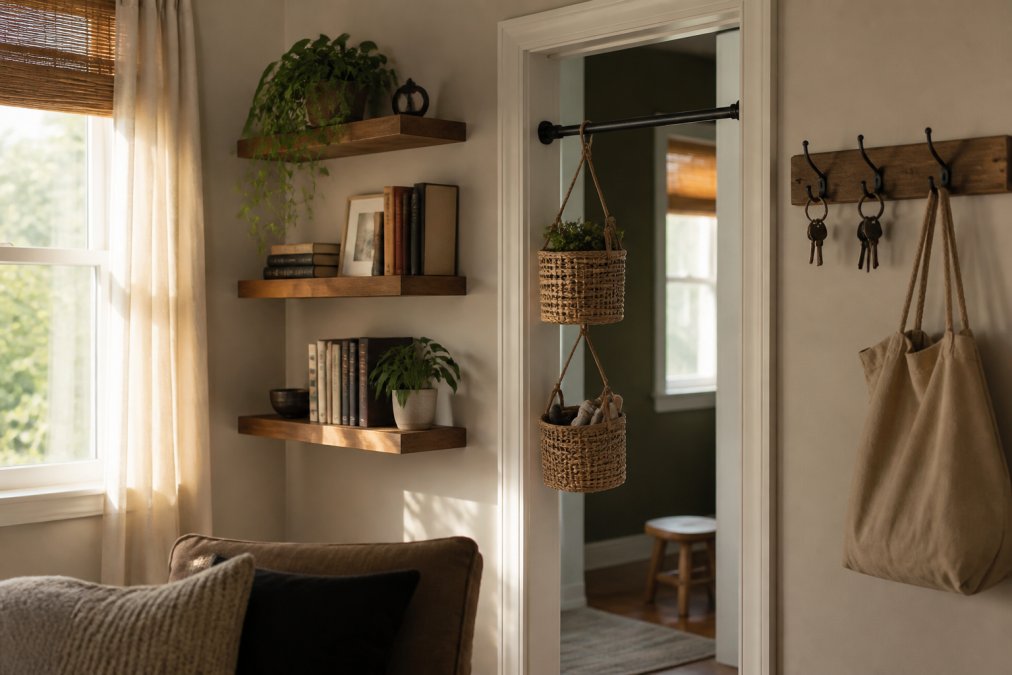
Think of your room in layers: floor, eye level, and high above. Most people only use the first two, which is why the top third sits empty while the floor feels crowded. The systems below are all non-furniture: they attach to surfaces you already have, and most cost under $30 in materials.
Non-Furniture Wall Systems You Can Build or Assemble
These are the workhorses. None is a piece of furniture, and each converts a flat surface into usable capacity.
- Pegboard panel. A 2 ft x 4 ft pegboard mounted above a desk or sofa holds hooks, small bins, and hanging tools. Paint it the same color as the wall so it recedes, and rearrange the layout in minutes without new holes.
- Slatwall strip. A single horizontal slatwall rail with clip-in hooks and shelves gives you a modular system that looks intentional. It is heavier than pegboard and needs studs or anchors.
- Ladder shelf against the wall. A leaning ladder shelf is technically furniture, but a wall-mounted ladder rail is not. A simple wooden rail with rungs holds folded blankets, magazines, and small baskets at zero floor depth.
- Over-door shoe organizer, repurposed. The fabric pocket version that hangs over a closet door is the cheapest vertical storage tool in a small living room. Load pockets with remotes, chargers, kids' crayons, pet leashes, and mail; it disappears behind the door when not in use.
- Magnetic strips on a metal door or fridge side. A magnetic knife strip or tool bar holds small metal items like keys, scissors, and binder clips, zero hardware if you already have a metal surface.
A common pattern is to combine two: a pegboard for heavy or awkward items and an over-door organizer for small, high-frequency clutter. Together they replace a storage cabinet without occupying floor space.
Rental-Friendly Wall Mounting Options
Rental-friendly mounting means securing things to walls without losing your security deposit. The best options are removable adhesive hooks, damage-free strips rated for your item's weight, and over-the-door brackets that need no drilling. Two rules: match the hardware rating to the actual weight, and test on a hidden patch of paint first, since adhesive strips fail on textured walls, brick, or wallpaper. For anything heavy, use a small nail and patch it later.
Over-the-Door and Tension Rod Hacks
Tension rods are the most underrated tool in small-space organizing. A rod wedged inside a doorway or between two cabinets creates an instant hanging rail with zero hardware and zero damage. Use one above a doorway for lightweight bags, one inside a closet opening for baskets at eye level, or one behind a curtain for keys, headphones, or pet leashes. A rod mounted low behind a sofa holds rolled blankets or a yoga mat out of sight.
The Ceiling and High-Wall Zone
The top 18 inches of your walls, from about 6 feet up, is the most ignored storage zone in a small living room (osha.gov). A single high shelf running the length of one wall can hold baskets of seasonal items, board games, or books at no cost to your floor. Use uniform, lidded baskets so the contents read as one calm line. Without a shelf, adhesive hooks along the ceiling line hold paper lanterns or a hanging plant. The trade-off is reach: anything above 6 feet needs a step stool, so reserve that zone for items you need a few times a year.
How to Hide Clutter in Plain Sight
Hiding clutter in plain sight means storing everyday items in containers that look like decor, so the room reads as calm even when it's full of things you use. The best candidates are items you use often but don't need to see: remotes, chargers, kids' toys, craft supplies, pet gear. If you reach for it daily, keep it accessible; if weekly, it can live behind a lid.
A few approaches that work well:
- A lidded basket beside the sofa holds throws and toys, and it looks intentional
- A decorative box on a shelf absorbs remotes, chargers, and small clutter
- A tray corrals candles, coasters, and small items so they read as a group
- A fabric bin tucked under a side table swallows the overflow
The one thing to avoid is the "everything drawer" that becomes a black hole. Label or mentally assign each container one category, and it stays useful.
Furniture Placement and Layout Optimization for Small Living Rooms
To organize small living room layouts, arrange furniture to maximize open floor space and improve how people move through the room. In a small living room, how you place what you already own often matters more than what you buy. Pull furniture slightly away from the walls where you can: floating a sofa a few inches forward creates depth. Then define functional zones, so the seating area, reading corner, and walkway each have a clear job.
Keep your main walkway clear. If you have to sidestep to cross the room, you have too much in the path, and no amount of organizing will fix a blocked route.
The Rental Constraint on Layout
Most layout advice assumes you can move anything; renters cannot. If your sofa must stay against the wall because the outlet is there, or your TV must face a certain direction because of the cable drop, the floating-furniture trick is off the table. Change what you can without moving the anchors:
- Swap the coffee table for two small nesting tables. Pull them apart when you need floor space, push them together when you do not. No installation required.
- Replace a heavy area rug with a smaller one. A rug that stops short of the walls makes the floor read as larger.
- Use a folding screen or a tall plant as a soft room divider. It creates a visual zone boundary without a wall or a built-in.
- Angle a lightweight accent chair. Turn it into the corner to open the center, then back when you need seating for guests.
- Slide a narrow console behind the sofa. If your sofa must sit against the wall, a slim console behind it adds a surface and a place for a lamp without adding floor depth in the walkway.
The principle matches floating furniture: create depth and break the flat edge, using movable pieces instead of relocating the heavy ones.
Sightlines and the Psychology of a Blocked View
Layout is also about what you can see from where you sit. In a small living room, a blocked sightline makes the room feel smaller than its square footage because your eye has nowhere to rest. Sit in your main seat and look straight ahead: if your view ends on clutter, boxes, or the back of a chair, fix that spot first by moving, lowering, or replacing the obstruction with something visually quiet like a plant or lamp. A clear path from your seat to a window, art, or an open corner does more for spaciousness than almost any purchase.
Zone Overlap Without Chaos
A small living room can hold three jobs: sitting, reading, and moving through. Let the zones share space without letting their contents mix. Use a rug for the seating zone, a side table and lamp for the reading corner, and an unobstructed strip of floor for the walkway. When an item doesn't belong to a zone, it goes back to its home; that rule prevents the clutter creep that collapses a zoned room back into one crowded space.
Cord and Cable Management Without Built-Ins
Cable management without built-ins comes down to three moves: shorten, bundle, and conceal. Swap long cables for shorter ones where you can, because slack is what tangles, then bundle what remains with velcro ties or clips.
For concealment, a few low-cost options do most of the work:
| Problem | Simple Fix | Why It Works |
|---|---|---|
| Cords behind the TV | Adhesive cable clips along the wall | Keeps cords straight and off the floor |
| Power strip on the floor | Mount it to the back of a low table | Removes the visual mess at floor level |
| Loose charger cables | Velcro ties at each bend | Stops tangling and shortens usable length |
| Cords under a rug edge | A cord cover strip | Flattens the bump and hides the line |
Much of cable clutter is visual noise rather than actual mess. Even a tidy setup looks chaotic when five black cords drape across a light wall; grouping and hiding them changes the feel of the room.
The Psychological Impact of Clutter in Small Spaces
Clutter in a small space affects how you feel, not just how the room looks. Every visible object competes for attention, and that low-level demand wears on you over time (PubMed). The effect is stronger in small rooms because there's no visual escape: in a large home, clutter in one corner fades into the background, but in a small living room it's always in view. The fix isn't perfection but reducing what competes for attention at once. A clear surface, a hidden bin, a tray that groups small items: each lowers the visual load.
If you want a system that sticks, reduce what's visible rather than hiding everything. Rooms you can live in stay organized; rooms that only look good in photos don't.
A small living room without storage furniture is a real constraint, and it trips up even experienced organizers. The answer isn't more bins or a bigger budget. It's a clear room, smart vertical use, and a system simple enough to keep. That's exactly what The Reset Aisle is built around: practical, space-saving organization products that help you make the items you already own work harder for you. Our curated selection is designed to cut daily overwhelm, not add to it. Start Your Reset with The Reset Aisle and turn a crowded room into a calm one you actually want to spend time in.
Frequently Asked Questions
How do you organize a living room with no storage?
Start by decluttering items you no longer need. Then use vertical space with floating shelves or wall hooks, and repurpose everyday items like baskets or tension rods for hidden storage. Group similar items in functional zones and keep surfaces clear. The goal is to make what you already own work harder, not buy more furniture.
What are the best ways to utilize vertical space in a small living room?
Install floating shelves above seating or in corners to hold books and decor. Use tension rods inside closets or between cabinets for hanging baskets. Over-the-door organizers can hold remotes, magazines, or charging cables. Wall-mounted hooks or pegboards keep bags and keys off the floor. These solutions add storage without taking up floor space.
How do you hide clutter in a small living room?
Use decorative boxes, baskets, or bins that blend with your decor to store everyday items. A lidded ottoman or a hollow coffee table can hold blankets and remotes. For cables, use cord clips or a cable management box. Group small items in trays or bowls. The key is to give everything a designated spot that looks intentional, not messy.
Can you organize a small space using only what you already own?
Yes. Look for unused containers, shoeboxes, or jars around your home. Repurpose them as drawer dividers or shelf organizers. Use tension rods you may have for hanging items. Rearrange furniture to create better flow. Declutter first so you only keep what you truly need. Often, you can solve storage problems without spending a dime.