

Table of Contents
- IKEA vs Premium Home Organization Systems: What's the Real Difference?
- Head-to-Head Comparison: Price, Features, and Durability
- IKEA Closet System vs Custom Closet: Which Fits Your Needs?
- Custom Closet System Cost: What You'll Actually Pay
- Best IKEA Organizers for Small Spaces and Tight Budgets
- Materials, Durability, and Long-Term Value
- Which System Should You Choose?
- Frequently Asked Questions
Last Updated: October 10, 2026
IKEA vs Premium Home Organization Systems: What's the Real Difference?
When facing an overflowing closet or jumbled kitchen cabinet, the choice seems simple: cheap IKEA bins or a premium system. But the real question is what happens six months later, are you still fighting chaos, or has your organized space already fallen apart?
IKEA vs premium home organization systems represent two fundamentally different approaches to solving clutter. IKEA offers affordable, modular solutions you can assemble yourself. Premium systems provide custom-fitted storage, higher-quality materials, and designs built to last through years of daily use. The difference matters more than most people realize, especially if you've already tried organizing and failed.
The tension isn't about money, it's whether you're buying a temporary fix or a lasting solution. Below, we break down where each approach wins and how to know which fits your life.
Head-to-Head Comparison: Price, Features, and Durability
IKEA organizers start under $25; a complete closet setup runs $150-300. Premium systems begin around $500 and easily exceed $2,000. The price gap is real but tells only part of the story.
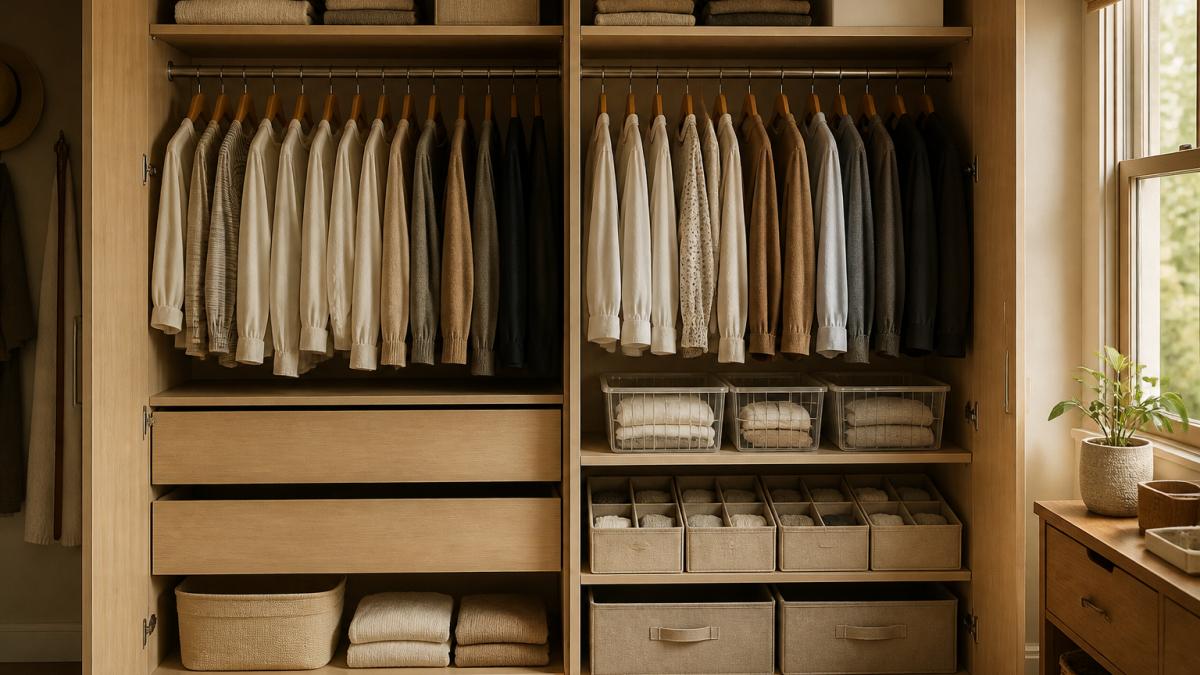
IKEA's strength is flexibility. You can buy components incrementally and swap them as needs change. Materials are lightweight particleboard and plastic, easy to move and rearrange, ideal if your life is unsettled or space is temporary.
Premium systems prioritize durability through material engineering. They use solid wood, plywood, or engineered wood with metal reinforcement and commercial-grade hardware. IKEA's particleboard shelves support 25-35 pounds per shelf before sagging; premium systems support 50-100+ pounds without deflection. This matters for high-load scenarios: pantry shelves, closet rods bearing winter coats, or garage storage holding power tools.
Particleboard absorbs water and swells, unsuitable for bathrooms or humid spaces. IKEA under-sink cabinets warp within 18-24 months; premium systems with sealed wood and metal hardware remain stable for a decade.
Durability emerges in specific failure modes:
-
Drawer slides: IKEA's plastic or basic metal slides wear within 2-3 years; premium ball-bearing slides last 50,000+ cycles (10-15 years).
-
Shelf sag: IKEA shelves sag 0.25-0.5 inches within 2-3 years; premium shelves resist deflection to under 0.1 inch over a decade.
-
Hardware wear: IKEA fasteners loosen with use; premium hardware maintains tight tolerances for thousands of cycles.
-
Finish degradation: IKEA's laminate scratches permanently; premium finishes can be touched up or refinished.
After two years, IKEA organizers often sag, crack, or misalign; drawers stick and shelves bow. Premium systems maintain function and appearance for a decade, with soft-close drawers, adjustable shelving, and wear-resistant finishes. They typically include 5-10 year warranties and professional installation.
| Feature | IKEA | Premium Systems |
|---|---|---|
| Starting Price | Under $25-300 | $500-2,000+ |
| Installation | DIY assembly | Professional install |
| Materials | Particleboard, plastic | Solid wood, metal |
| Shelf Load Capacity | 25-35 lbs/shelf | 50-100+ lbs/shelf |
| Moisture Resistance | Poor | Excellent |
| Drawer Cycle Rating | 5,000-10,000 cycles | 50,000+ cycles |
| Customization | Limited, modular | Built to your space |
| Durability | 2-3 years typical | 10+ years |
| Warranty | Limited (1-2 years) | Often 5-10 years |
| Best For | Renters, flexibility | Homeowners, permanence |
IKEA Closet System vs Custom Closet: Which Fits Your Needs?
IKEA closet systems work for standard rectangular closets but create gaps in spaces with slanted ceilings, odd corners, or irregular spacing. Custom systems are designed for your specific room, accounting for obstacles and maximizing every inch, crucial since awkward closets can waste 20-30% of storage with off-the-shelf components.
IKEA works best for renters or those moving within a few years; custom systems suit homeowners planning to stay long-term. The Reset Aisle's Closet Reset Bundle ($36.99) offers flexibility between these extremes, combining a space-saving pant hanger with a fabric drawer organizer.

Custom Closet System Cost: What You'll Actually Pay
Premium custom closets typically cost $2,000-5,000 for a single room, including design, materials, and installation. High-end systems can exceed $10,000.
Total cost of ownership matters more than sticker price, as premium and budget systems diverge significantly over their lifespan.
Initial costs for a master closet typically range $2,800-8,700, including design ($0-500), materials ($1,500-4,000), installation ($500-1,500), delivery ($100-300), and optional electrical ($300-800) or structural work ($200-1,000).
Ongoing and replacement costs over 10 years:
IKEA systems require replacement or repair within 3-5 years. A closet system that cost $250 initially may need $150-300 in replacement shelves, drawer slides, or hardware within 3 years.
Premium systems have minimal replacement costs. Drawer slides, hinges, and hardware are designed for 10+ years and are rarely replaced. If a component fails (rare), replacement parts cost $50-200 and are often covered under warranty.
Reconfiguration and adaptation costs:
Life changes. You may need to adjust shelf heights, add or remove drawers, or reconfigure the system when your storage needs shift. IKEA's modularity makes this cheap: $50-150 in new components and an afternoon of reassembly. Premium systems are semi-permanent.
Removal and disposal costs:
The Closet Reset Bundle | Pant Hanger + Drawer Organizer →
When you move or renovate, IKEA systems are easy to disassemble and donate or sell (recovering 20-40% of original cost on secondhand markets).
Total cost of ownership over 10 years:
- IKEA approach: $250 (initial) + $600 (replacements and repairs) + $100 (reassembly labor) = ~$950 total, or $95/year
- Premium approach: $5,000 (initial) + $100 (minor repairs/parts) + $0 (reconfiguration, if you accept the system as-is) = ~$5,100 total, or $510/year
However, this changes dramatically if you factor in:
-
Replacement cycles: If you replace the IKEA system twice in 10 years (realistic for high-use spaces), the cost becomes $250 × 2 + $600 = $1,100, or $110/year, still lower than premium, but the gap narrows.
-
Reconfiguration: If you reconfigure the premium system once (e.g., adding shelves for a new storage need), add $400, bringing premium to $5,500, or $550/year.
-
Rental vs. ownership: If you're renting and move every 3-5 years, IKEA's low removal cost and resale value make it far cheaper. If you own and plan to stay 15+ years, the premium system's per-year cost drops to $340/year, making it more competitive.
Per-year amortization by tenure:
| Years in Home | IKEA Cost/Year | Premium Cost/Year | Winner |
|---|---|---|---|
| 3 years | $95 | $1,700 | IKEA |
| 5 years | $110 | $1,020 | IKEA |
| 7 years | $110 | $730 | IKEA |
| 10 years | $110 | $510 | Premium |
| 15 years | $110 | $340 | Premium |
The break-even point is roughly 7-9 years. If you plan to stay in your home for at least 10 years and use the closet daily, the premium system becomes cheaper per year.
Best IKEA Organizers for Small Spaces and Tight Budgets
IKEA's strength is solving specific problems affordably. For small spaces, their drawer dividers and stackable bins are genuinely useful. The KALLAX shelving unit ($60-150) is versatile enough for closets, pantries, and offices. Their PAX wardrobe system ($200-400) handles basic closet organization without custom design.
Where IKEA excels: under-sink organization, pantry shelving, drawer dividers, and modular closet rods. Where it struggles: odd-shaped spaces, heavy-duty daily use, and creating a cohesive look across multiple rooms.
The Reset Aisle fills the gap between IKEA's basic affordability and premium custom systems. Our Kitchen Reset bundle ($52.99) combines a rotating spice rack with an under-sink organizer, solving two of the messiest kitchen spots in one afternoon. For drawers, our Fabric Drawer Organizers ($22.99) are designed with internal supports that hold their shape.


Materials, Durability, and Long-Term Value
IKEA uses particleboard (compressed wood fibers) for shelves and cabinets. It's lightweight and inexpensive, but it sags under sustained weight and deteriorates when exposed to moisture. The plastic hardware is functional but wears quickly. After two years of daily use, many IKEA pieces show visible wear.
Premium systems use solid wood or engineered wood with metal reinforcement. The hardware is commercial-grade. Finishes are applied to resist scratches and moisture. These materials cost more upfront but maintain function and appearance for a decade.
The durability question matters most for high-traffic areas like kitchen pantries or master closets where you access storage multiple times daily. A bedroom closet used moderately might keep IKEA pieces functional for five years. A pantry accessed daily will show problems within two years.
According to research on consumer storage preferences, households that invest in durable storage solutions report higher satisfaction and lower replacement costs over ten years. This is where total cost of ownership becomes important.
Which System Should You Choose?
Choose IKEA if you're renting, your space is standard-shaped, you want flexibility, or you're testing whether you'll actually maintain an organized system. It's a low-risk way to see if organizing actually sticks in your life. Many people discover they don't maintain any system consistently, IKEA lets you find this out without a $3,000 investment.
Choose a premium system if you own your home, you've successfully organized before and know you'll maintain it, your space has irregular dimensions, or you plan to stay in your home for at least five more years. The investment only makes sense if you'll actually use it for years.
Choose a mid-range approach, like The Reset Aisle's curated solutions, if you want better durability than IKEA without custom design costs. Our Under Sink Organizer with Sliding Shelves ($34.99) handles the specific problem of that chaotic cabinet under your sink. Our Pull-Out Cabinet Organizer ($49.99) solves deep-cabinet access without custom installation.
The real differentiator is honesty about your habits. If you've tried organizing three times and it never stuck, IKEA's affordability lets you experiment without guilt. If you're finally ready to commit, mid-range solutions offer better durability than IKEA at a fraction of premium costs.
Frequently Asked Questions
Are premium home organization systems worth the extra cost?
Premium systems cost more upfront but often last longer and require fewer replacements. IKEA organizers typically cost $20-$60 per item and may need replacement every 2-3 years with heavy use. Premium systems, while costing 2-3 times more initially, often last 5-10 years. If you plan to stay in your home long-term and want a system that adapts to your lifestyle, the investment often pays off through durability and customization options that IKEA cannot match.
How does IKEA storage compare with custom closet systems?
IKEA storage is modular, affordable, and works well for standard spaces. Custom closet systems are tailored to your exact dimensions, awkward layouts, and specific needs. IKEA excels for renters and small spaces where flexibility matters; custom systems work better for permanent homes with non-standard closets, deep pantries, or specific storage requirements. The Reset Aisle's Closet Reset Bundle ($36.99) offers a middle ground with practical, space-saving solutions designed for real homes.
Which lasts longer: IKEA organizers or premium storage systems?
Premium storage systems typically outlast IKEA products. IKEA organizers are made from particleboard and plastic. Premium systems use solid wood, steel frames, and heavy-duty hardware. Products like The Reset Aisle's Under Sink Organizer with Sliding Shelves ($34.99) combine durability with affordability, using sturdy metal frames and plastic baskets that withstand regular household use.
Can I customize IKEA closet systems to fit awkward spaces?
IKEA closet systems have limited customization. They're designed for standard wall widths and shelf heights, making them difficult to adapt to slanted ceilings, deep pantries, or oddly shaped closets. Custom closet systems can be built to exact specifications. If your space is non-standard, measure carefully before buying IKEA products, or consider a custom system that fits your actual dimensions without gaps or wasted space.
Organizing your home doesn't require choosing between cheap and expensive. It requires choosing between temporary and lasting, between flexibility and permanence. The Reset Aisle offers solutions designed for real life, products that solve specific clutter problems without overwhelming you with assembly or cost. Start your reset with our curated organizers built to stay functional through years of daily use.