

Table of Contents
- Why Slanted Ceiling Closets Are Harder to Organize (And How to Fix That)
- Sloped Ceiling Closet Storage Ideas That Actually Work
- How to Maximize Vertical Storage in Small Closets with Sloped Walls
- Best Closet Organizers for Small Spaces with Awkward Angles
- DIY Framing, Lighting, and Structural Considerations
- Seasonal Storage Strategies for Slanted Ceiling Closets
- Conclusion
Last Updated: August 11, 2026
Why Slanted Ceiling Closets Are Harder to Organize (And How to Fix That)
Organizing small closets with slanted ceilings is genuinely harder than organizing standard rectangular spaces. The angled walls eliminate uniform hanging height, dead space accumulates in low corners, and off-the-shelf organizers rarely account for the geometry.
At The Reset Aisle, we hear this frustration constantly: "My closet is tiny and oddly shaped with slanted ceilings, and I'm worried your products are designed for standard homes." That concern is valid. Most home organization advice was written for square rooms. Attic closets and knee-wall closets play by different rules.
The fix starts with accepting the shape instead of fighting it. A sloped ceiling closet has three distinct zones: the tall wall where a full hanging rod fits, the mid-height zone where shelving works well, and the low-clearance floor area under the angle. Each zone has a job. Once you assign the right storage type to each zone, the awkward geometry becomes an asset rather than a liability.
Sloped Ceiling Closet Storage Ideas That Actually Work
The most effective sloped ceiling closet storage ideas share one principle: they treat the angled wall as a feature, not a flaw. Low-profile storage goes where the ceiling is low; tall items go where the ceiling is high.
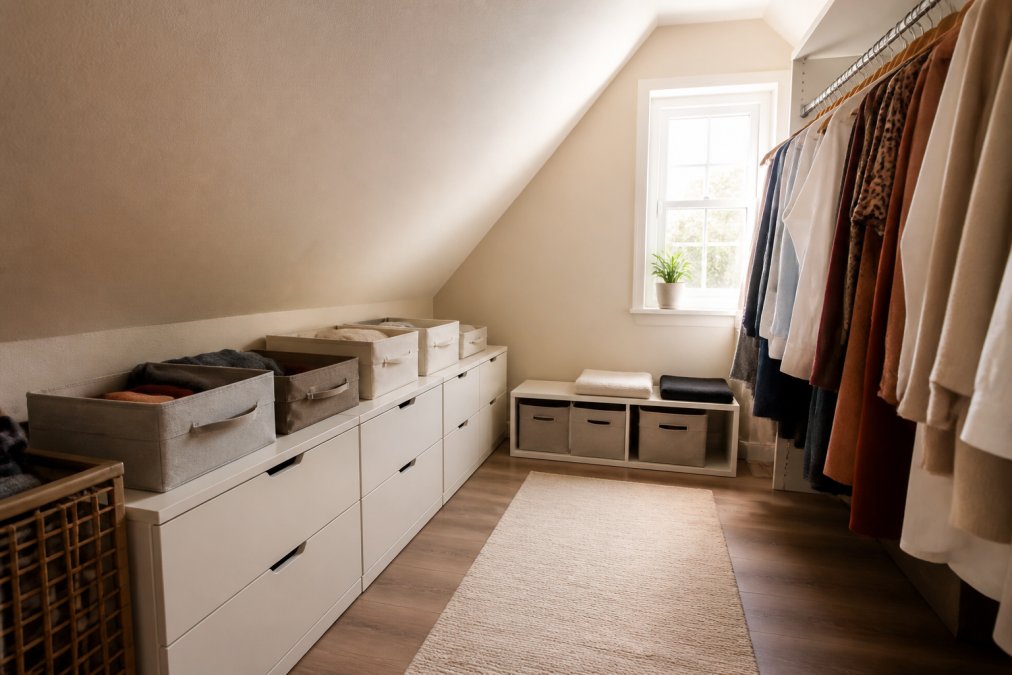
Use the Low-Clearance Floor Area for Drawers and Bins
The floor area beneath a sloped ceiling is the most underused real estate in any attic closet. Treat it as dedicated drawer and bin storage instead of a dumping ground.
Flat, low-profile drawer units work perfectly here. Aim for units no taller than 24 to 30 inches, which keeps them well below a typical knee-wall angle. Fabric drawer organizers are especially useful inside these units because they compress and flex to hold items like socks, underwear, and folded accessories without wasting space.

The Fabric Drawer Organizers for Socks & Underwear from The Reset Aisle ($22.99) fit neatly inside low dresser drawers or open cubbies positioned under the slope. They keep small items visible and separated so you're not digging through a pile every morning.
Storage bins on the floor work for bulkier seasonal items. Clear bins with lids let you see contents without pulling everything out, and labeling the front face makes the system self-maintaining.
Build or Install Custom Shelving Along the Angled Wall
The mid-height zone along the angled wall, typically between 30 and 60 inches from the floor, is ideal for shelving. Cut shelf boards at a slight angle so the back edge sits flush against the sloped drywall and the front edge remains level, giving you full shelf depth without a gap at the rear.
Modular shelving units with adjustable heights let you reconfigure as your storage needs change. Look for systems where individual shelf heights can shift in one-inch increments. That flexibility is especially valuable in a closet where every inch of clearance counts.
Hang Clothes Where the Ceiling Gives You Room
Hanging rods belong at the tallest point of the closet. The tall wall often provides 72 to 84 inches of clearance, which is more than enough for a standard double-rod configuration.
A double rod setup on the tall wall effectively doubles your hanging capacity. Use the upper rod for shirts, jackets, and shorter items. Use the lower rod for pants folded over hangers. The Space Saving Pant Hanger (Holds 40 Pairs) ($19.99) collapses what would otherwise be 40 individual hangers down to a single rod position. For a small closet, that kind of compression is significant.

How to Maximize Vertical Storage in Small Closets with Sloped Walls
Maximizing vertical storage in a small closet with sloped walls means using every inch of height on the tall wall while keeping the angled zones functional.
Floor-to-Ceiling Shelving on the Tall Wall
The tall wall of a sloped ceiling closet is your primary vertical storage opportunity. Install shelves from floor level up to within a few inches of the ceiling. The lower shelves can hold shoes, folded jeans, or storage bins. The upper shelves are ideal for seasonal items, spare linens, or anything you access infrequently. A sturdy step stool stored in the low-clearance zone gives you safe access to the upper shelves.
A wall that previously held one rod of hanging clothes now holds that rod plus four or five additional shelves above it. The closet's total storage capacity increases without adding any floor space.
Stacking Modular Units for a Custom Fit Without Custom Prices
Custom millwork for an attic closet can cost several thousand dollars. Stacking modular shelving units is a budget-friendly alternative that achieves a similar result for a fraction of the price.
Buy freestanding cube or tower units and stack or arrange them to fill the available height on the tall wall. Because the units are independent, you can configure them around the slope rather than cutting custom pieces to fit. A tower unit placed at the tall wall, a mid-height unit beside it, and a low cube unit in the corner can together fill the entire closet wall in a way that looks intentional.
| Storage Zone | Recommended Solution | Ideal Height | Best For |
|---|---|---|---|
| Low-clearance floor area | Drawer units, flat bins | Under 30 inches | Folded clothes, seasonal items |
| Mid-height angled wall | Adjustable shelving | 30 to 60 inches | Folded clothes, shoes, bins |
| Tall wall, upper section | Floor-to-ceiling shelves | 60 to 84+ inches | Rarely used items, linens |
| Tall wall, hanging zone | Single or double rod | 60 to 72 inches | Shirts, jackets, pants |
Fill gaps between units with shallow bins or baskets rather than leaving them empty. Dead space in a small closet is expensive.
Best Closet Organizers for Small Spaces with Awkward Angles
The best closet organizers for small spaces with awkward angles are low-profile enough to work under a slope, adjustable enough to fit non-standard dimensions, and make contents visible without requiring you to pull everything out.
Here are the organizer types that consistently perform well in sloped ceiling closets:
- Fabric drawer organizers: Flexible enough to fit inside any drawer or cubby, and they compress to accommodate odd dimensions. Best for socks, underwear, accessories, and small folded items.
- Clear stackable bins with lids: Ideal for the low-clearance floor zone. The transparency eliminates guessing what's inside, and lids keep dust off seasonal items.
- Slim velvet hangers: In a small closet, standard plastic hangers waste horizontal rod space. Slim hangers increase hanging capacity noticeably on a short rod.
- Space-saving multi-pant hangers: A single hanger that holds multiple pairs of pants dramatically reduces rod crowding in the hanging zone.
- Adjustable shelf dividers: Useful on any shelf to keep folded stacks from toppling sideways, especially on narrower shelves along the angled wall.
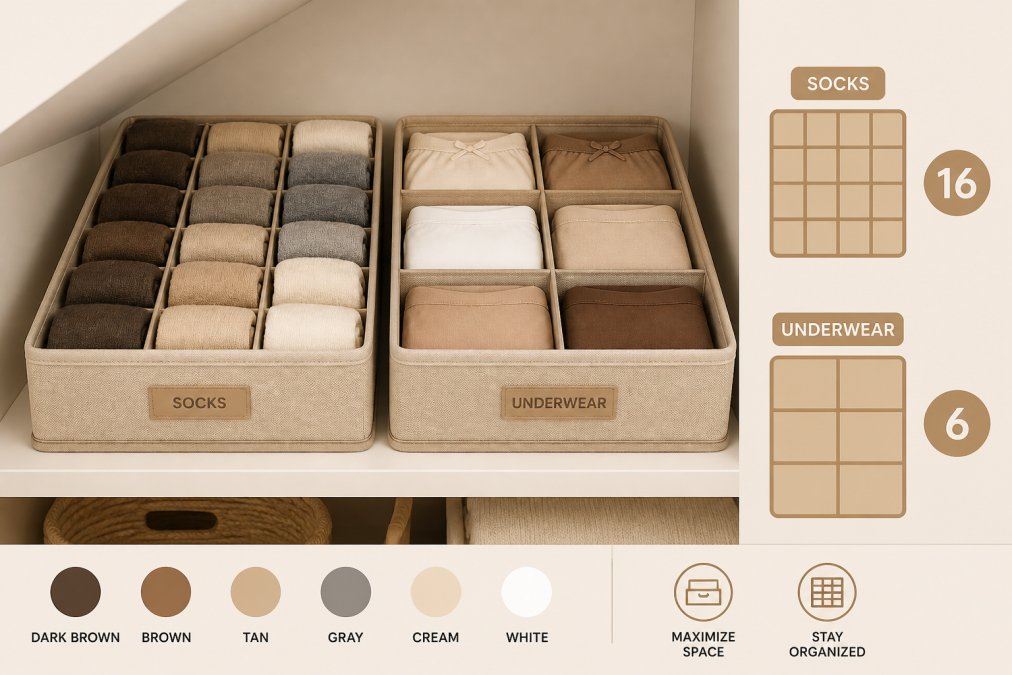
The Fabric Drawer Organizers for Socks & Underwear and the Space Saving Pant Hanger from The Reset Aisle address two of the most common pain points in small closets: the chaos of uncontained small items and the rod congestion from individual pant hangers.
Organizer selection should follow zone assignment, not precede it. Decide which zone holds which category of item first, then choose the organizer that fits that zone's dimensions and access requirements.
DIY Framing, Lighting, and Structural Considerations
Load-Bearing Awareness Before You Mount Anything
Mounting heavy shelving, rods, or drawer units to the walls of an attic closet requires knowing what's behind the drywall. Attic closets typically have knee walls with 2x4 studs on 16-inch centers, which are suitable anchor points for shelving brackets and rod supports. The sloped ceiling framing above contains rafters that carry roof load. Mounting heavy shelving directly into rafter framing without proper blocking can compromise structural integrity over time.
Mount into vertical knee wall studs whenever possible. Use a stud finder before drilling. For the sloped wall surface itself, add horizontal blocking between rafters if you need a mounting point, or use a freestanding unit that doesn't require wall attachment.
Lighting Solutions for Dark Attic Closets
Dark attic closets are a real problem. A closet you can't see into clearly is a closet you won't maintain. The low-clearance zones under the slope are especially prone to becoming dark dead zones.
Battery-powered LED puck lights are the simplest fix. They mount with adhesive, require no wiring, and can be placed exactly where you need light: inside the low-clearance floor area, under shelves, and at the back of the hanging zone. Motion-activated versions turn on automatically when you open the door.
Seasonal Storage Strategies for Slanted Ceiling Closets
Seasonal storage is where a sloped ceiling closet can genuinely shine. The low-clearance floor area is perfectly sized for flat storage bins holding off-season clothes, holiday items, or gear you rotate twice a year.
A practical seasonal storage system works like this:
- Assign the low-clearance zone to off-season items. Flat, lidded bins slide easily under the slope and stack two or three high in many cases. Label the front face of each bin with the season and category.
- Rotate at the change of season. When spring arrives, pull the winter bins out, move them to a secondary storage location, and slide the spring and summer bins in. The process takes 20 to 30 minutes and keeps the accessible zones stocked with what you actually need right now.
- Use vacuum storage bags for bulky items. Down coats, heavy sweaters, and extra bedding compress significantly in vacuum bags, which means more seasonal items fit in the same low-clearance floor area.
- Keep an inventory list on the closet door. A simple taped list of what's in each bin eliminates the need to open multiple bins to find one item.
- Reassess annually. A seasonal swap is the natural moment to declutter. If you didn't reach for something last season, it probably doesn't need to come back in.
The low-clearance floor area of a typical attic closet can hold a surprising volume of seasonal items when you use flat bins and vacuum compression. Many people find that this one zone, properly organized, eliminates the need for a separate storage unit entirely.
Organizing small closets with slanted ceilings doesn't require a renovation budget or a custom millwork quote. The Reset Aisle's curated selection, including the Space Saving Pant Hanger and Fabric Drawer Organizers, is built for exactly this kind of constrained, oddly shaped space. Start Your Reset and turn that awkward attic closet into the most functional storage space in your home.
Frequently Asked Questions
How do you hang clothes in a closet with a slanted ceiling?
Place your hanging rod at the tallest section of the closet, where the ceiling gives you at least 60 to 66 inches of clearance from the floor. That's enough height for dresses and long coats. For shorter items like shirts and folded pants, a space-saving multi-pant hanger lets you fit far more on a single rod. Reserve the low-clearance zones under the slope for drawers, bins, and folded items instead of hanging garments.
What kind of shelving works best for sloped ceilings?
Adjustable shelving units with individual shelf brackets work best because you can set each shelf at a different height to follow the angle of the ceiling. Modular cube systems are another practical option since you can arrange them in a stair-step pattern that mirrors the slope. Avoid fixed-height, floor-to-ceiling wardrobes designed for flat ceilings, they waste the usable depth and leave awkward dead space at the top corners of an attic closet.
How do you organize a tiny closet with a slanted ceiling for maximum space?
Divide the closet into three zones based on ceiling height. Use the tallest zone for hanging rods and floor-to-ceiling shelving. Use the mid-height zone for folded items, shelf cubbies, and vertical storage bins. Tuck drawer units, flat storage boxes, and seasonal items into the lowest zone under the knee wall. Adding battery-powered LED strip lights along the shelves makes it easier to see everything stored in darker corners of an attic closet.
What are the most common closet organization mistakes in sloped-ceiling spaces?
The biggest mistake is treating the angled wall as wasted space and ignoring it entirely. That low-clearance area is actually ideal for shallow drawer units, rolling bins, and flat storage boxes. A second common mistake is buying standard-height wardrobes that don't fit the slope, leaving gaps and dead space. Skipping lighting is another error, dark attic closets make it hard to find anything, which causes clutter to build back up quickly after organizing.
This article was written using GrandRanker