

Table of Contents
- Why Shoe Racks Fall Short in Small Entryways
- Shoe Storage for Narrow Hallways: Slim Cabinets and Vertical Solutions
- Shoe Storage Bench for Small Spaces: Seating and Storage in One
- Over-the-Door Shoe Organizer: Zero Floor Space Required
- DIY and Repurposed Shoe Storage Ideas
- How to Choose: Measurements, Capacity, and Household Size
- Rental-Friendly and No-Drill Shoe Storage Solutions
- Managing Wet, Muddy, and Seasonal Shoes in Small Entryways
- Frequently Asked Questions
Last Updated: October 9, 2026
Why Shoe Racks Fall Short in Small Entryways
Most shoe rack alternatives solve a problem you don't actually have. They hold shoes, sure, but they do it in the one place a small entryway can't spare: open floor space. A standard two-tier rack eats roughly 60 centimeters of depth and turns a narrow hallway into an obstacle course.
That's the real issue. Shoe rack alternatives for small entryways work because they change where storage lives, not just how much of it you buy. They move shoes up a wall, under a bench, behind a door, or into a cabinet that doubles as furniture.
Here's the throughline: in a tight entryway, storage should be vertical, concealed, or multi-purpose. Never just "a rack."
Shoe Storage for Narrow Hallways: Slim Cabinets and Vertical Solutions
Shoe storage for narrow hallways comes down to one number: depth. A slim cabinet or wall-mounted unit that stays under 30 centimeters deep keeps your walkway clear while still hiding shoes out of sight.
Slim Shoe Cabinets With Concealed Storage
A slim shoe cabinet is the closest thing to a rack replacement that still looks like furniture. Most models run 20 to 30 centimeters deep, with tilted internal shelves that hold shoes at an angle so the cabinet stays shallow. A typical two-door unit holds 12 to 18 pairs.
The trade-off: tilted shelves favor flats and low-profile sneakers. Tall boots usually need a separate spot.
Wall-Mounted and Stackable Options for Tight Spaces
Wall-mounted storage clears the floor entirely, which matters most in a hallway under a metre wide. Stackable and modular units let you grow storage upward as your shoe count changes. The catch is installation: wall-mounted units need solid anchors, so this route suits owners more than renters.
Shoe Storage Bench for Small Spaces: Seating and Storage in One
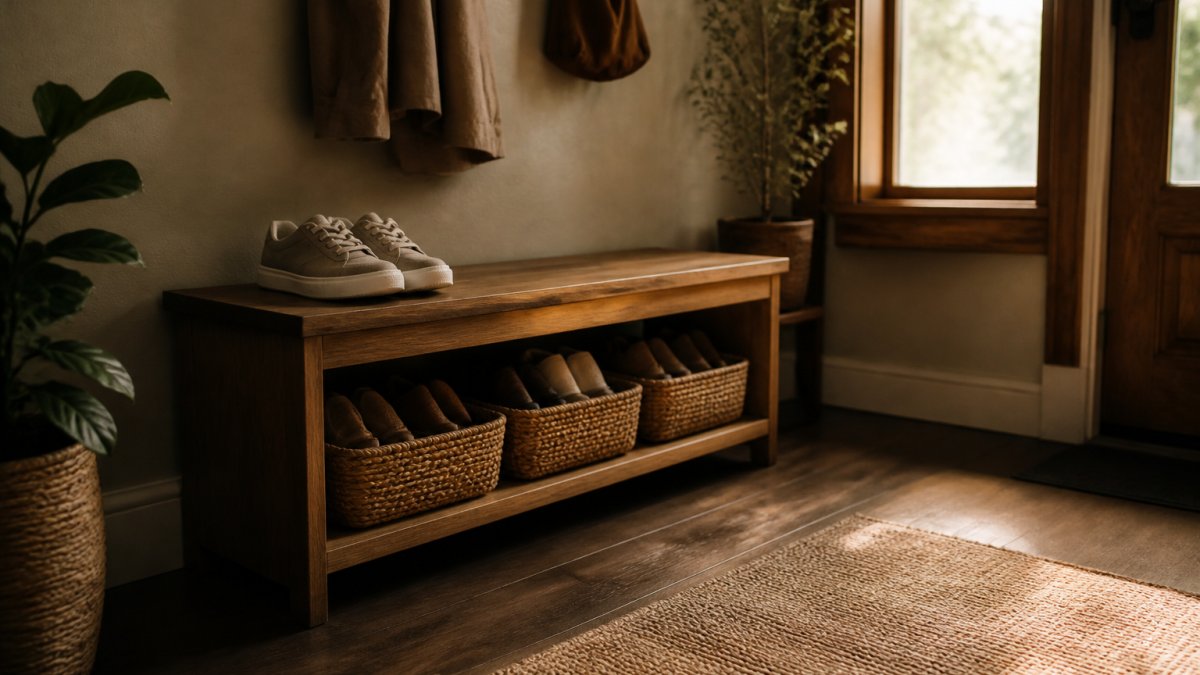
A shoe storage bench for small spaces earns its footprint by doing two jobs: somewhere to sit while you tie laces, and somewhere to hide shoes underneath. That dual purpose is why benches often beat racks in entries under 1.5 square metres.
Under-Bench Shoe Storage: Baskets, Bins, and Cubbies
Under-bench shoe storage is the flexible part. Open cubbies suit everyday shoes you grab constantly. Baskets and bins hide the messy pairs and work well for kids who won't stack neatly. Choose a bench with an open base and you can swap between the two as your household changes.
Over-the-Door Shoe Organizer: Zero Floor Space Required
An over-the-door shoe organizer uses space you already have and never think about: the back of a door. It requires no floor footprint, no drilling on most models, and holds 12 to 24 pairs depending on pocket size. This is the fastest fix for a hallway with genuinely no spare centimetres.
The honest limitation: pockets are sized for standard shoes. Boots, chunky sneakers, and anything above ankle height usually won't fit. Treat this as everyday-shoe storage, not a whole-collection solution.
DIY and Repurposed Shoe Storage Ideas
DIY and repurposed storage works when you want a custom fit without a custom price. The trick is picking materials that match your entryway's dimensions exactly, then giving each option a defined job so it doesn't become another pile.
Wooden Crates, Ladder Shelves, and Storage Baskets
- Wooden crates: A standard milk-style crate runs about 12 inches wide, 12 inches deep, and 12 inches tall. Stack two or three on their sides and you get instant cubbies roughly 12 inches tall, enough for sneakers, flats, and low boots, but not tall shafts. They're sturdy, cheap, and you can paint them to match your walls. Line the bottom with a cut-to-fit boot tray if you'll store damp shoes.
- Ladder shelves: A leaning ladder shelf typically stands 60 to 72 inches tall with a footprint under 18 inches deep. That slim profile is why it works in a hallway where a full rack won't. It leans against the wall, so no mounting is required, but it also means the bottom rung is the only one a small child can reach safely.
- Storage baskets: Woven or fabric baskets are the cheapest way to hide loose shoes. A 15-inch cube basket holds roughly four to six pairs of adult shoes or eight to ten pairs of kids' shoes. Tuck them under a bench or on a low shelf to corral shoes and keep the entryway tidy.
Repurposed Furniture That Beats a Rack
Look at what you already own before you buy anything new. A few common pieces convert cleanly:
- A low bookshelf laid on its side becomes a bench-height cubby unit. A three-shelf unit on its side gives you three compartments roughly 12 inches tall and 24 to 30 inches wide, enough for two pairs per compartment.
- A dresser with shallow drawers hides shoes completely. Measure drawer depth first: you need at least 12 inches of interior depth for adult sneakers, and 14 to 16 inches for boots laid flat.
- A metal or wire utility cart rolls out of the way when you need the floor space back. Two or three tiers hold six to nine pairs and cost far less than a dedicated cabinet.
A Quick Cost and Effort Comparison
| Option | Typical Cost | Setup Time | Pairs Held |
|---|---|---|---|
| Stacked crates | $20-$60 | 10 minutes | 6-12 |
| Ladder shelf | $40-$120 | 15 minutes | 8-12 |
| Baskets under a bench | $15-$50 | 5 minutes | 8-16 |
| Repurposed bookshelf | $0-$80 | 20 minutes | 6-12 |
| Rolling utility cart | $30-$70 | 10 minutes | 6-9 |
Prices vary by retailer and material, but the pattern holds: repurposed and DIY options cost a fraction of a slim cabinet and install in minutes.
How to Choose: Measurements, Capacity, and Household Size
Match the storage to your space and your people before you buy anything. Most entryway storage fails not because it's the wrong style, but because it's the wrong size for the doorway, the walkway, or the household. Here's the decision framework we use at The Reset Aisle.
Measure Three Things First
Grab a tape measure and record these numbers before you shop:
- Available floor depth. Measure from the wall to the point where you'd still feel comfortable walking past. In a narrow hallway, that's usually 12 to 18 inches. Anything deeper starts to feel like an obstacle.
- Wall height and usable vertical space. Note where outlets, light switches, and door swings interrupt the wall. A wall-mounted unit needs a clear run of at least 24 inches wide and 30 inches tall for a two-tier design.
- Door clearance. Measure the full arc of every door that opens into the space, front door, closet door, and any interior door. A storage piece that blocks even part of that arc will get shoved aside within a week.
A Simple Fit Test
Once you have those three numbers, run this quick check:
- Depth: Does the unit's depth plus 6 inches of walking clearance still fit within your hallway width? If not, go shallower or go vertical.
- Height: Can you reach the top shelf without a step stool? If not, reserve the top for off-season storage only.
- Swing: Does the unit sit fully outside every door's swing path? If not, relocate it or choose a freestanding option you can move.
Match Capacity to Household Size
| Household Size | Pairs to Store | Best Alternative | Rough Capacity |
|---|---|---|---|
| 1-2 people | 6-12 pairs | Over-the-door organizer | 12-24 pockets |
| 3-4 people | 12-24 pairs | Slim cabinet | 12-18 pairs |
| 4+ people, kids | 24+ pairs | Bench with cubbies | 18-30 pairs |
| Renters | Any | No-drill options | Varies |
Capacity matters more than style. A beautiful cabinet that holds eight pairs won't survive a family of five. Count your household's actual everyday pairs, not the whole collection, and add two or three slots for guests and seasonal swaps.
Account for Seasonal Footwear
Boots and tall shoes break most storage plans. A pair of tall boots needs 14 to 16 inches of vertical clearance if stored upright, or roughly 12 inches of depth if laid flat. If your household owns more than two pairs of tall boots, plan a dedicated tall compartment or a boot tray near the door rather than trying to force them into a slim cabinet.
Rental-Friendly and No-Drill Shoe Storage Solutions
Renters need storage that leaves no holes and no damage. Over-the-door organizers, freestanding benches, stackable crates, and tension-pole shelving all work without a single screw. Freestanding slim cabinets are another solid pick: they lean or stand against the wall and move with you when you leave.
The rule for rentals: if it needs an anchor, skip it. Everything else on this list installs in minutes and comes out just as fast.
Managing Wet, Muddy, and Seasonal Shoes in Small Entryways
Wet and muddy shoes need airflow, not a sealed box. If you shut damp boots inside a closed cabinet, they stay wet, smell, and degrade faster. Keep one open cubby or a boot tray near the door for wet pairs, and reserve concealed storage for dry, everyday shoes.
For seasonal swaps, store off-season shoes in labeled bins up high or under the bench, and keep only the current season within reach. That single habit cuts entryway clutter more than any product you can buy.
Frequently Asked Questions
How can I store shoes in a small entryway without a shoe rack?
Use a storage bench with baskets underneath to hold shoes out of sight. A slim shoe cabinet takes up less floor space than a rack and hides clutter behind doors. An over-the-door organizer works well when floor space is zero. Wall-mounted shelves or stackable cubbies also keep shoes off the floor. The key is choosing a solution that matches your entryway's dimensions and your daily shoe count, so the system stays easy to use.
Are shoe cabinets better than open shoe racks for small spaces?
Shoe cabinets win on visual calm because doors conceal the contents, which matters in a small entryway where every item is visible. Open racks offer faster access and better airflow for drying wet shoes. For narrow hallways, a slim cabinet with concealed storage often fits better than a standard rack because it sits flush against the wall. If you rotate between a few pairs daily, a cabinet with open shelves at the bottom gives you both.
How many pairs of shoes should I keep by the front door?
Aim for two to four pairs per person: one everyday pair, one weather-appropriate option, and one for quick errands. Anything beyond that belongs in a closet or bedroom. This limit keeps entryway clutter manageable and makes any storage solution, whether a bench, cabinet, or cubby, easier to maintain. Rotate seasonal shoes in and out so your entryway only holds what you actually wear this week.
What can I use under a bench to store shoes?
Woven baskets, stackable bins, and open cubbies all work under a bench. Baskets hide shoes and suit wet or muddy pairs since you can carry them to clean. Cubbies give each person a dedicated slot, which helps busy households stay organized. Measure the clearance under your bench first; most offer 10 to 14 inches of height, enough for a basket or a row of low shoes but not tall boots.
A cramped entryway doesn't have to mean tripping over shoes every morning. The right alternative, whether that's a slim cabinet, a storage bench, or a no-drill over-the-door organizer, turns chaos into calm. At The Reset Aisle, we focus on practical, space-saving solutions that make the belongings you already own work harder for your home. Explore our curated organization products and start your reset today.