

Last Updated: October 29, 2026
Quick Summary
For sloped ceiling closet lighting, measure your lowest ceiling clearance first, then choose low-profile flush mounts, adjustable recessed downlights, or LED strips that fit under that height. Under 1.8 meters at the low end, skip anything that hangs and use flush or surface-mounted fixtures only.
- Measure ceiling height at the low wall, middle, and high wall; the lowest number is your real clearance.
- Keep flush mount drop depth under 10 cm for tight headroom.
- Sloped-ceiling recessed trims typically adjust from about 15 to 45 degrees.
- Aim for roughly 30 to 50 lumens per square foot of closet floor.
- Mount wall switches 36 to 48 inches from the floor on the latch side of the door.
Table of Contents
- Why Low Sloped Ceilings Change Your Closet Lighting Plan
- Low-Profile Flush Mount Lights for Low Ceilings
- Recessed Lighting for Sloped Ceilings: What Fits and What Doesn't
- LED Strip Lights for Closets: The Shadow-Free Option
- Motion Sensor Closet Lights: Hands-Free Visibility in Tight Spaces
- Brightness, Color Temperature, and Color Rendering: Getting the Numbers Right
- Wiring, Controls, and Rental-Friendly Options
- Start Your Reset: Choosing Your First Closet Light
- Frequently Asked Questions
Why Low Sloped Ceilings Change Your Closet Lighting Plan
Sloped ceiling closet lighting turns a simple closet update into a puzzle. The same closet lighting ideas for low sloped ceilings that work in a standard room often fail here, because the ceiling drops exactly where you need light most. A fixture built for a flat ceiling often hangs too low or throws light into the wrong corner. The fix starts with math, not shopping.
The Headroom Math: How Much Clearance Do You Have?
Measure the vertical distance from floor to ceiling at the lowest point of the slope, then again at the highest. That gap tells you what will actually fit.
- Under 1.8 meters (6 feet) at the low end: skip anything that hangs. Flush or surface-mounted only.
- 1.8 to 2.1 meters: a low-profile flush mount with a shallow drop works.
- Above 2.1 meters at the low point: you have room for slim pendants or track lighting.
Most people measure once, at the door, and call it done. Measure at three points instead: the low wall, the middle, and the high wall. The lowest number is your real ceiling clearance.
Where Shadows Come From in a Slanted Closet
Shadows in a slanted closet come from three things: a single light source, shelving that blocks the beam, and the angle itself. A fixture on the high side throws light across the room but leaves the low side dark; one on the low side lights the floor but not the top shelf.
The angle makes it worse. Light travels in straight lines, so a slanted ceiling pushes the beam toward one wall. Even illumination in an attic closet or A-frame room takes more than one fixture, or a fixture placed off-center on purpose.
Low-Profile Flush Mount Lights for Low Ceilings
Flush mount lights for low ceilings are the safest bet when headroom is tight. They sit close to the surface, so nobody bonks their head reaching for a sweater. The trade-off: most are built for flat ceilings, and a slanted surface leaves a visible gap on one side.
Look for fixtures with an adjustable canopy or a swivel base. Those mount flush against an angled ceiling without a wedge of empty space behind them. A few other things to check:
- Drop depth: keep it under 10 cm (about 4 inches) for tight headroom.
- Dimmable: worth the extra cost in a small space.
- Warm-to-neutral color range: more on this below.
Clearance Rules for Angled Ceilings
Check the fixture's listing and your local code before mounting anything close to a sloped surface.
Watch out: mounting a flat-canopy fixture directly to a slope can crack the canopy or leave the wiring exposed. Always use a fixture rated for angled mounting.
Recessed Lighting for Sloped Ceilings: What Fits and What Doesn't
Recessed lighting for sloped ceilings needs a specific type of housing: an adjustable or "sloped ceiling" recessed can. Standard housings sit square to a flat ceiling; on a slope they either won't sit flush or aim straight down into a wall. The fix is a housing with a gimbal or adjustable trim that tilts the light cone back toward the closet floor and shelves.
Housing and Trim Specs That Actually Matter on a Slope
Before you cut a hole, match four specs to your ceiling angle and closet layout:
- Tilt range: Sloped-ceiling trims typically adjust from about 15 to 45 degrees. Measure your ceiling pitch first (a 4-in-12 slope is roughly 18 degrees; a 12-in-12 A-frame is 45 degrees). If your slope exceeds the trim's tilt range, the light will wash the wall instead of the floor.
- IC rating: An insulation-contact (IC) rating is required if insulation sits within 3 inches of the housing. Non-IC housings need a clear air gap, often impossible in a tight attic closet. Check the label inside the can.
- Airtight rating: An airtight (AT) housing keeps closet air from leaking into the attic and reduces condensation in cold months. Verify airtight rating before purchase.
Placement by Ceiling Angle and Closet Width
Generic advice says "aim the light at the shelves." On a slope, the geometry changes with closet width and storage height:
- Narrow closet (under 4 feet wide) with a single slope: Place one 4-inch adjustable downlight on the high side, tilted toward the low wall. This throws light across hanging clothes and the floor without a second fixture.
- Wide closet (6 feet or more) with a single slope: Use two 4-inch adjustable downlights spaced evenly along the high side, each tilted 20 to 30 degrees toward the low side. Avoid placing a fixture directly over the highest shelf; it will cast a hard shadow under the shelf above.
- A-frame or double-slope ceiling: Place fixtures along the ridge line if headroom allows, or use two fixtures on opposite slopes aimed toward the center. A single ridge fixture often leaves both low walls dark.
Installation Sequence and When to Call an Electrician
Recessed lights are the cleanest look for a low sloped ceiling because they sit nearly flush. The catch is installation. Cutting into a sloped ceiling and running wire is a job for a licensed electrician in most cases. The sequence matters:
- Confirm the ceiling cavity: A sloped ceiling often has rafters running parallel to the slope. A 4-inch housing needs about 4.5 inches of clear cavity depth; a 6-inch housing needs about 6 inches. Check from the attic or with a stud finder before cutting.
- Run wire before cutting: The electrician will typically run NM cable from the switch box to each housing location, then cut the holes. Cutting first and fishing wire later is harder on a slope.
- Mount the housing to the rafter, not the drywall: Sloped-ceiling housings clamp to the framing and must sit square to the rafter, not the drywall plane, or the trim will not sit flush.
- Set the tilt before final trim: Adjust the gimbal to the target angle, then lock it. Reaching back through a 4-inch hole to adjust a gimbal is frustrating.
If you rent, skip recessed lighting entirely. The holes are permanent, and patching a sloped ceiling is a drywall job most renters should not take on. A plug-in or battery fixture delivers most of the visibility without the lease risk.
LED Strip Lights for Closets: The Shadow-Free Option
LED strip lights for closets solve the shadow problem better than almost anything else. They mount under shelves and along the perimeter, so light comes from the same direction as your hands.
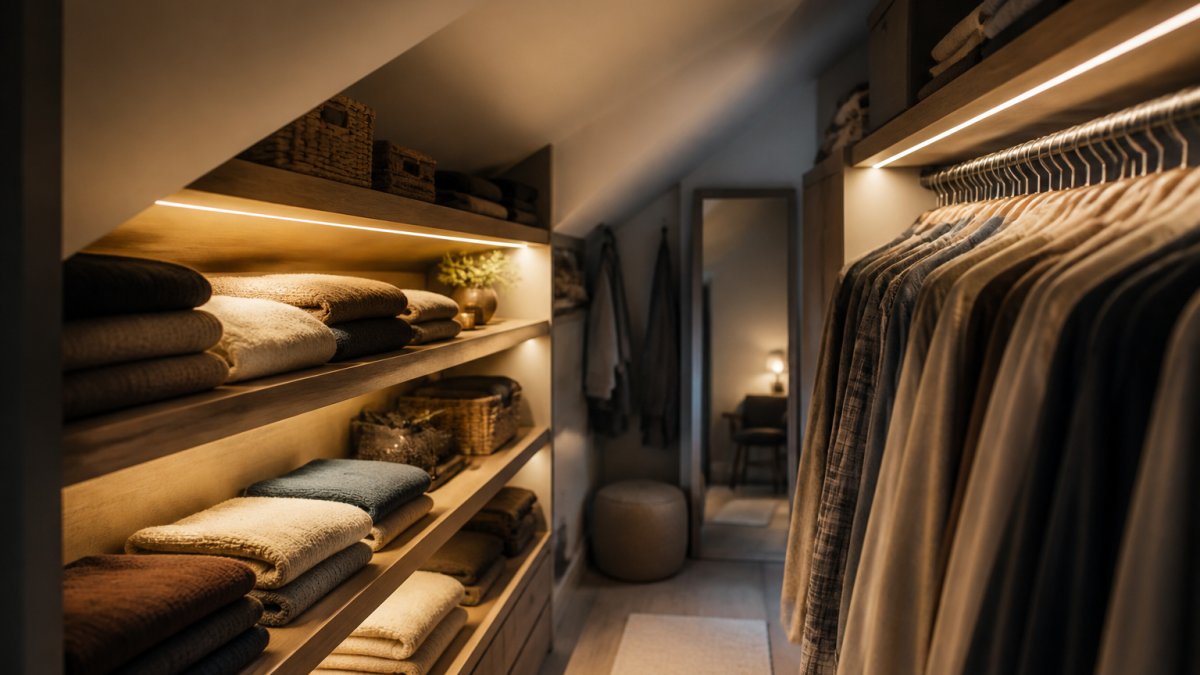
Strips come in plug-in, battery, and hardwired versions. For a wireless option that installs without an electrician, our USB-rechargeable under-cabinet LED light gives you motion-activated light right where you need it.
Motion Sensor Night Light – USB Rechargeable Wireless LED Cabinet Light →

Shelf and Perimeter Placement That Works Under a Slope
Placement matters more than brightness with strips. Follow the slope:
- Under each shelf: run a strip along the front edge, facing down.
- Along the low wall: a vertical strip lights the floor and lower shelves.
- Around the door frame: perimeter lighting kills the shadow when the door opens.
Motion Sensor Closet Lights: Hands-Free Visibility in Tight Spaces
Motion sensor closet lights are the practical answer for tight spaces where you are holding an armful of clothes. They turn on when you walk in and off when you leave, so you never fumble for a switch in the dark.
Look for a detection range that covers the whole closet, not just the doorway. Our motion sensor night light detects motion within roughly 3 to 5 meters at a 120-degree angle and shuts off after about 25 seconds.
Brightness, Color Temperature, and Color Rendering: Getting the Numbers Right
Getting the numbers right means matching three specs to how you use the closet: lumens for brightness, kelvin for color temperature, and CRI for color rendering.
- Lumens: aim for roughly 30 to 50 lumens per square foot of closet floor. A small closet needs less than you think.
- Color temperature: 2700K to 3000K feels warm and cozy; 4000K to 5000K is crisp and neutral for seeing true colors.
- Color rendering (CRI): look for 90 or higher if you pick outfits by color. Low-CRI light makes navy look black.
Dimmable lights can help in a small space.
Wiring, Controls, and Rental-Friendly Options
Wiring options split into three camps, and your lease decides which one you get. Hardwired lighting is permanent and clean but needs an electrician. Plug-in lighting is easy but needs an outlet nearby. Battery-powered lights need no wiring at all. The gap most guides miss is controls: where the switch goes, how the sensor sees you, and whether the dimmer you bought actually works with the fixture.
Hardwired, Plug-In, or Battery: A Practical Comparison
| Option | Best for | Install effort | Reversible | Key trade-off |
|---|---|---|---|---|
| Hardwired | Owners, permanent setups | High (electrician, permit in some jurisdictions) | No | Highest upfront cost; cleanest look; dimmer and switch options are widest |
| Plug-in | Renters with an outlet | Low | Yes | Cord must reach an outlet; use adhesive cable clips to route neatly |
| Battery/rechargeable | Renters, no outlet, closets under 6 feet wide | None | Yes | Recharge or replace batteries every few weeks to months depending on use |
A few specifics that change the decision:
- Hardwired dimming: Most LED recessed and flush fixtures are dimmable, but the dimmer must be LED-compatible. A standard incandescent dimmer can cause flicker or buzz. Look for a dimmer labeled "CL" (compatible with LED) or "ELV" if the fixture specifies it.
- Plug-in outlet access: In a closet, the outlet is often on the wall behind hanging clothes or above the door. Measure the cord run before buying. A 6-foot cord rarely reaches from a high shelf to a low outlet on a sloped wall.
- Battery life math: A motion-sensor LED strip rated at 100 lumens typically runs 1 to 3 months on AA batteries with light daily use. Rechargeable USB fixtures often need a charge every 2 to 6 weeks. A fixture you forget to charge is a fixture that stays dark.
Switch and Sensor Placement in a Tight, Sloped Closet
Sloped ceiling closet lighting controls matter more in a low closet because the door, shelves, and slope all interfere with line of sight. Place controls where your hand or body naturally lands:
- Wall switch: Mount it on the latch side of the door, 36 to 48 inches from the floor, and at least 6 inches from the door frame. On a sloped wall, keep the switch below the point where the ceiling drops under 6 feet so you can reach it without ducking.
- Motion sensor: Aim the sensor across the doorway, not at it. A sensor pointed at the door sees you only after you are inside; one aimed across the threshold triggers as you enter. In a closet under 4 feet wide, mount the sensor on the ceiling or high on the wall opposite the door to avoid false triggers from swaying clothes.
- False triggers: Pets, HVAC vents, and reflective surfaces (mirrors, glass bins) can trip a motion sensor. Keep the sensor at least 3 feet from a vent and avoid aiming it at a mirror. A 120-degree field and a 3-to-5-meter range is typical for a small closet; a wider field in a narrow space causes more false triggers, not fewer.
Cord Routing and No-Drill Mounting That Looks Intentional
For renters, no-drill and adhesive options are the way to go. Use adhesive cable clips to route any cords neatly along a shelf edge or baseboard, so the setup looks intentional instead of improvised. A few routing rules that hold up on a sloped ceiling:
- Run cords along the top edge of the lowest shelf, not across the floor where they catch on shoes.
- Keep cords at least 2 inches from any heat source, including incandescent bulbs and HVAC registers.
- Use a cord cover or raceway on visible runs; a loose cord on a sloped wall reads as clutter.
Switch placement matters too: put a switch or sensor where your hand naturally lands when you open the door, not behind a stack of bins. In a sloped closet, that is usually the wall just inside the door on the high side, where the ceiling gives you room to stand.
Start Your Reset: Choosing Your First Closet Light
Start with one fixture and one goal. If your closet is dark and cramped, a motion sensor light gives you the fastest win. If shadows are the problem, LED strips under the shelves fix more than a ceiling fixture ever will.
Measure your clearance first, then pick the fixture type that fits it.
When you are ready to rework the whole closet, our space-saving storage hangers can help free up room in the closet. And if you want more practical guides like this one, browse our home organization blog for closet, pantry, and drawer systems that hold up.
Frequently Asked Questions
What type of lighting works best on a low sloped ceiling?
The best fit is usually a combination of low-profile fixtures and strip lighting. A flush mount light for low ceilings keeps clearance tight against the highest point of the slope, while LED strip lights for closets run along shelves and perimeter edges where the ceiling drops. That pairing gives you ambient light overhead and accent lighting at eye level, so clothing stays visible without a fixture hanging into your headroom.
Can recessed lights be installed in a sloped ceiling?
Yes, but the housing has to be rated for sloped ceilings and matched to your actual roof pitch. Standard recessed cans sit level and will either cut into the slope or leave a gap. Recessed lighting for sloped ceilings uses adjustable or slope-specific trims so the light points straight down. In a closet, also check that the housing depth fits above the drywall without hitting framing or insulation.
How do you light a closet with a sloped ceiling without wiring?
Battery-powered and USB-rechargeable options cover most no-wiring situations. Motion sensor closet lights with a magnetic mount attach to metal shelving or brackets and switch on automatically, which suits rentals and attic closets without an outlet. The Reset Aisle's Motion Sensor Night Light, $49.99, is 1.1 cm thick, rechargeable by USB, and offers three color temperatures from roughly 3000K to 6000K.
Where should lights go in a closet with a sloped ceiling?
Put the main fixture at the highest point of the ceiling, where clearance is greatest, and run strip lighting along the shelf fronts and the low perimeter where the slope meets the wall. Aim light at the clothing rather than the floor. In a small closet, two light sources at different heights reduce shadow reduction problems far better than one bright ceiling fixture.
Your closet does not have to stay dark and frustrating. The Reset Aisle curates space-saving organization products built to make small, awkward spaces work harder, from motion sensor lights to storage that clears the clutter blocking your light. Start your reset with The Reset Aisle and turn that sloped closet into a space you can actually see and use.
