

Table of Contents
- Why Kitchen Organization Systems Fail: The Core Problem
- Common Kitchen Organization Mistakes That Sabotage Your System
- How to Organize a Kitchen for Efficiency That Lasts
- Maintaining Kitchen Organization Habits for the Long Term
- The Real Cost of Accessibility and Ergonomic Failures
- Budget-Friendly vs. Custom Solutions: What Actually Works
- Recognizing When Your System Is Breaking Down
- Conclusion
Last Updated: August 22, 2026
Why Kitchen Organization Systems Fail: The Core Problem
Most kitchen organization systems fail because they're built on a false assumption: that a perfect system can exist independent of how you actually live. You buy matching containers, install shelf dividers, label everything, and for two weeks it's pristine. Then life happens. Within a month, your carefully designed system has collapsed back into chaos.
This isn't a personal failure. It's a systems failure. At The Reset Aisle, most kitchen organization systems fail because they ignore the gap between theory and daily reality. They don't account for your actual workflow, prioritize aesthetics over accessibility, and demand maintenance that no busy household can sustain. Understanding why this happens is the first step toward building a system that actually sticks.
Common Kitchen Organization Mistakes That Sabotage Your System
Ignoring Your Actual Daily Workflow
The biggest mistake people make is organizing based on how they think they should use their kitchen, not how they actually do. You might believe you meal-prep every Sunday, but in reality, you grab what you need when you need it.
Effective kitchen organization starts with honest self-assessment. Track your actual patterns for a week. Where do you spend the most time? What do you reach for first? Which items cause frustration because they're hard to find? Most people organize around an idealized version of themselves, then feel defeated when the system doesn't work.
The fix is to organize around your real habits. If you always grab coffee first thing in the morning, your coffee supplies should be at arm's reach near the coffee maker. If you're constantly searching for a specific cooking tool, it shouldn't be buried in a deep drawer. Your kitchen organization system should make your actual routine easier, not require you to change your routine to fit the system.
Over-Organizing Before You Declutter
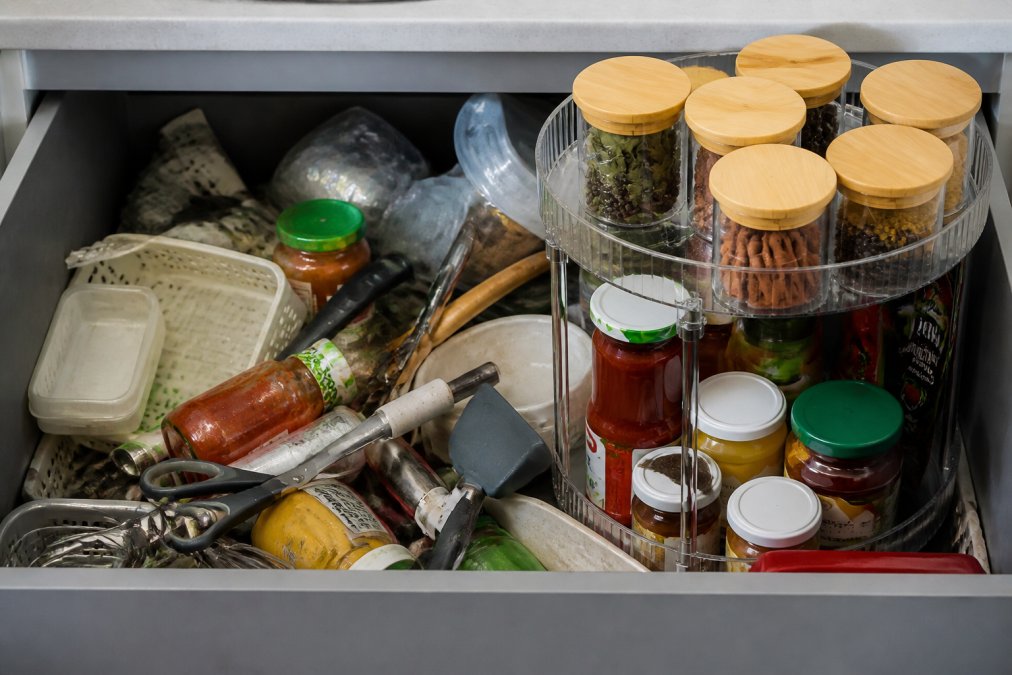
Most kitchen organization attempts fail because people buy organizers before they've decided what to actually keep. You end up with containers for items you don't use and a system that's fighting against clutter instead of preventing it.
Decluttering must come first. Go through your kitchen and honestly assess what you use and what you don't. That bread maker you used twice? Gone. The specialty gadgets collecting dust? Donate them. The expired spices? Throw them out. Once you've decluttered, you know exactly what you're organizing. Your containers fit your actual inventory. Your system becomes sustainable because it's not fighting against excess.
Choosing Storage Capacity Over Accessibility
A common mistake is maximizing storage capacity at the expense of accessibility. You install deep shelves and cram as much as possible into every space. Items in the back become invisible. You forget they exist and end up buying duplicates.
Accessibility trumps capacity. An item you can easily reach and see is infinitely more useful than an item that's technically stored but effectively invisible. This is why zone-based kitchen organization works better than traditional cabinet storage. Items stay in the zones where you use them. Your spices stay near the stove. Your cooking oils stay near the prep area. Your baking supplies stay near the oven.
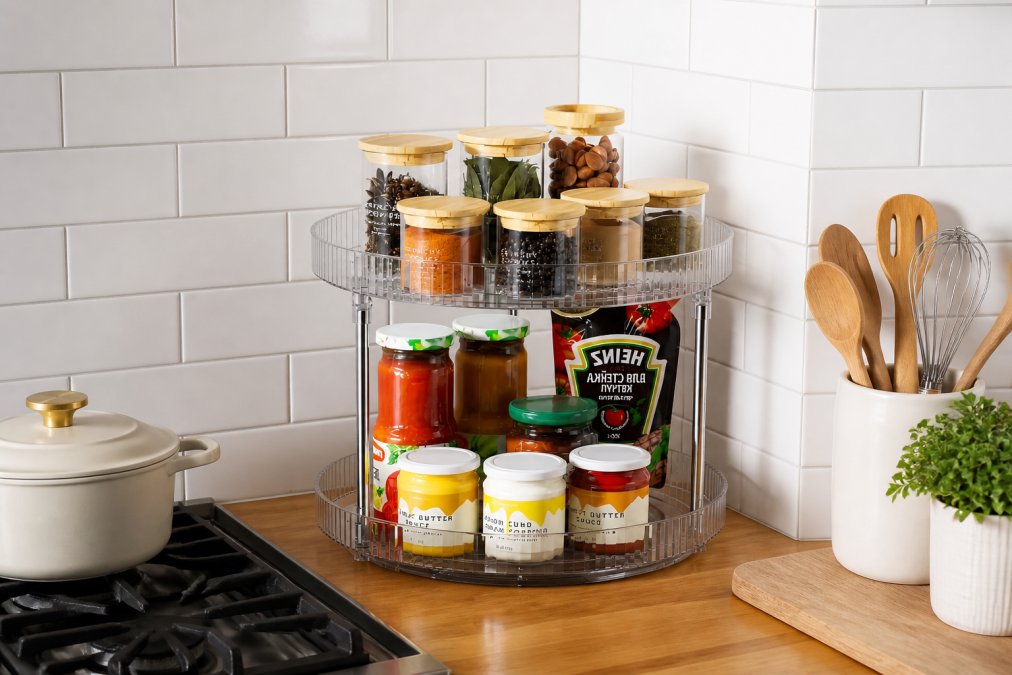
The Reset Aisle's approach focuses on this principle. Products like the Double-Layer Rotating Spice Rack put every jar within reach on a 360-degree turntable. Nothing hides in the back. Everything is visible and accessible. When evaluating kitchen organization solutions, ask yourself: Can I see this item easily? Can I reach it without moving other items? Will I remember it exists? If the answer to any of these is no, the storage capacity doesn't matter.

How to Organize a Kitchen for Efficiency That Lasts
Design Around Your Zone-Based Kitchen Workflow
Zone-based organization is the foundation of any kitchen organization system that actually works. Instead of scattering items throughout your kitchen, you group related items near where you use them. Your coffee zone near the coffee maker. Your cooking zone near the stove. Your prep zone near the cutting board and sink. Your baking zone near the oven.
This approach aligns your kitchen organization with your actual workflow. You're not running across the kitchen searching for items. Everything you need for a specific task is in one place. This reduces friction, saves time, and makes maintenance easier because the system mirrors how you naturally move through your kitchen.
Look at your work triangle, the imaginary line connecting your sink, stove, and refrigerator (the NIH). This is where most kitchen activity happens. Items used frequently should be in this zone. Items used occasionally can be further away. Items rarely used can go in the back of upper cabinets.
Match Storage to Your Real Habits
Your kitchen organization system should adapt to your habits, not force your habits to adapt to the system. If you're someone who likes to see everything at a glance, open shelving and clear containers work better than closed cabinets. If you prefer a minimalist aesthetic, closed storage works better.
Understanding your organizational style prevents the common mistake of buying solutions that don't match your personality. You'll use a system that feels natural to you. You'll abandon one that fights against your instincts.
The Reset Aisle's Under Sink Organizer with Sliding Shelves works because it adapts to different storage styles. The sliding design lets you customize the layout based on what you actually store. It doesn't force a predetermined organization scheme. It works with your habits, not against them.

Maintaining Kitchen Organization Habits for the Long Term
The Daily Reset: Your System's Foundation
Most kitchen organization systems fail because people treat organization as a one-time project. They spend a weekend organizing, then expect the system to maintain itself. Organization requires maintenance. The difference between systems that last and systems that collapse is the daily reset.
A daily reset is a 5-10 minute routine where you put things back where they belong, wipe down surfaces, and reset the system so it's ready for the next day (peer-reviewed research). This isn't obsessive. It's preventive maintenance. It stops small disorder from becoming complete chaos.
Make the daily reset part of your evening routine. Right before bed or right after dinner, spend ten minutes putting your kitchen back in order. This habit prevents the slow decay that turns an organized kitchen into a chaotic one.
Building Sustainability Into Your System
Long-term sustainability requires systems that work with your life, not against it. This means building in flexibility to accommodate seasonal changes, new purchases, and evolving habits.
A sustainable system also means choosing durable, quality organizers that will actually last. Cheap plastic containers crack. Flimsy dividers collapse. The Reset Aisle focuses on curated, durable solutions specifically because cheap organizers sabotage long-term sustainability.
Sustainability also means being realistic about what you can maintain. If your system requires 30 minutes of daily organization, it will fail. If it requires 5-10 minutes, it's sustainable. Build your system with this reality in mind.
The Real Cost of Accessibility and Ergonomic Failures
Poor accessibility and ergonomic failures are silent kitchen organization saboteurs. If frequently used items are stored at shoulder height or below knee level, your system creates physical strain. Over time, this friction causes people to abandon the system.
Frequently used items should be stored at waist to eye level, where you can reach them comfortably without bending or stretching (the CDC). Less frequently used items can go higher or lower. Heavy items should be stored at waist level, not overhead where they're dangerous.
Accessibility also means considering who uses your kitchen. If you have children, some items need to be within their reach. If you have elderly family members, items shouldn't require excessive bending or stretching. A kitchen organization system that works for one person but creates barriers for others will eventually fail.
Budget-Friendly vs. Custom Solutions: What Actually Works
The choice between budget-friendly and custom solutions often comes down to sustainability. A $5 plastic bin might work for a week. A $25 quality organizer might work for years. The real cost of a cheap solution is the frustration when it breaks, the time spent replacing it, and the deterioration of your system.
Budget-friendly solutions work when they're matched to your actual needs. A simple clear container works perfectly for storing pasta or baking supplies. You don't need custom solutions for everything. Invest in quality where it matters most: frequently used items, items that get physical stress, and items that define your workflow.
The Reset Aisle's approach is curated, not comprehensive. You're buying specific, high-quality solutions for your most problematic areas. The Kitchen Reset tackles two of the worst clutter spots. The Double-Layer Rotating Spice Rack solves the spice organization problem. The Under Sink Organizer handles the chaotic space under the sink. These targeted investments in quality organizers create better long-term results than a comprehensive budget solution.

Recognizing When Your System Is Breaking Down
Most people don't realize their kitchen organization system is failing until it's completely collapsed. Learning to recognize early warning signs lets you make adjustments before deterioration.
Warning signs include: you're searching for items regularly, items are ending up in wrong zones, your daily reset is taking longer than 10 minutes, you're buying duplicate items because you forgot you already had them, or your kitchen looks messier despite having organizers. These aren't signs that you've failed. They're signs that your system needs adjustment.
When you notice these signs, the fix isn't to buy more organizers. It's to evaluate what's not working. Is the problem accessibility? Move items to a more convenient location. Is the problem capacity? Declutter items you're not using. Is the problem your daily habits? Adjust your zones to match your actual workflow. A kitchen organization system that breaks down is feedback telling you to adjust. The best systems evolve and adapt based on what actually works in your kitchen.
A chaotic kitchen drains energy every time you walk into it. The Reset Aisle understands this, which is why we focus on practical, space-saving solutions that actually solve the problem instead of just hiding it. Start your reset with targeted, quality organizers that address your specific pain points. With the right tools and a realistic system built around your actual habits, your kitchen can stay organized long-term. Get started with The Reset Aisle and transform your kitchen from a source of daily frustration into a functional, peaceful space.
Frequently Asked Questions
What are the most common kitchen organization mistakes that cause systems to fail?
The biggest mistakes are organizing before decluttering, ignoring your actual daily workflow, and choosing storage capacity over accessibility. Many people also fail to build in maintenance habits, they create a picture-perfect system but have no plan for the daily reset. Systems fail because they don't match how you actually use your kitchen, not because the bins or organizers are wrong. Accessibility matters too: if items are hard to reach or return to their spots, the system breaks down within weeks.
How do you organize a kitchen for efficiency that actually sticks?
Design around your zone-based kitchen workflow, not an idealized version of how you think you should cook. Keep frequently used items within arm's reach of where you use them. Match your storage capacity to what you actually own and use regularly. Use tools like The Kitchen Reset ($52.99) to handle multiple problem areas at once, and the Double-Layer Rotating Spice Rack ($24.99) to improve accessibility in tight spaces. The key is making your system so intuitive that maintaining it requires minimal effort.
Why do organized kitchens fall back into chaos after a few months?
Most systems fail because they lack a maintenance structure. People create the perfect setup but skip the daily reset, the 5-10 minute habit of returning items to their zones and clearing countertops. Without this habit, visual noise builds, items migrate, and the system collapses. Additionally, systems often fail because they don't account for life changes: new family members, dietary shifts, or work schedule changes. A sustainable system must be flexible enough to adapt without requiring a complete overhaul.
What's the difference between just buying storage and actually organizing your kitchen?
Storage is containers and shelves; organization is a system that matches your daily habits and workflow. You can buy bins and organizers, but without understanding how you actually move through your kitchen, you'll end up with expensive clutter. True organization involves decluttering first, designing zones based on how you cook, choosing accessible storage solutions, and building maintenance habits. It's the difference between having places to put things and having a system that keeps things accessible and sustainable.
This article was written using GrandRanker