

Table of Contents
- Why Junk Drawers Need Real Organization Solutions
- How to Organize a Junk Drawer: The Step-by-Step Process
- Types of Drawer Organizers That Work
- Measuring Your Drawer and Choosing the Right Organizer
- Junk Drawer Organization Ideas for Maximum Space
- Materials That Last: Durability and Maintenance
- Making Organization Stick Long-Term
- Conclusion
Last Updated: August 24, 2026
Why Junk Drawers Need Real Organization Solutions
Every home has one: that drawer where everything lands. Rubber bands tangled with dead batteries, pens that don't work mixed with takeout menus, loose screws rattling around next to hair clips and expired coupons. The junk drawer isn't a failure of organization, it's a symptom of a deeper problem. You never designed a system for these items because they don't belong anywhere else.
The best drawer organizers for junk drawers solve this by creating structure where chaos has nowhere to hide. When items have a designated spot, you spend less time searching and more time living.

Most people approach junk drawer organization with the wrong mental model. They think the problem is too much stuff. In reality, the problem is no system. The difference between chaos and calm comes down to one thing: visibility and containment.
How to Organize a Junk Drawer: The Step-by-Step Process
Start by removing everything from the drawer onto a clean surface. This step matters because you can't organize what you can't see.
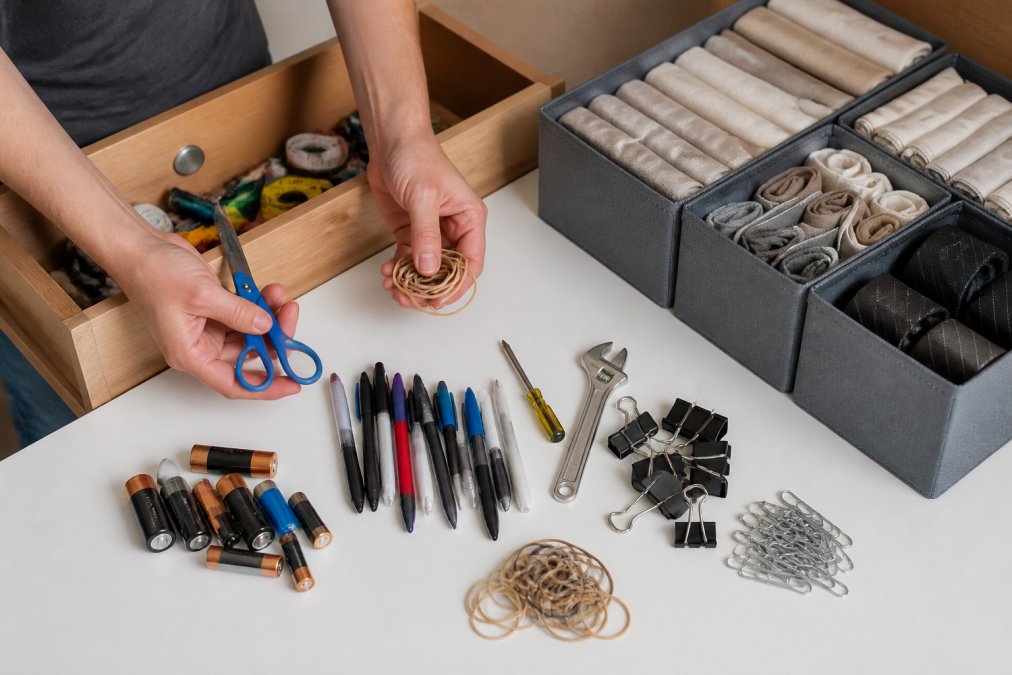
Next, sort into categories. Group similar items together: all batteries in one pile, all writing instruments in another, office supplies together, hardware separate. This reveals patterns in what you actually use and what's just taking up space.
Discard or donate items you don't use. If you haven't reached for it in the past year, it's unlikely you'll need it in the next year. This creates the space you need for items that actually matter.
Measure your drawer dimensions before purchasing organizers. Know the width, depth, and height, and account for any obstacles like pipes under kitchen drawers or uneven bottoms. These details determine whether your organizers will actually work.

Choose the right organizer type for your drawer's contents and dimensions. Shallow drawers benefit from acrylic trays or single-layer dividers. Deep drawers can accommodate stackable solutions or two-tier organizers that maximize vertical space.
Arrange items by frequency of use. Items you reach for daily should be most accessible, typically the front or center of the drawer. Less frequently used items can go toward the back.
Types of Drawer Organizers That Work
The market offers several categories of best drawer organizers for junk drawers, each with specific strengths.
Acrylic Trays and Multi-Compartment Inserts
Acrylic trays offer clear visibility and durable containment. Because they're transparent, you can see exactly what's in each compartment without opening the drawer. Multi-compartment inserts come in fixed configurations or modular systems. Fixed designs work well for standard drawers where you know your categories in advance. Modular compartments let you adjust the layout if your needs change. Acrylic trays typically cost between $15 and $35 depending on size and compartment count.
The strength of acrylic organizers is durability and clarity. They won't degrade over time like some plastic alternatives, and they're easy to clean. The limitation is rigidity, once you've decided on compartment sizes, changing the layout requires buying new trays. Acrylic works best for drawers containing office supplies, hardware, batteries, and other small items that benefit from visual separation.
Adjustable Drawer Dividers for Custom-Fit Storage
Adjustable dividers give you complete control over compartment size. These typically use tension rods or sliding panels that you position to match your specific items. Adjustable dividers range from $20 to $40 depending on the system and work for nearly any drawer depth and width because you customize the fit.
The best use case for adjustable dividers is when you have items of varying sizes or when you're not sure how to organize the space yet. They let you experiment and refine your system over time.
Fabric Organizers and Stackable Solutions
Fabric organizers excel at containing soft items and creating visual separation without the rigidity of acrylic. The Reset Aisle's Fabric Drawer Organizers for Socks & Underwear ($22.99) exemplify this category. Fabric organizers typically cost $15 to $30 and come in various sizes and configurations.
Stackable solutions, whether fabric or plastic, maximize deep drawer space by using vertical height. Two-tier organizers let you store twice as much in the same footprint. Fabric organizers have a limitation: they're less transparent than acrylic, so you lose some visibility. However, this matters less for items you know well. Fabric also handles weight better than some plastic alternatives, making it suitable for drawers holding heavier tools or hardware.
Measuring Your Drawer and Choosing the Right Organizer
The most common reason organizers don't work is a mismatch between the product dimensions and the actual drawer. Measure three things: width, depth, and height using a ruler or tape measure.
Width is straightforward, measure from the inside of the left wall to the inside of the right wall. Depth requires measuring from the front of the drawer to the back, accounting for any slides or mechanisms that reduce usable space. Height is the distance from the bottom to the top, minus any clearance needed for the drawer to close completely.
Check for obstacles that consume space. Kitchen drawers often have pipes or fixtures underneath that reduce usable depth. Bedroom drawers might have uneven bottoms. These obstacles determine which organizers actually fit.
Consider weight capacity if your drawer will hold heavy items like tools. Some plastic organizers can't handle the weight of a full complement of hardware. Acrylic and quality plastic can typically handle 20-30 pounds distributed across compartments (astm.org).
Once you have measurements, compare them to organizer dimensions before purchasing. If dimensions aren't listed, contact the seller for specifics. The best drawer organizers for junk drawers are ones that actually fit your drawer.
Junk Drawer Organization Ideas for Maximum Space
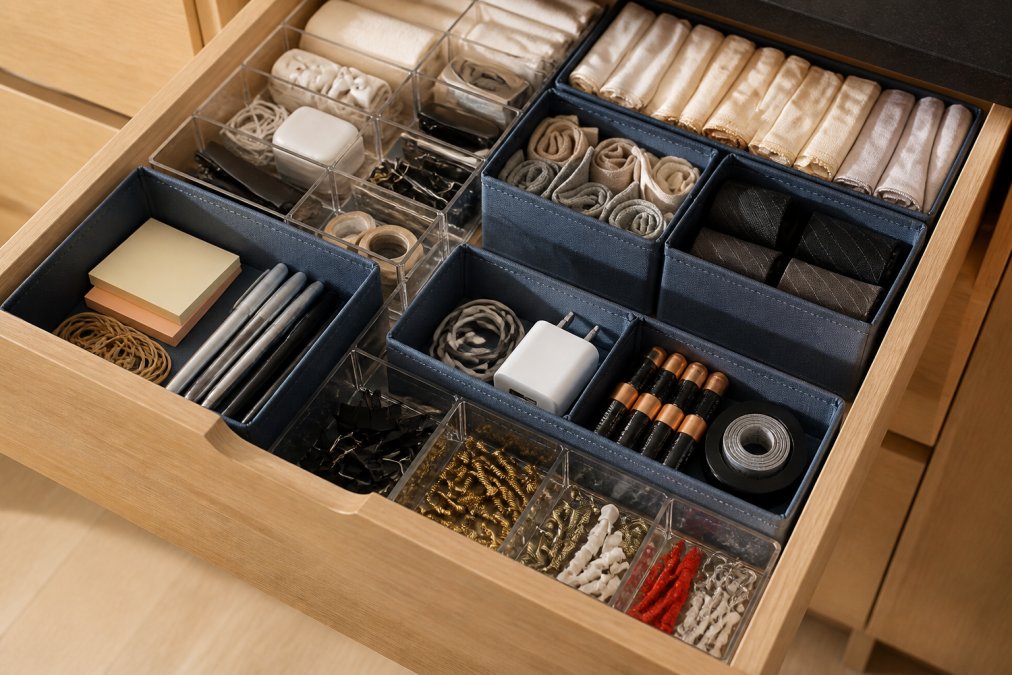
Deep drawers present a specific challenge: they offer vertical space but can become black holes where items disappear. Maximize this space with stackable organizers or two-tier solutions. A two-tier system lets you store items in two layers, effectively doubling your capacity without increasing the drawer's footprint.
Use the front-to-back dimension strategically. Place frequently accessed items toward the front where you can reach them without moving other organizers. Reserve the back for items you use less often.
Create a "miscellaneous" zone for items that don't fit other categories, but be intentional about it. Limit it to a single small compartment. If miscellaneous grows beyond that space, it's a signal that you need to reassess your categories or discard items.
Vertical dividers work well in shallow drawers. Instead of stacking organizers, divide the drawer into sections using adjustable dividers. This approach keeps everything visible and accessible without creating layers that require moving items to find what's underneath.
Consider drawer liners. A non-slip liner prevents organizers from sliding around when you open and close the drawer. Most liners cost $10-20 and last several years.
The Reset Aisle's approach to drawer organization emphasizes making your existing items work better rather than buying more stuff. Before purchasing additional organizers, assess whether your current volume of items actually needs more compartments or whether you simply need better arrangement of what you already have.
Materials That Last: Durability and Maintenance
Acrylic resists degradation better than many plastics. It won't yellow or become brittle with age, and it handles temperature fluctuations without warping. Quality acrylic typically lasts 5+ years with normal use (peer-reviewed research).
Plastic organizers vary widely in quality. Budget plastic can become brittle within 2-3 years, especially in humid environments like kitchens or bathrooms (peer-reviewed research). When evaluating plastic organizers, check the material specification and look for polypropylene or similar durable plastics rather than generic "plastic."
Fabric organizers depend on stitching quality more than material choice. The Reset Aisle's Fabric Drawer Organizers feature high-quality stitching that withstands daily use. Check that seams are reinforced and stitching is tight. Quality fabric organizers last 3-5 years with normal use.
Maintenance affects longevity. Acrylic organizers are easiest to clean, a damp cloth handles most dirt. Plastic organizers can accumulate dust in seams; use a small brush to clean corners. Fabric organizers benefit from occasional vacuuming to remove debris.
Weight capacity matters for durability. Organizers filled beyond their intended capacity can warp or crack. Distribute weight evenly across compartments. If you're storing heavy tools or hardware, choose organizers rated for heavier loads.
Making Organization Stick Long-Term
Organization systems fail not because they're poorly designed but because they're not maintained. The best drawer organizers for junk drawers only work if you consistently put items back in their designated spots.
Start with realistic expectations. A perfectly organized drawer requires ongoing effort. The question isn't whether you'll maintain perfection, you won't. The question is whether your system makes it easy enough that you'll maintain basic order.
Simplify your categories. Too many categories means more decisions every time you put something away. If you have more than 6-8 categories in a single drawer, you're likely overcomplicating things.
Establish a weekly reset. Spend five minutes every Sunday evening returning items to their proper compartments. This small investment prevents the drawer from devolving back into chaos.
Make returning items easier than leaving them out. If your organizer requires removing multiple pieces to access a compartment, people will stop using it. The best system is one where putting items away takes the same effort as leaving them out.
Involve other household members. If you're the only person maintaining the system, it will fail when life gets busy. Explain the system to others and make it simple enough that they can maintain it without detailed instructions.
Review and adjust quarterly. After three months, assess what's working and what isn't. If certain categories consistently overflow while others remain empty, rebalance. Organization systems should evolve with your actual needs.
Conclusion
A junk drawer doesn't have to be a source of daily frustration. The right organizer, combined with a simple maintenance system, transforms it into a functioning storage space where you can find what you need. The best drawer organizers for junk drawers aren't the fanciest ones, they're the ones that match your drawer's dimensions, accommodate your actual items, and fit into a maintenance routine you'll actually follow.
The Reset Aisle's curated organizer collection includes solutions for nearly every junk drawer scenario: the Fabric Drawer Organizers ($22.99) for soft items and delicate storage, along with modular compartment systems that adapt to your specific needs. Start your reset with a clear measurement of your drawer, an honest assessment of what you actually use, and an organizer system that makes putting items back as natural as taking them out. Get started with The Reset Aisle and transform your most chaotic drawer into an organized, functional space.
=== FAQ ANSWERS (audit these too, same rules) ===
[1] Q: What is the best way to organize a junk drawer? A: Start by emptying your drawer completely and sorting items into categories: office supplies, hardware, batteries, and miscellaneous tools. Measure your drawer depth and width, then select organizers that fit your space. Use acrylic trays for small items, adjustable dividers for flexible compartmentalization, and stackable solutions to maximize depth. Group similar items together so everything has a designated spot. This categorization method reduces clutter and makes items easy to find.
[2] Q: How do adjustable drawer dividers help organize a junk drawer? A: Adjustable drawer dividers create custom-fit compartments that adapt to your specific drawer dimensions and item sizes. Unlike fixed organizers, they allow you to reconfigure sections as your storage needs change. Spring-loaded or tension-based dividers prevent items from shifting, and their modular design means you can add or remove dividers without replacing the entire system. This flexibility is especially useful for junk drawers that hold varied items of different sizes.
[3] Q: How do you keep a junk drawer organized long-term? A: Maintain organization by returning items to their designated compartments immediately after use. Set a monthly 10-minute reset to remove expired items, dried-out pens, or broken hardware. Use drawer liners to prevent items from sliding and to make cleanup easier. Establish a rule: if something doesn't belong in the drawer, it goes elsewhere. Consistency matters more than perfection; a system that's 80% maintained beats a perfect system abandoned after a month.
[4] Q: What materials are most durable for drawer organizers? A: Acrylic and high-quality plastic with reinforced edges offer durability for daily use and resist warping. Bamboo and wood organizers provide aesthetic appeal but require more maintenance. Fabric organizers with sturdy internal supports, like those made from polyester blends, handle weight well without tearing. For heavy tools or batteries, choose organizers with weight capacity ratings. Non-slip bases prevent shifting, extending the organizer's lifespan and keeping your drawer stable.
Frequently Asked Questions
What is the best way to organize a junk drawer?
Start by emptying your drawer completely and sorting items into categories: office supplies, hardware, batteries, and miscellaneous tools. Measure your drawer depth and width, then select organizers that fit your space. Use acrylic trays for small items, adjustable dividers for flexible compartmentalization, and stackable solutions to maximize depth. Group similar items together so everything has a designated spot. This categorization method reduces clutter and makes items easy to find.
How do adjustable drawer dividers help organize a junk drawer?
Adjustable drawer dividers create custom-fit compartments that adapt to your specific drawer dimensions and item sizes. Unlike fixed organizers, they allow you to reconfigure sections as your storage needs change. Spring-loaded or tension-based dividers prevent items from shifting, and their modular design means you can add or remove dividers without replacing the entire system. This flexibility is especially useful for junk drawers that hold varied items of different sizes.
How do you keep a junk drawer organized long-term?
Maintain organization by returning items to their designated compartments immediately after use. Set a monthly 10-minute reset to remove expired items, dried-out pens, or broken hardware. Use drawer liners to prevent items from sliding and to make cleanup easier. Establish a rule: if something doesn't belong in the drawer, it goes elsewhere. Consistency matters more than perfection; a system that's 80% maintained beats a perfect system abandoned after a month.
What materials are most durable for drawer organizers?
Acrylic and high-quality plastic with reinforced edges offer durability for daily use and resist warping. Bamboo and wood organizers provide aesthetic appeal but require more maintenance. Fabric organizers with sturdy internal supports, like those made from polyester blends, handle weight well without tearing. For heavy tools or batteries, choose organizers with weight capacity ratings. Non-slip bases prevent shifting, extending the organizer's lifespan and keeping your drawer stable.
This article was written using GrandRanker