

Table of Contents
- Why Home Organization Tools Matter in 2026
- Kitchen and Pantry Organization
- Luxury Closet Organizers for Maximum Space
- Under-Sink Organization and Bathroom Storage
- Smart Home Organization Systems
- Sustainable and Budget-Friendly Organization Hacks
- Organization for Small Spaces and Neurodivergent Needs
- Maintenance and Decluttering Routines That Stick
Why Home Organization Tools Matter in 2026
Clutter drains mental energy and physical space (peer-reviewed research). When your pantry is jumbled, your closet overcrowded, and your under-sink cabinet chaotic, you're not just wasting time searching, you're living with constant low-level stress that compounds over months and years.
Modern home organization tools address real friction points: awkward cabinet layouts, deep shelves that hide items, closets that don't maximize vertical space, and drawers that become catch-alls. The Reset Aisle offers a curated selection of products designed to solve them systematically.
What separates effective organization from temporary fixes is this: you need tools that work WITH your existing space, not against it. A rotating spice rack doesn't require kitchen renovation. A space-saving pant hanger doesn't demand closet overhaul. These targeted interventions create immediate wins that compound. Once you see what's possible in one area, you're motivated to tackle the next.

Below, we'll walk you through modern home organization tools that actually stick, from kitchen and pantry solutions to closet optimization, bathroom storage, and systems designed for small spaces and neurodivergent needs. We'll also cover maintenance routines that keep organized spaces from sliding back into chaos.
Kitchen and Pantry Organization
A functional pantry saves time and reduces food waste. The problem most people face is visibility and accessibility, items get lost in the back, duplicates accumulate because you forgot what you had, and spices expire unopened because you couldn't see them.
Double-Layer Rotating Spice Rack
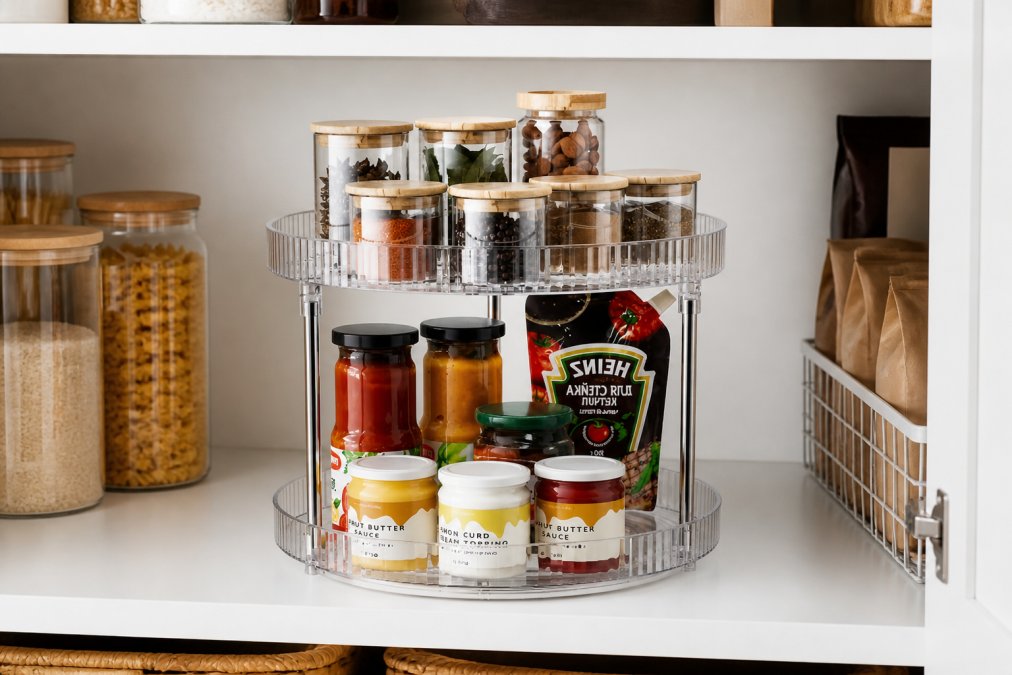
Reaching for paprika and knocking over cumin is a sign your spice storage needs a rethink. The Double-Layer Rotating Spice Rack solves this with a 360-degree turntable that brings every jar to you instead of forcing you to dig through a cabinet.
The two-tier design brings back-row jars front-and-center when you spin it. A cabinet shelf that held twelve jars in a jumbled mess now holds them organized and visible in one footprint. At $24.99, it's a targeted fix for one of the most frustrating kitchen storage problems.
What works: The free-standing design means no drilling or mounting hardware. It sits on a countertop, inside a cabinet, or in the pantry. The clear plastic construction lets you see every jar at a glance.
What to watch for: If your cabinet shelves are very shallow (under 8 inches deep), measure before ordering. The rotating base needs clearance to spin fully.
The Kitchen Reset Bundle
If your kitchen has two major clutter zones, the spice cabinet and the under-sink chaos, The Reset Aisle created a bundle that handles both in one afternoon. The Kitchen Reset ($52.99) pairs the Double-Layer Rotating Spice Rack with the Under Sink Organizer with Sliding Shelves, priced below buying them separately.

The under-sink component transforms that tangle of pipes and cleaning supplies into usable, pull-out storage. Sliding shelves make it easy to access items in the back without unloading everything in front.
What works: The bundle pricing saves money. The two-piece design of the under-sink organizer lets you customize how you use the space. The vertical design maximizes a notoriously wasted space.
What to watch for: Measure your under-sink cabinet depth and the space around your pipes. The organizer is designed for standard configurations, but unusual plumbing layouts may require adjustment.
Luxury Closet Organizers for Maximum Space
Your closet is either your most efficient room or your biggest daily frustration. Most people sacrifice hanging space to accommodate too many pants on individual hangers, leaving drawers a chaotic jumble of socks and underwear.
Space Saving Pant Hanger
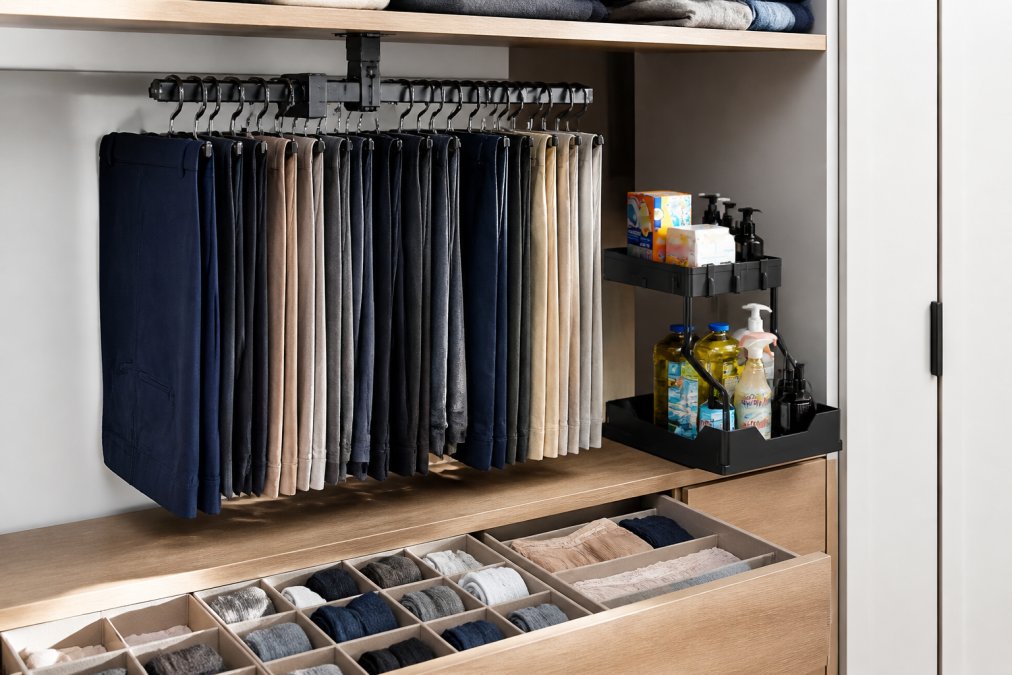
Leggings and pants consume disproportionate closet real estate. Five separate hangers hold what one well-designed hanger can manage. The Space Saving Pant Hanger holds 40 pairs using 10 strong clips, reclaiming the rod space five standard hangers used to occupy.

At $19.99, this is a high-impact, low-cost intervention. The clips are strong enough for repeated use and accommodate everything from lightweight leggings to denim.
What works: The immediate space gain is visible. You'll have room on your closet rod for other items. The clips don't leave marks on most fabrics.
What to watch for: Heavier fabrics like wool trousers may slide slightly if bumped. Rotating your pants periodically prevents any single pair from bearing too much weight.
Fabric Drawer Organizers
Drawer dividers prevent chaos when socks, underwear, bras, and ties share the same space. The Fabric Drawer Organizers come as a set of three, each designed to hold a specific category of items without taking up extra drawer space.
At $22.99 for the set, these organizers use high-quality polyester with durable internal supports that keep their shape through daily use. The sectioned compartments mean you can find what you need without sorting through a tangled pile.
What works: Premium stitching ensures durability. They're foldable and collapsible for flat storage. The compartments are sized intuitively.
What to watch for: These organizers work best in standard-depth drawers (4-6 inches). Very shallow drawers may not accommodate the full height.
The Closet Reset Bundle
The Closet Reset ($56.99) bundles the Space Saving Pant Hanger with two Fabric Drawer Organizers. It's designed as a complete closet intervention: more hanging space on top, organized drawers below.
What works: The bundle pricing is better than buying components separately. The combination solves two distinct problems in one coordinated system.
What to watch for: The bundle assumes you have drawer space available. If your closet is all hanging and no drawers, the pant hanger alone may be your better choice.
Under-Sink Organization and Bathroom Storage
Under-sink cabinets are universally problematic. Pipes create awkward angles, water damage is a constant risk, and the space somehow manages to be both cramped and wasteful.
The Under Sink Organizer with Sliding Shelves transforms this space into functional storage. At $34.99, it's a targeted solution for a universal problem. The two-piece design with sliding shelves means you can access items in the back without unloading everything in front.
The vertical design maximizes what's typically a wasted space. Cleaning supplies, bathroom toiletries, and housekeeping items each get a designated shelf. The sturdy metal frame and plastic storage baskets withstand the moisture and daily use that characterizes under-sink environments.
What works: The sliding shelves let you pull out items without disturbing the rest. The design fits most standard sink configurations. The vertical space optimization is significant compared to stacking bottles on the cabinet floor.
What to watch for: Measure your under-sink cabinet around the pipes. The organizer is designed for standard plumbing, but unusual configurations may require customization. Keep heavier bottles on the lower shelf to maintain balance.
Bathroom storage follows the same principle: maximize vertical space and create zones for different categories. Drawer dividers in bathroom vanities prevent medicine cabinet chaos. Over-the-toilet shelving adds storage without taking up floor space. Wall-mounted organizers keep frequently used items at arm's reach while keeping countertops clear.
The goal is visibility and accessibility. When you can see what you have, you use it. When items are organized by category, you find them without searching.
Smart Home Organization Systems
Organization systems that integrate across multiple rooms create consistency and reduce decision fatigue. Instead of solving the pantry in isolation, then the closet separately, then the bathroom, you're building a cohesive approach to how your home functions.
Smart systems start with assessment: what are your actual pain points? For many people, it's not the whole house, it's three specific areas where clutter accumulates fastest. Identifying those zones lets you prioritize your effort and investment.
The Reset Aisle approach focuses on solving those high-impact areas first. The Kitchen Reset and Closet Reset bundles tackle the two worst clutter zones in those rooms with coordinated tools. Once those spaces are working, maintaining them becomes easier, and you develop momentum to address other areas.
Labeling and identification systems are part of smart organization. Clear labels on containers mean everyone in your household knows what belongs where. This prevents the "I forgot what this was supposed to hold" problem that causes organized spaces to slide back into chaos.
Smart systems also include maintenance routines. Organization doesn't stick without a decluttering schedule. The difference between temporary organization and lasting change is a simple routine: a monthly 15-minute reset of each major area, a quarterly deep declutter, and a yearly assessment of what's actually working.
Sustainable and Budget-Friendly Organization Hacks
Not every organization solution requires buying new products. Many of the most effective hacks use items you already have or can source affordably.
Glass jars from pasta sauce, jam, or other products become excellent pantry storage containers. They're free, transparent, and durable. Stack them on your shelves and label them with a permanent marker or adhesive labels.
Drawer dividers can be DIY creations. Cardboard boxes cut to size and arranged in your drawers create the same compartmentalization as commercial organizers.
Vertical space optimization doesn't always require new tools. Shelf risers, even simple wood blocks or stacked books, double your usable shelf space. Tension rods inside cabinets create additional hanging space for spray bottles or bags.
The sustainable angle matters increasingly. Plastic organizers work, but they contribute to landfill waste. Natural materials like wood, canvas, and metal have longer lifespans and are easier to repurpose or recycle. The Fabric Drawer Organizers from The Reset Aisle use polyester and durable internal supports that last for years, reducing the need to replace them frequently.
Budget-friendly organization starts with using what you have. Before buying new storage, declutter ruthlessly. The best storage solution is not needing to store it in the first place. When you do invest in organization tools, prioritize the areas where clutter causes the most daily friction.
Organization for Small Spaces and Neurodivergent Needs
Small-space organization requires a different mindset. You can't spread things out. Every item needs to earn its space through regular use. Vertical organization becomes essential rather than optional.
Wall-mounted storage, under-bed containers, and stackable solutions are non-negotiable in small spaces. The Space Saving Pant Hanger is particularly valuable here, reclaiming closet rod space in rooms where closet space is already constrained. The Under Sink Organizer with Sliding Shelves transforms a small bathroom's under-sink cabinet from a black hole into usable storage.
Modular bins and stackable containers let you customize storage to fit odd-shaped spaces. Clear containers are essential in small spaces, you need to see what's inside without opening everything (apa.org).
Organization for neurodivergent needs prioritizes visibility and accessibility over aesthetics (peer-reviewed research). Everything should be in your line of sight, not hidden in drawers or behind cabinet doors. Items you use daily should require minimal steps to access.
Labeling becomes critical. Detailed, specific labels (not just "office supplies" but "pens," "notepads," "tape") reduce decision-making friction. Color-coding by category helps people quickly identify where things belong. Duplicate storage in multiple locations prevents the "I know I have it somewhere" problem.
Clear containers are non-negotiable. Opaque storage means you forget what's inside. The Fabric Drawer Organizers have the advantage of being semi-transparent, letting you see what's in each section without opening them.
Reduce decision-making at decision points. If you have to think about where something belongs, you'll put it down somewhere convenient instead. One-step returns, where the item's home is obvious and accessible, work better than complex systems.
Maintenance and Decluttering Routines That Stick
Organization fails when maintenance stops. The difference between a home that stays organized and one that gradually reverts to chaos is a simple routine.
A weekly 10-minute reset works better than waiting for a crisis. Sunday evening, spend 10 minutes putting things back where they belong. This prevents small messes from becoming big ones.
A monthly 30-minute deep reset targets one area. Month one: kitchen. Month two: bedroom. Month three: bathroom. This rotation ensures every major area gets attention regularly without overwhelming you.
A quarterly declutter removes items that aren't serving you. Every three months, spend an hour going through one category. Look for duplicates, expired items, and things you haven't used since the last declutter.
The yearly assessment happens once a year. Look at your entire organization system. What's working? What's not? What areas have reverted to chaos? Use this information to adjust your approach the next year.
Decluttering before organizing is essential. You can't organize your way out of too much stuff. The only solution is removing items you don't use, don't like, or don't need.
The key is consistency. A routine you can sustain beats a perfect system you'll abandon after a month. Start small with a weekly 10-minute reset and build from there. Once that becomes habit, add the monthly reset. Once both are automatic, add the quarterly declutter. This gradual approach creates lasting change instead of temporary organization that falls apart.
Getting organized is straightforward when you have the right tools and a system that actually works for your lifestyle. The Reset Aisle has built a curated selection of home organization products specifically designed to solve the high-impact clutter problems that waste your time and mental energy every day. Start with your biggest pain point, whether that's your pantry, closet, or under-sink cabinet, and watch how one solved area motivates the next. Start Your Reset with tools built to keep your home neat, provide space-saving storage, and bring control back to cluttered spaces.
Frequently Asked Questions
What are the top home organization trends for 2026?
The biggest trends focus on space optimization, minimalist storage, and functional design. Vertical space utilization, modular bins, and aesthetic organization systems dominate. Sustainable materials and personalized organization for neurodivergent needs are also gaining traction. Tools like rotating storage racks, drawer dividers, and under-bed organizers help maximize existing space while keeping items visible and accessible. The shift emphasizes making your current belongings work harder rather than buying more storage.
How do smart home organization systems reduce daily overwhelm?
Smart organization systems combine visual clarity with easy access. Rotating turntables bring items to you instead of requiring digging. Labeled containers and drawer dividers create clear categories so you know exactly where everything is. Sliding shelves and stackable containers optimize vertical space. When everything has a designated spot and is visible, decision fatigue drops. You spend less time searching and more time on what matters. Systems designed for your specific lifestyle (small spaces, busy households, or neurodivergent needs) prevent clutter from building back up.
Are luxury closet organizers worth the investment compared to budget options?
Quality closet organizers deliver durability and function that budget alternatives often lack. A space-saving pant hanger rated for 40 pairs with strong clips prevents sagging and damage to clothing. High-quality fabric drawer organizers with reinforced stitching maintain their shape through years of daily use. The cost difference is typically small (often $20-60 per tool), but the longevity means you're not replacing failed systems repeatedly. For busy households and remote workers who use these daily, the investment pays for itself in time saved and frustration avoided.
How can I organize a small space or oddly shaped closet effectively?
Vertical space is your best friend in small areas. Use wall-mounted shelves, over-door organizers, and hanging solutions to keep floor space clear. Slim hangers and multi-clip pants hangers reclaim significant rod space. Drawer dividers and fabric organizers maximize drawer depth without wasting corners. Rotating turntables fit in tight cabinet spaces and eliminate the need to reach to the back. For slanted ceilings or irregular shapes, measure carefully before buying. Modular, adjustable systems work better than fixed solutions because you can customize them to your exact dimensions.
What's the best way to maintain organization so it doesn't slip back into chaos?
Maintenance routines are the difference between organization that sticks and organization that fails. Set a weekly 15-minute tidying block to return items to their designated spots. Monthly, review what's actually being used and remove expired or unused items. Label everything clearly so household members know where things belong. Create a home inventory system (even a simple spreadsheet) to track pantry staples and prevent duplicates. The key is making it easy to put things back in the right place. When your system matches how you actually live, not how you think you should live, maintenance becomes automatic rather than overwhelming.
This article was written using GrandRanker