

Table of Contents
- Why Closet Organization Matters More Than You Think
- Small Closet Storage Solutions: The Decluttering Foundation
- Vertical Closet Organization Hacks for Maximum Capacity
- How to Organize a Small Reach-In Closet Without Renovation
- Smart Hanger Upgrades and Drawer Organization
- Off-Season Clothing Storage and Inventory Management
- Budget-Specific Strategies for Every Closet Size
- Making Organization Stick: Long-Term Maintenance
Last Updated: August 25, 2026
Why Closet Organization Matters More Than You Think
A disorganized closet isn't just an aesthetic problem, it's a daily friction point that drains mental energy before you leave the house. When you can't find what you need, you waste time. When you can't see what you own, you buy duplicates. When everything's crammed together, nothing lasts as long. The real cost of a messy closet is the cumulative effect of those small decisions made under pressure every morning.
Space-saving closet organization ideas are practical tools that make your existing wardrobe work harder for you. Whether you're living in a compact apartment or managing a reach-in closet that feels impossibly small, the strategies that follow will show you how to reclaim functionality without renovation, without drilling holes, and without spending a fortune.
Small Closet Storage Solutions: The Decluttering Foundation
Before you buy a single organizer, you need to make space for organization to work. Most people add storage systems to an overstuffed closet and wonder why nothing improves. The answer is simple: you can't organize what you don't need.
Decluttering isn't about becoming a minimalist. It's about keeping only what serves you right now. Clothes that don't fit, styles you've outgrown, or pieces that never quite work with anything else are taking up real estate that your actual wardrobe needs.
The Psychology of Letting Go
The hardest part of decluttering is managing the guilt and "what-if" thinking that holds you back. The key is separating emotion from utility. Ask yourself: Have I worn this in the past year? Does it fit me now? Do I feel good in it? If the answer is no, it's taking up space that could go to something you actually use. Keeping something "just in case" is actually costing you, every item you're unsure about makes it harder to see and access the pieces you love.
The Four-Box Method for Quick Decisions
Use four boxes: Keep, Donate, Sell, and Relocate. Keep holds items you wear regularly and love. Donate is for anything still in good condition but no longer serving you. Sell works for higher-quality pieces with resale value using apps like Poshmark or Depop. Relocate is for seasonal items or specialty pieces that belong elsewhere.
This method works because it removes the pressure of making one right choice. Most people complete this process for a full closet, resulting in immediate visibility into what you actually own.
Vertical Closet Organization Hacks for Maximum Capacity
Most closets waste enormous amounts of vertical real estate. The wall above hanging clothes, the gap between shelves, and the rod itself are all opportunities. Vertical storage multiplies your usable space by stacking and layering strategically.
Tension Rods and Multi-Tier Hanging Systems
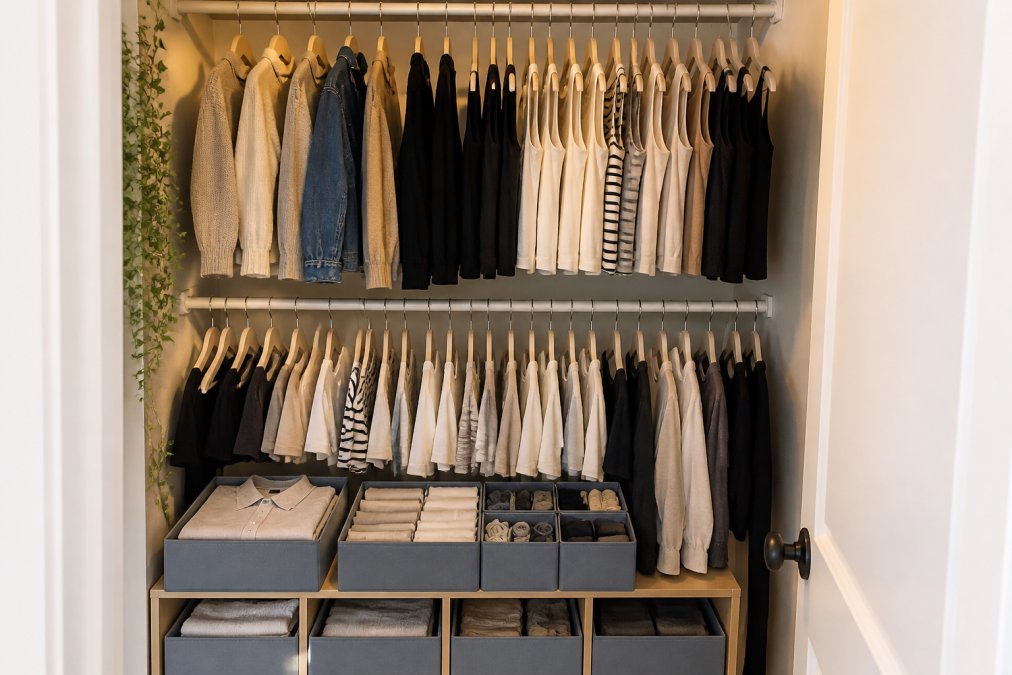
A single closet rod is a massive constraint. Add a second rod 18-24 inches below the first, and you've instantly doubled your hanging capacity in that same footprint. Tension rods are rental-friendly, require no permanent installation, and cost under $20.
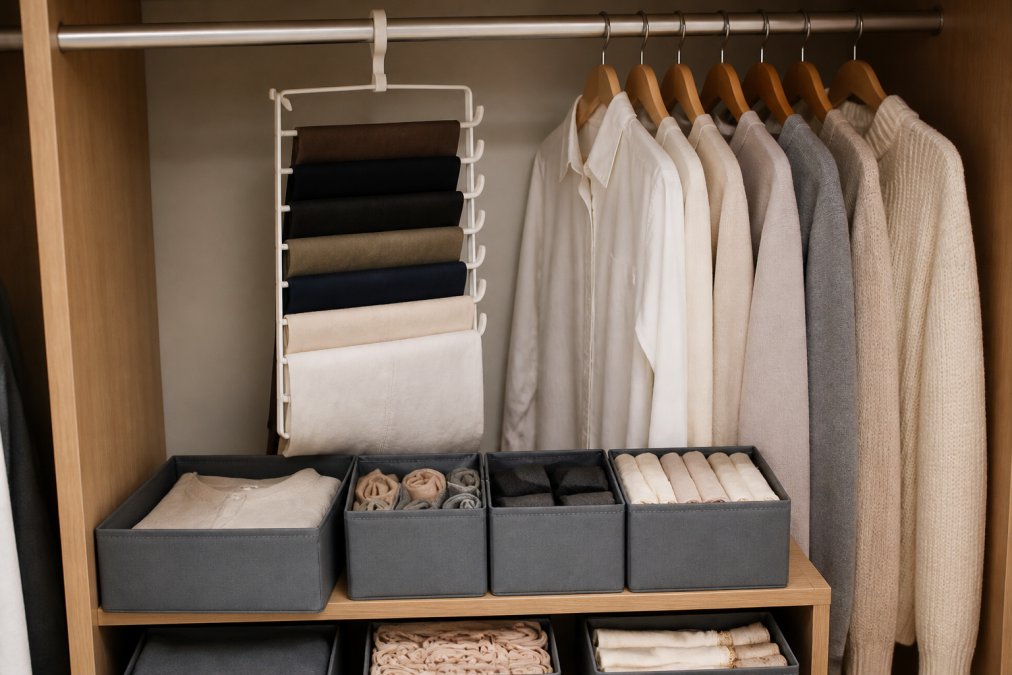
Multi-tier hanger systems are another option. A space-saving pant hanger holds up to 40 pairs of pants or leggings on 10 strong clips, the space of a single hanger but reclaiming the rod space five separate hangers would use. Over a full closet, that's a significant gain.

Wall-Mounted Shelving and Over-the-Door Storage
Wall-mounted shelves hold folded items, boxes of off-season pieces, or accessories without taking up floor space. For renters, floating shelves with no-drill adhesive strips are available, though they work best for lighter loads.
Over-the-door storage uses typically wasted space. Shoe organizers, hanging organizers with clear pockets, or simple hooks turn that door into prime real estate for scarves, belts, bags, or additional hanging items. Don't overcrowd these spaces, use 70% of available space and keep items visible and reachable.
How to Organize a Small Reach-In Closet Without Renovation
A reach-in closet presents specific challenges due to limited depth and height. The foundation is editing ruthlessly, in a reach-in closet, every item needs to earn its space. Once you've done that, focus on density without chaos.
Rental-Friendly Hacks That Don't Require Drilling
Tension rods fit snugly between side walls and double your hanging capacity. Freestanding shelving units hold folded items, boxes, or additional hanging space and are portable. Over-the-door organizers and adhesive hooks add storage without permanent installation.
Custom Configuration for Awkward Spaces
Not all closets are rectangular boxes. Some have slanted ceilings, odd corners, or unusual depth variations. Start by measuring the actual usable space in different areas. A slanted ceiling might limit hanging height on one side but accommodate tall items on the other.
Think in layers. Instead of fitting one perfect system, build a custom configuration using multiple small solutions. A tension rod in one area, a shelf in another, hooks on the wall, and an over-the-door organizer combine to create a system that actually fits your space.
Smart Hanger Upgrades and Drawer Organization
Hangers and drawers are where most closet organization actually happens. Standard wire hangers are the enemy of organization, they're thin, they slip, and they encourage cramming. Slim hangers are a simple upgrade that immediately makes a closet feel less cluttered and fit more items on the rod.
Space-Saving Hangers That Hold More
The most efficient hangers hold multiple items in the space of one. Multi-clip hangers, pant hangers with tiered clips, and cascading hangers work on this principle. The Space Saving Pant Hanger from The Reset Aisle holds 40 pairs of pants or leggings on 10 strong clips. Instead of 40 individual hangers taking up 40 inches of rod space, one hanger uses 1 inch. For other items like tank tops or scarves, a cascading hanger holds 5-7 items in the space of one.
Drawer Dividers and Fabric Organizers
Drawers are where small items disappear. Drawer dividers create compartments so socks, underwear, bras, ties, and scarves each get their own space instead of one tangled pile. Fabric organizers are particularly effective because they're flexible, they stack, and they're not permanent. The Fabric Drawer Organizers from The Reset Aisle are designed specifically for this, with high-quality stitching and sectioned compartments. When items are organized into categories, you actually use them more consistently and rotate through your full inventory, which extends the life of everything.
Off-Season Clothing Storage and Inventory Management
Off-season clothes are taking up valuable real estate in your closet. Moving them out immediately frees up space for what you're actually wearing. Use clear storage boxes so you can see what's inside without opening them, and label them clearly. Take a quick photo or note what's in each box to prevent buying duplicates and help you rotate items seasonally.
Budget-Specific Strategies for Every Closet Size
Organization doesn't require a big budget, but strategy matters.
Under $50: Essential Basics
Focus on the highest-impact items. Slim hangers cost $15-25 for a pack of 50 and immediately improve functionality. A tension rod costs under $20 and instantly doubles hanging capacity. Adhesive hooks for over-the-door storage run $10-15 for a set. Together, these three items cost under $50 and solve the biggest problems in most small closets.
$50-$150: Complete System Approach
Start with slim hangers and a tension rod (about $35-40 combined). Add fabric drawer organizers ($22.99) to handle small items. Invest in an over-the-door organizer ($15-25) for additional storage space.
The Reset Aisle's Closet Reset bundle combines the Space Saving Pant Hanger and Fabric Drawer Organizers for $56.99, a complete solution that addresses both hanging and drawer organization. Thoughtful, incremental investment beats buying a bunch of cheap organizers that don't solve anything.
Making Organization Stick: Long-Term Maintenance
Organization is not a one-time project, it's a system you maintain. Most people organize their closet, feel great for a month, and watch it slowly slip back into chaos. The difference is maintenance habits, not willpower.
Start with a simple rule: one in, one out. When you buy something new, something similar leaves. This prevents creep and forces intentionality about new purchases. Spend 5 minutes every Sunday resetting your closet, hangers back to uniform direction, drawer organizers straightened, items returned to their designated spots. Every 3 months, spend 30 minutes checking that your system is still working and make small adjustments to prevent big problems.
An organized space reinforces organized behavior. When you open your closet and everything is visible, accessible, and intentional, you're more likely to keep it that way.
Closet organization isn't about perfection or minimalism or spending a lot of money. It's about making your existing wardrobe work harder for you and making daily decisions easier. Start with The Closet Reset bundle or individual pieces like the Space Saving Pant Hanger and Fabric Drawer Organizers. These tools solve real problems in real closets. Your organized closet starts with editing ruthlessly, then using space intelligently. Start Your Reset.

| Strategy | Best For | Time Investment | Cost |
|---|---|---|---|
| Decluttering (Four-Box Method) | Editing down to pieces you wear | 2-4 hours | $0 |
| Tension Rod Installation | Adding a second hanging tier | 15 minutes | $15-25 |
| Slim Hangers | Maximizing rod capacity | 30 minutes to swap | $15-25 for 50 |
| Space-Saving Pant Hanger | Consolidating pants and leggings | 5 minutes | $19.99 |
| Fabric Drawer Organizers | Organizing small items | 10 minutes | $22.99 per set |
| Over-the-Door Storage | Using vertical wall space | 10 minutes | $15-25 |
| Off-Season Storage | Freeing up active closet space | 1-2 hours | $20-40 |
EXTERNAL SOURCES FOR CREDIBILITY:
Research from the American Psychological Association on decision fatigue shows that decision fatigue compounds throughout the day, which explains why morning closet choices often default to chaos or repetition.
The National Association of Professional Organizers emphasizes that sustainable organization relies on systems that require minimal ongoing effort, which is why maintenance habits matter more than initial setup.
According to the Journal of Environmental Psychology research on organized spaces, visual clutter in personal spaces directly impacts stress levels and decision-making quality, reinforcing why closet organization has real psychological benefits beyond convenience.
Frequently Asked Questions
Q: What's the best way to organize a closet for more space?
A: Start by decluttering ruthlessly, remove items you haven't worn in a year. Then maximize vertical space with tension rods, stackable organizers, and slim hangers. Use drawer dividers to eliminate wasted space underneath, and consider multi-tier hanging systems to double your rod capacity. The Space Saving Pant Hanger ($19.99) alone reclaims the space five regular hangers use by holding 40 pairs on a single rod. Pair it with Fabric Drawer Organizers ($22.99) to contain socks, underwear, and accessories without visual clutter.
Q: How do I declutter a closet before organizing it?
A: Use the four-box method: keep, donate, sell, and trash. Be honest about what you actually wear. If you haven't touched it in 12 months and it doesn't fit or make you feel confident, it's taking up valuable real estate. This psychological shift, recognizing that empty space is more valuable than unused items, is the foundation of sustainable organization. Once you've purged, you'll be amazed how much space emerges without buying a single organizer.
Q: What are the best closet organizers for small spaces?
A: For small closets, prioritize vertical storage and multi-functional pieces. Space-saving hangers with clips, tension rods for secondary hanging, and stackable fabric organizers deliver the most impact per square inch. The Closet Reset bundle ($56.99) combines a 40-pair pant hanger with two drawer organizers, a proven system for reach-in closets. Avoid oversized bins and single-purpose items; instead, choose modular storage that adapts to your exact shelf heights and drawer dimensions.
Q: How can I organize a small reach-in closet without drilling holes or making permanent changes?
A: Tension rods, over-the-door hooks, adhesive shelf liners, and freestanding shelving units work brilliantly in rental closets. Command hooks and damage-free hanging systems let you add vertical storage without landlord concerns. Fabric drawer organizers and stackable bins sit flat on existing shelves, and slim hangers maximize rod space without installation. This approach gives you 70% of the benefit of a custom closet system at a fraction of the cost and commitment.
This article was written using GrandRanker