

Last Updated: October 27, 2026
Quick Summary
To organize LEGO bricks, pick one sorting method that matches how your family builds: color for toddlers and small collections, shape for free-builders, or set for collectors who rebuild. Start with a few broad groups, containerize them in clear bins with snap-on lids, and label each bin with a picture. Split any bin further only after two weeks of use shows it has become hard to search.
- Sorting too finely at the start can make a system harder to use, so begin with a few groups.
- Color sorting is easiest to teach but slows hunts for a specific piece.
- Set sorting needs one container per set and slows free-building.
- Label bins with pictures, since a photo beats a word for pre-readers.
- Keep small-part bins out of reach of toddlers using a high shelf or locked cabinet.
Table of Contents
- Why a Sorting System Beats a Big Bin
- How to Sort LEGO Bricks: Choosing Your Method
- Picking LEGO Storage Containers That Actually Work
- Small Toy Storage Ideas for Everything Else
- LEGO Organization for Kids: Making It Stick
- Keeping Sets, Minifigures, and Small Parts Together
- Setting Up Your Play Space and Cleanup Routine
- Start Your Reset: Build Your Sorting Setup This Weekend
- Frequently Asked Questions
Why a Sorting System Beats a Big Bin
A sorting system beats a big bin because it helps you organize LEGO bricks so every piece is findable in seconds, and findable toys get played with. A single bin turns a collection into a lucky dip. Kids dig, give up, and wander off.
Here is the core idea that runs through this whole guide. You are not storing toys. You are building a retrieval system your kids can run without you.
The Consumer Product Safety Commission's guidance on toy storage and safety makes one point plain: safe, accessible storage keeps small parts out of the wrong hands and off the floor. A bin does neither.
How to Sort LEGO Bricks: Choosing Your Method
The best sorting method for LEGO bricks depends on how your family builds, how old your kids are, and how big the collection has grown. There is no universal answer, and anyone who tells you otherwise has not met your kids. Pick the method that matches how the bricks get used, not how they look on a shelf.
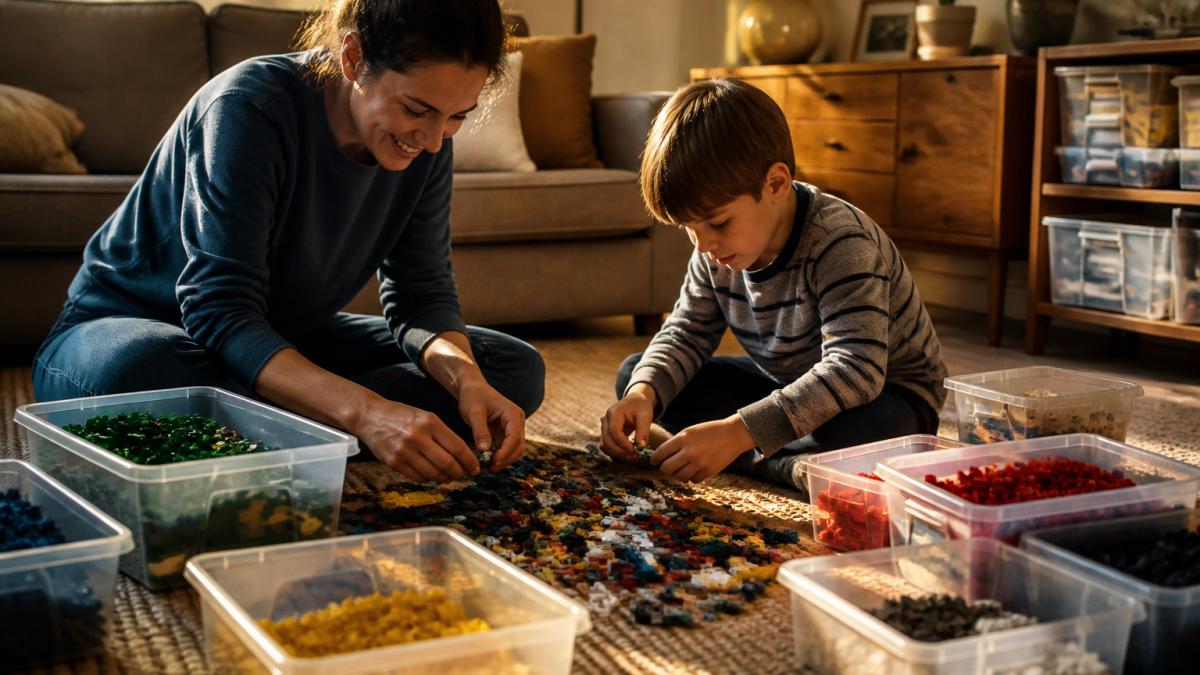
Here is a decision guide. Answer honestly.
| If your family... | Sort by | Why it works | Watch out for |
|---|---|---|---|
| Follows instructions and rebuilds sets | Set | Keeps each build complete and easy to find | Space cost: one container per set |
| Free-builds and invents constantly | Color or shape | Fast to scan, fast to dump back | Color sorting slows specific-piece hunts |
| Has a huge mixed collection | Shape, then color | Breaks the pile into workable groups | Setup time is high; start with broad shapes |
| Has young kids who lose interest fast | Color, big bins | Simple enough for a toddler to use | Fine sorting gets abandoned quickly |
| Wants display plus play | Set, with a display shelf | Protects finished builds from the bin | Display space competes with play space |
Sorting too finely at the start can make a system harder to use. Start with a few groups and split further only when a group gets hard to search.
Sorting by Color, Shape, or Set
Color sorting is the easiest to teach and the fastest to maintain. Kids can do it alone from a young age. The trade-off: a sea of one color makes finding a specific piece slow.
Shape sorting suits builders who hunt for a particular element. Wheels here, plates there, technic pins in their own tray. It takes more setup but pays off in speed.
Set sorting is the collector's method. Each set gets its own bag or box, ideally with the instructions tucked inside. It protects value and makes rebuilding possible. The cost is space, since you need a container per set. It also slows free-building because pieces are locked inside set bags.
A Step-by-Step Process for Sorting an Existing Collection
If you already have a mixed pile, do not try to sort it in one sitting. Use this sequence:
- Dump and screen. Spread everything on a sheet or mat. Pull out non-LEGO items, trash, and broken pieces first.
- Separate by broad type. Make three or four piles: bricks, plates, specialty pieces, and minifigures/accessories. This is the only pass that needs to be thorough.
- Pick your primary method. Use the table above. Commit to one method for the first pass rather than mixing systems.
- Containerize. Move each pile into a clear container with a snap-on lid. Leave one "miscellaneous" bin for pieces you cannot classify yet.
- Label as you go. A picture label beats a word for pre-readers. Label the lid and the side so the bin is identifiable whether stacked or shelved.
- Refine later. After two weeks of use, split any bin that has become hard to search. Do not split preemptively.
Matching the Method to Age and Collection Size
Age and volume change the right answer more than anything else.
- Toddlers and preschoolers (roughly ages 2-4): color sorting with large bins and picture labels. Keep small parts out of reach entirely; see the safety notes below.
- Early elementary (roughly ages 5-7): color or broad shape sorting. The goal is a system a child can run alone, not a perfect taxonomy.
- Older kids and teens: shape or set sorting, depending on whether they rebuild sets or free-build. Let them choose; ownership drives maintenance.
- Small collections (a few hundred pieces): one or two bins may be enough. Over-sorting a small collection creates more work than it saves.
- Large collections (many thousands of pieces): shape first, then color within the most-used shape family. Set sorting becomes impractical unless the collection is mostly display sets.
Picking LEGO Storage Containers That Actually Work
Good LEGO storage containers share four traits: clear sides, snap-on lids, stackable shapes, and a size a child can lift. Everything else is decoration. If you want a deeper look at materials before you buy, our guide to eco friendly toy storage bin materials covers the options in detail.
Clear containers can make it easier to see what is inside without opening them. Shoe boxes and drawers are other options to consider.
Consider whether a child can lift a full container. Choose a size they can carry comfortably.
Small Toy Storage Ideas for Everything Else
Small toys beyond LEGO bricks need the same treatment: group, contain, label. The categories change, the logic does not. Think cars, figures, doll clothes, craft bits, and the endless small parts that migrate across the floor. Most storage guides stop at bricks; the broader keyword covers the whole small-toy ecosystem, so this section handles the rest.
Sort by Play Pattern, Not by Type
Sort these by play pattern rather than type. If the cars and the road mat get used together, store them together. If the doll clothes only come out with the doll, they belong in the same box. A bin that matches a play scenario gets used; a bin that matches a product category gets ignored.
A few patterns that hold up:
- Shallow trays for figures and mini figures, so nothing gets buried.
- A lidded box per craft type, kept on a high shelf.
- A "miscellaneous" bin that gets sorted once a month.
- Wall hooks for dress-up and bags, off the floor entirely.
- Divided boxes for tiny parts (beads, game pieces, doll shoes) so they stay visible and contained.
Combining Bricks With Other Small Toys
When bricks live alongside other small toys, the risk is cross-contamination: a doll shoe in the LEGO bin, a technic pin in the craft box. Two habits prevent it:
- Give each toy family its own container color or label icon. A picture of a car on the car bin is faster than reading a word.
- Keep a "return to owner" tray. Anything found in the wrong bin goes there and gets re-sorted during the weekly reset.
If space is tight, stack small-toy bins on a low shelf and keep the most-used bins at kid height. An under bed shoe storage organizer offers another spot for toys and small items out of the way. Less-used items go higher, not out of the room. Vacuum storage bags offer a space-saving way to store bulky soft toys and clutter.
Safety and Age-Appropriate Storage
Small toys and small parts are a choking hazard for children under three (Small Parts Ban and Choking Hazard Labeling). The Consumer Product Safety Commission's guidance on small parts and choking hazards is the reference to check before buying any container. Practical rules:
- Keep small-part bins out of reach of toddlers. Use a high shelf or a locked cabinet for anything that fits through a toilet-paper tube.
- Choose snap-on lids over loose lids. A loose lid on a tipped bin spills small parts onto the floor where a toddler can find them.
- Label hazards, not just contents. A simple "small parts" icon on the bin helps older family members remember to keep it elevated.
- Check bins for sharp edges and flimsy hinges. Inexpensive containers sometimes fail at the hinge, which is where small parts escape.
LEGO Organization for Kids: Making It Stick
A system may be easier for kids to use when it has labels they can read, bins they can reach, and rules simple enough to remember.
Try these moves:
- Label with pictures. A photo of the contents beats a word for pre-readers.
- Put bins at kid height. If it needs a stool, it will not get used.
- Set a two-minute rule. Quick tidy at the end of play, not a big weekend event.
- Let them choose the colors. Ownership beats perfection.
Keeping Sets, Minifigures, and Small Parts Together
Keeping sets together comes down to one habit: a home for every set before it gets opened. Bag the pieces, box the bag, and file the instructions with it. Minifigures deserve their own small tray or divided box so they do not vanish into the general pile.
Small parts are the real risk. A single missing piece can stall a build and sour the whole afternoon. A divided sorting box with snap-on lids keeps the tiny elements contained and visible.
For collectors, a simple inventory helps. A photo of the completed set and a note of where it lives takes seconds and saves hours later. When a piece goes missing, you know exactly which box to check.
Setting Up Your Play Space and Cleanup Routine
A play space can be arranged to make putting things away easier.
Start with the building surface. A low table or a mat with raised edges keeps pieces from scattering. Put storage within arm's reach of that surface, not across the room.
Then set the routine:
- Pick a home base. One spot for building, every time.
- Stage the bins. Sorting boxes within reach, overflow storage higher up.
- Hang the gear. Wall-mounted utility hooks for tools and play gear get bulky items off the floor.
- Corral the cleaning tools. A wall-mounted mop and broom holder keeps the cleanup kit together and ready.
- Set a five-minute reset. Same time each day, everyone helps.
Consider assigning roles so more than one person can help with cleanup.
Start Your Reset: Build Your Sorting Setup This Weekend
You do not need a perfect system. You need a starting point you can adjust. Pick one method, buy a few clear containers with snap-on lids, label them with pictures, and put them where your kids can reach them. That is the whole weekend project.
Our curated storage solutions focus on making the things you already own work more effectively for your lifestyle, with practical, space-saving solutions designed to help reduce overwhelm and keep living spaces neat and under control.
Start Your Reset with The Reset Aisle.
Frequently Asked Questions
What is the best way to organize LEGO bricks?
Choose a sorting rule that suits how the bricks are used: color, shape, or set. Consider clear containers, labels, and a tray for in-progress builds.
Should you sort LEGO bricks by color, size, or type?
It depends on how the bricks get used. Options include sorting by color, piece type or size, or keeping sets in separate labeled containers. Specialty pieces such as wheels, windows, and minifigures can also be grouped separately.
How do you store LEGO sets without losing pieces?
One option is to give each set its own container and keep the instructions with it. Minifigures and small accessories can be stored with the set. A label listing the set name can identify the container.
How can kids clean up and put LEGO bricks away easily?
Consider keeping bins at kid height and using a play mat or shallow tray. Picture labels and a regular tidy routine are other options to try.
