

Table of Contents
- Measure Your Sloped Ceiling and Closet Layout
- Sloped Ceiling Closet Storage Ideas That Work
- Choose Custom Shelving vs. Modular Units
- Best Closet Organization Tools for Small Spaces
- Closet Organization Mistakes to Avoid
- DIY Installation vs. Professional Help
- Conclusion
Last Updated: August 21, 2026
Measure Your Sloped Ceiling and Closet Layout
Organizing small closets with slopes requires understanding your space before buying organizers. The angle of your sloped ceiling determines usable storage, and measuring correctly prevents costly mistakes.
Start by identifying the exact slope angle using a digital level or smartphone level app against the wall where it meets the ceiling. Most residential sloped ceilings range from 30 to 45 degrees. Measure at multiple points, the angle can vary across the closet, especially in older homes or attic conversions.
Next, map your floor space by identifying the knee wall (where the ceiling becomes too low for standard storage) and measuring height at the wall's base, then every foot moving outward. The dead space at the eaves is perfect for seasonal storage, flat items, or low-profile bins.
Finding the Angle of Your Sloped Ceiling
The angle of your sloped ceiling is the foundation for every storage decision. A shallow slope (under 30 degrees) leaves more standing room but creates awkward angles. A steep slope (45+ degrees) maximizes vertical space near the wall but limits center storage.
Use a digital level placed flush against the sloped wall where it meets the ceiling, or download a free level app on your phone. Record this number, you'll reference it when choosing shelving depth and hanging rod placement. Pay attention to how the angle changes across the closet, as many sloped closets don't slope uniformly, affecting where you can place tall items.
Mapping Your Usable Floor Space
Floor space in a sloped closet is deceptive. You might have 50 square feet on paper, but only 30 are actually usable at a comfortable height.
Create a simple sketch marking floor dimensions, ceiling height at the wall, the knee wall point, and the closet center. Use a measuring tape to find the exact distance from the wall to the knee wall, this is your primary storage zone. Beyond it, heights drop quickly, making it unsuitable for hanging rods or standard shelving.
Identify the dead space at the eaves, those low triangular areas where the sloped ceiling meets the floor. These zones are perfect for under-bed storage containers, flat bins, or rolled textiles. They often account for 15-25% of your total closet volume when used strategically (peer-reviewed research).
Sloped Ceiling Closet Storage Ideas That Work
Once you understand your layout, the real organizing begins. The best storage ideas work WITH your angles, not against them.
Stair-step shelving is the most effective approach for sloped closets. Instead of fighting the angle with standard horizontal shelves, stair-step designs follow the slope. Each shelf sits at a slightly different height, creating a cascading effect that maximizes usable space and keeps items visible and accessible.
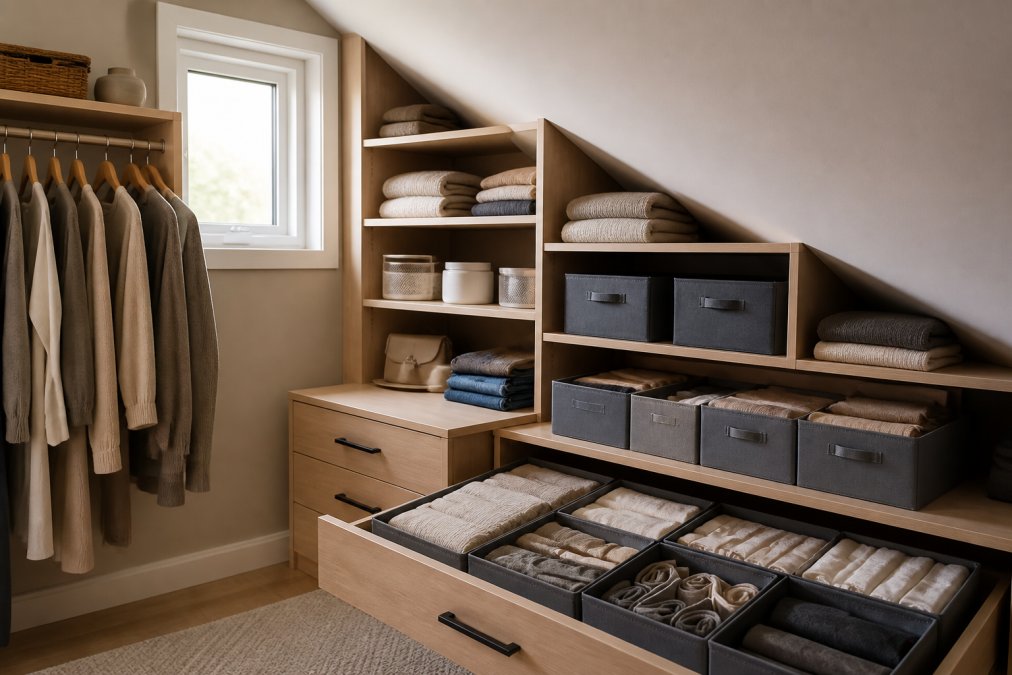
Stair-Step Shelving for Angled Walls
Stair-step shelving transforms the challenge of sloped closets into an advantage. Each shelf aligns with the ceiling angle, eliminating wasted space and creating a clean, intentional look.
Build stair-step shelves by installing brackets at progressively higher points along the wall. The first shelf sits low, near the floor; the second sits higher, and so on. The vertical distance between shelves decreases as you move up the wall, following the slope.
The depth of each shelf matters. Shelves near the wall (where the ceiling is highest) can be 12-14 inches deep (nkba.org). As you move toward the center and the ceiling drops, reduce shelf depth to 8-10 inches. Mount brackets securely into studs or use heavy-duty wall anchors rated for the weight you plan to store.
Using the Dead Space at the Eaves
The dead space at the eaves is prime real estate for seasonal storage, off-season clothing, or infrequently accessed items.
Flat storage bins work best in eave spaces. Measure the height of your eaves at different points and choose bins that fit these dimensions. Fabric storage containers are better than rigid plastic because they compress slightly and stack more efficiently in irregular spaces.
Label everything stored in eaves clearly. Use a clear inventory system: photograph the contents and tape the photo to the bin, or use a detailed label maker. Don't stack items too heavily, distribute weight evenly and avoid stacking more than three bins high.
Choose Custom Shelving vs. Modular Units
Custom shelving built specifically for your sloped ceiling offers the best fit and maximum space use. A carpenter can create shelves that follow your exact angle, use every inch of space, and match your aesthetic. Custom work costs more upfront but solves problems modular units can't address.
Modular units offer flexibility and easier adjustment. Systems like wire shelving and closet organizer kits work in sloped closets but are less efficient. Modular shelves are typically horizontal, so they don't follow the slope, creating gaps and unused space above each shelf.
If you rent or want to avoid permanent installation, modular units make sense. The Reset Aisle's closet organization tools are designed to work in various spaces, including those with unusual angles. For permanent solutions in owned homes, custom shelving can be a significant investment.

Best Closet Organization Tools for Small Spaces
The right tools make organizing small sloped closets manageable and sustainable.
Hanging Rods and Bracket Adjustments
Hanging rods in sloped closets need careful placement. Standard closet rods hang at 65-67 inches from the floor, which works only near the wall where the ceiling is highest (nkba.org). As you move toward the center, the ceiling drops, and a standard rod becomes unusable.
Install adjustable hanging rods that can move up and down. Position the main rod near the wall at standard height for full-length items like dresses and coats. Install a secondary rod lower (around 40-48 inches) in the center area for pants, folded shirts, or shorter items.
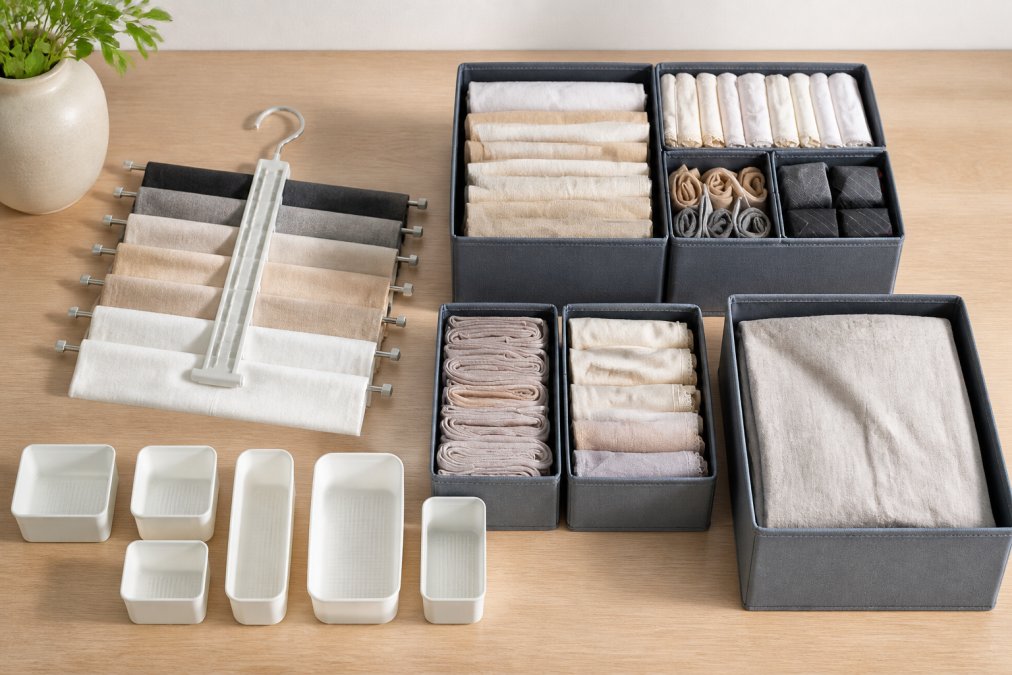
Use sturdy brackets rated for the weight of hanging clothes. Adjustable brackets allow you to tilt the rod slightly, following the slope of the ceiling rather than hanging perfectly horizontal. The Space Saving Pant Hanger from The Reset Aisle holds up to 40 pairs of pants on a single hanger, turning a rod that might hold 8-10 pairs into space for 40. In a sloped closet where linear hanging space is limited, this multiplier effect is invaluable.

Storage Bins and Drawer Organizers
Storage bins in sloped closets must fit your irregular spaces. Measure the exact dimensions of areas where you plan to store bins, height, width, and depth. Shallow bins (6-8 inches tall) work better than deep ones in eave spaces.
Label each bin with its contents using a photo inventory system: take a photo of the bin's contents before sealing it, print the photo, and tape it to the bin.
Fabric drawer organizers are essential for small closets. The Fabric Drawer Organizers for Socks & Underwear from The Reset Aisle divide drawer and shelf space into sections, preventing items from shifting. Use dividers on shelves to create sections, a single shelf can hold folded sweaters on one side, rolled scarves in the middle, and storage containers on the other.
Closet Organization Mistakes to Avoid
Small sloped closets forgive nothing. One mistake wastes precious space and creates frustration every time you open the door.
The biggest mistake is ignoring the slope and forcing standard storage solutions into a non-standard space. Horizontal shelves create dead space above each shelf where the ceiling slopes down. Measure your angle, then choose solutions that work with it.
Don't underestimate the dead space at the eaves. Many people leave these areas empty because they're awkward to access, but seasonal storage and rarely-used items belong there.
Avoid overstuffing. A sloped closet that's 85% full feels chaotic. Aim for 70% capacity to see what you have and grab items without disturbing everything else.
Don't install shelves without considering load-bearing. Sloped walls distribute weight differently than vertical walls. If you're unsure about structural integrity, consult a contractor before installing permanent shelving.
Failing to measure twice is expensive. Measure your ceiling angle, floor space, eave heights, and the distance from wall to knee wall. Bring these measurements when buying organizers.
DIY Installation vs. Professional Help
Installing storage in a sloped closet is doable as a DIY project if you're comfortable with basic carpentry. DIY installation saves money, but sloped ceilings add complexity. Finding studs in a sloped wall is trickier than in standard walls, and uneven angles mean your level might not read true.
Professional installation guarantees proper bracket placement, correct load-bearing assessment, and a finished product that looks intentional. A carpenter can build custom stair-step shelving that perfectly follows your ceiling angle.
The cost difference depends on your project's scope. Simple bracket installation might cost $200-400 professionally. Custom stair-step shelving could run $800-2,000. DIY versions cost 30-50% less but require your time and skill. For renters or those wanting to avoid permanent installation, DIY modular solutions work fine. For permanent solutions in owned homes, professional installation is worth considering.
Organizing small closets with slopes doesn't require magic, it requires understanding your space and choosing solutions that work with your angles instead of against them. The Reset Aisle's curated organization products are designed to adapt to real homes with real challenges, including awkward sloped ceilings. Start with accurate measurements, choose storage that follows your ceiling angle, and invest in quality tools like the Space Saving Pant Hanger and Fabric Drawer Organizers that multiply your storage capacity. A well-organized sloped closet feels larger, functions better, and makes getting dressed easier every single day. Start Your Reset with products built for spaces like yours.
Frequently Asked Questions
How do you hang clothes in a closet with a sloped ceiling?
Install an adjustable hanging rod that runs perpendicular to the slope, positioning it at the highest point where headroom allows. Use tiered or staggered rods at different heights to work around the angle. For low-clearance areas, install shorter rods or use cascading hangers that hold multiple items vertically. The Space Saving Pant Hanger lets you maximize rod space by holding 40 pairs on a single hanger, freeing up room for other garments.
What's the best way to organize an extremely small closet with an angled wall?
Prioritize vertical space and dead space at the eaves. Use stair-step shelving that steps down as the ceiling slopes, and install shallow shelves or cubbies in the knee wall area. Add drawer organizers for socks and accessories to keep small items contained. The Closet Reset bundle includes tools designed specifically for tight layouts, helping you reclaim space that typically goes unused.
What are common closet organization mistakes to avoid?
Avoid oversizing shelves that don't fit the angle, leaving dead space unused, and choosing storage units too deep for low-clearance areas. Don't install rods at fixed heights without measuring your slope first. Skip bulky organizers that waste space; instead, use slim, modular solutions that fit your layout. Finally, don't ignore accessibility, place frequently used items at comfortable heights, not crammed in hard-to-reach spots.
How do I measure the angle of a sloped ceiling for organizing?
Use a digital level or angle finder app to measure where your ceiling begins to slope. Mark the highest point and lowest point, then measure the vertical drop and horizontal distance to calculate the angle. Alternatively, place a ruler against the sloped surface and photograph it for reference when shopping for shelving. Accurate measurements prevent buying organizers that won't fit and ensure custom shelving sits flush against the wall.
This article was written using GrandRanker