

Table of Contents
- Why Ditch Plastic Food Storage in Your Pantry
- Plastic vs Glass Pantry Storage: What the Evidence Shows
- BPA-Free Pantry Containers: What That Label Really Means
- Best Non-Toxic Materials for Pantry Organization
- How to Organize a Pantry With Glass Jars
- Maintenance, Pest Prevention, and Lifecycle: What Most Guides Skip
- A Budget-Friendly Transition Plan to Non-Toxic Storage
- Frequently Asked Questions
Last Updated: September 16, 2026
Why Ditch Plastic Food Storage in Your Pantry
If you're wondering why choose non-toxic storage for pantry organization, the short answer is this: plastic containers can leach chemicals into your food over time, and glass, ceramic, and stainless steel don't.
The case isn't about panic. It's about reducing cumulative exposure in a room where you store food your family eats every day.
The Health Risks of Microplastics and Chemical Leaching
Microplastics are tiny plastic fragments that shed from containers, lids, and packaging into food and drink. Leaching is the related problem: chemicals migrating out of plastic into whatever it touches, especially when heat, fat, or acid is involved.
A common mistake is assuming this only happens with cheap plastic. It happens across the category. The practical takeaway: for hot, oily, or acidic foods, choose glass or stainless steel and stop worrying about which plastic is "safer."
Plastic vs Glass Pantry Storage: What the Evidence Shows
Plastic is lighter and cheaper. Glass is heavier, costs more, and doesn't absorb odors, stain, or hold onto yesterday's garlic. That trade-off is the whole debate.
| Factor | Plastic | Glass | Stainless Steel |
|---|---|---|---|
| Leaching risk | Higher with heat and fat | None | None |
| Odor retention | Absorbs smells | None | None |
| Visibility | Often cloudy | Transparent | Opaque |
| Durability | Cracks, yellows | Chip-resistant | Dent-resistant |
| Best for | Short-term, dry goods | Pantry staples | Bulk, light-sensitive items |
For most pantries, glass wins on transparency and cleanliness. Stainless steel is the better pick for bulk items stored away from light.
BPA-Free Pantry Containers: What That Label Really Means
A BPA-free pantry container is one manufactured without bisphenol A, a chemical historically used to make polycarbonate hard plastics and epoxy linings. That is the entire scope of the claim. It says nothing about what replaced the BPA, and it says nothing about whether the finished container still migrates other compounds into food.
This is where the marketing gets ahead of the science. When "BPA-free" became a selling point, many manufacturers swapped bisphenol A for structurally similar bisphenols, often bisphenol S (BPS) or bisphenol F (BPF). These substitutes share the same bisphenol backbone, and researchers have raised concerns that they may act on hormone pathways in comparable ways. "BPA-free" is therefore a label about one ingredient, not a guarantee of inertness.
Phthalates, Endocrine Disruptors, and FDA Safety Standards
Phthalates are a separate family of additives used to make plastics flexible, the reason a thin lid bends instead of snapping. They are classified as endocrine disruptors, meaning they can interfere with hormone signaling (Endocrine Disruptors). Because phthalates are not chemically bound to the plastic, they can migrate into fatty or acidic foods over time, and heat accelerates the process.
The regulatory picture matters here.
- Glass, inert, non-porous, and does not contain plasticizers or bisphenols to migrate.
- Stainless steel, non-porous and uncoated when food-grade; no plastic additives in the food-contact surface.
- Food-grade silicone, a silicone polymer rather than a plastic; check that it is labeled food-grade and free of filler.
Certification and Labeling: What to Actually Look For
Labels are not interchangeable, and reading them correctly saves money and guesswork:
- "BPA-free", confirms the absence of bisphenol A only. Silent on BPS, BPF, and phthalates.
- "Phthalate-free", a separate claim that must be stated explicitly; it is not implied by BPA-free.
- "Food-grade" or "food-safe", indicates the material is intended for food contact. For silicone, this is the minimum bar.
- "FDA-compliant", the material meets the applicable food-contact standard for its intended use.
Best Non-Toxic Materials for Pantry Organization
The three materials worth your money are borosilicate glass, food-grade silicone, and stainless steel. Each solves a different problem, and none of them leach the way plastic can, but they are not interchangeable, and the right choice depends on what you are storing and where.
Borosilicate Glass, Food-Grade Silicone, and Stainless Steel Compared
Borosilicate glass is made with boron trioxide, which lowers the glass's thermal expansion coefficient. In plain terms, it tolerates rapid temperature swings, freezer to oven, without the stress cracking that plagues cheaper soda-lime glass. It is non-porous, so it does not absorb odors, stains, or oils, and it is fully transparent, which matters more than people expect: you actually use what you can see. The trade-offs are weight and breakage.
- Borosilicate glass: best all-rounder, oven and fridge safe, fully transparent, non-porous
- Food-grade silicone: best for lids, seals, and squeeze storage; verify it is filler-free
- Stainless steel: best for bulk dry goods and anything light-sensitive; label everything
Maintenance and Deep Cleaning for Non-Toxic Materials
Most guides stop at the purchase. The part that determines whether your non-toxic containers stay non-toxic, and whether your pantry stays pest-free, is maintenance.
- Glass: wash with hot soapy water and dry completely before refilling. Trapped moisture is the fastest way to ruin a jar of flour or rice. Glass is dishwasher-safe, but hand-dry the rims and threads where water pools.
- Silicone seals and lids: remove them from the container and wash separately. Crumbs and oils collect in the groove between the seal and the lid, and that residue is where mold and odors start. A baking-soda soak handles lingering smells; a diluted vinegar rinse handles residue. Silicone can absorb odors, so rotate seals if you store strongly scented spices.
- Stainless steel: wash and dry promptly. It is non-porous, but standing water and acidic residue left on the surface can leave marks over time. Avoid abrasive pads that scratch the finish.
Lifecycle and Pest Prevention: What the Material Choice Actually Buys You
Two things most guides skip entirely: how long each material lasts, and how it performs against pantry pests.
How to Organize a Pantry With Glass Jars
Organizing a pantry with glass jars comes down to three moves: match jar size to how fast you use each staple, seal everything airtight, and keep the most-used items at eye level.
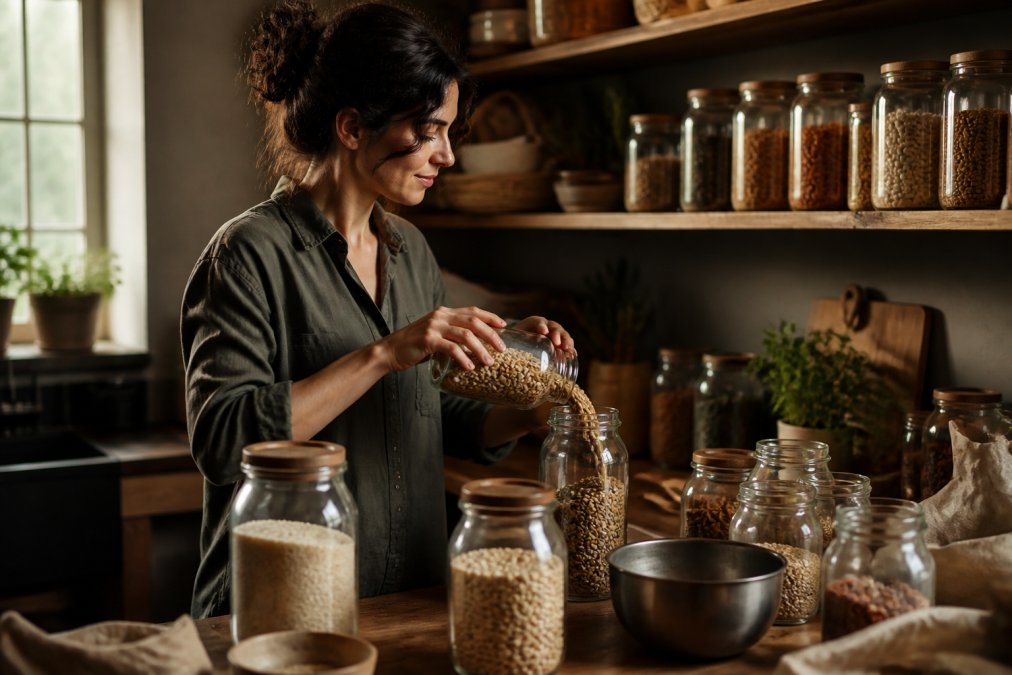
Airtight Seals, Stackable Jars, and Dry Goods Storage
An airtight seal is what keeps dry goods fresh and pantry pests out. Stackable, transparent jars let you see what you have at a glance, which is half the battle in a small pantry.
- Group staples by use: baking, cooking, snacking
- Decant into matched jars so they stack cleanly
- Label with contents and date
- Keep daily items forward, bulk items high or low
- Leave a small gap between rows for easy grabbing
Maintenance, Pest Prevention, and Lifecycle: What Most Guides Skip
Most guides stop at the pretty shelf. The part nobody tells you about is maintenance. Glass jars need washing with hot soapy water and thorough drying before refilling, or trapped moisture ruins the contents. Silicone seals should be removed and cleaned separately, since they harbor crumbs.
A Budget-Friendly Transition Plan to Non-Toxic Storage
You don't need to replace everything at once. Start with the containers that touch hot or oily food, then work outward.
- Month 1: Replace reheating containers with borosilicate glass
- Month 2: Swap bulk dry goods into airtight jars
- Month 3: Add stackable jars for the overflow shelf
- Ongoing: Replace plastic as it cracks or yellows
Frequently Asked Questions
What are the best non-toxic materials for pantry storage?
Borosilicate glass, food-grade silicone, and stainless steel are the three most reliable choices for non-toxic pantry storage. Borosilicate glass is non-porous, does not leach chemicals, and works for both dry goods and leftovers. Stainless steel is durable and blocks light, which helps preserve oils and spices. Food-grade silicone lids and seals offer an airtight fit without plastic leaching. Avoid any container labeled only 'BPA-free' without additional material information, since replacement chemicals like BPS may carry similar concerns.
Is it better to store pantry items in glass or plastic?
Glass is generally the better choice for pantry organization because it is non-porous, does not absorb odors or stains, and does not leach chemicals into food. Plastic containers can scratch over time, and those scratches can harbor bacteria and release microplastics. Glass also lets you see what you have, which reduces duplicate purchases and food waste. The main trade-off is weight and breakage risk, but borosilicate glass handles temperature changes better than standard glass and is worth the upgrade for high-use staples.
How do I identify truly BPA-free and food-grade storage containers?
Look for containers that state the specific material, such as borosilicate glass, 18/8 stainless steel, or platinum-cure silicone, rather than relying on a 'BPA-free' sticker alone. Check for FDA food-contact compliance on the packaging. Avoid unmarked plastics with recycling codes 3 (PVC) and 7 (other, which often includes polycarbonate). If a container has no material information at all, treat that as a red flag. Transparent, non-porous materials with clear labeling are the safest bet.
Does non-toxic storage help keep pantry food fresher for longer?
Yes, when the container has a proper airtight seal. Moisture and oxygen are the two biggest causes of stale dry goods, and airtight glass jars with silicone gaskets block both. This keeps pantry staples like flour, rice, coffee, and spices at peak quality for longer. Stainless steel adds light protection, which matters for oils and herbs that degrade in sunlight. Beyond freshness, airtight seals also help prevent pantry pests from getting into your dry goods storage.
The hardest part of ditching plastic isn't the shopping, it's the habit of reaching for the same old container. The Reset Aisle makes that switch easier with curated, space-saving pantry and drawer organizers designed to reduce daily overwhelm and bring order to cluttered spaces. Start your reset with The Reset Aisle and turn a chaotic pantry into a calm, functional one.