

Table of Contents
- Why Family Kitchens Fall Into Chaos (and How to Stop It)
- Family Kitchen Zone Planning: Assign Every Task a Home
- How to Organize Deep Pantry Shelves So Nothing Gets Lost
- Kitchen Organization Hacks for Busy Families
- Decluttering Countertops and Cabinets for Workflow
- A Maintenance Schedule That Keeps the Kitchen Organized
- Sustainable and Budget-Friendly Organization Choices
- Conclusion: Start With One Zone, Not the Whole Kitchen
- Frequently Asked Questions
Last Updated: September 8, 2026
Why Family Kitchens Fall Into Chaos (and How to Stop It)
A family kitchen is the hardest-working room in the house, yet most organization advice treats it like a showroom. The reason kitchens descend into chaos isn't a lack of willpower; it's a lack of a system. Efficient kitchen organization for families isn't about perfection; it's about creating predictable systems that survive a Tuesday morning rush. The families who succeed aren't the most disciplined; they design their space around actual daily routines.
The common mistake is tackling the whole room at once. Instead, think of your kitchen as a series of small, manageable workflow zones. The goal is to reduce the friction between "where things are" and "where things are used." By assigning every task a specific geographic home, you turn a frantic search for the colander into a simple, repeatable reach. This approach aligns with broader principles of home workflow optimization research which suggests that reducing visual clutter directly lowers cognitive load in shared domestic spaces.
Family Kitchen Zone Planning: Assign Every Task a Home
Zone-based organization is the single most effective strategy for busy households. Instead of grouping items by type, you group them by task. This is the core of family kitchen zone planning. If the coffee maker is on the counter, the mugs, spoons, and sugar should live in the cabinet directly above it, not across the room.
Zone 1: Prep and Cooking
This zone centers on the stove, cutting boards, and your primary countertop workspace. Store pots and pans near the heat source, and keep oils, spices, and utensils within arm's reach of the prep area. A Double-Layer Rotating Spice Rack is essential here because it spins a full 360 degrees, so the back row is always the front row.

Zone 2: Cleaning and Waste
Locate your trash can, dishwasher, and cleaning supplies near the sink to create a logical flow. The goal is to minimize the distance dirty dishes travel. If you have space, an Under Sink Organizer with Sliding Shelves transforms that awkward cabinet around the pipes into pull-out storage for sponges, sprays, and scrub brushes.

Zone 3: Breakfast and Snacks
Designate a low cabinet or drawer for kid-friendly bowls, plates, and unbreakable cups. Pair this with a specific snack shelf in the pantry. When children know exactly where their stuff lives, they can help themselves without asking you to find the blue cup for the fifth time that morning.
How to Organize Deep Pantry Shelves So Nothing Gets Lost
Deep pantry shelves are the graveyard of canned goods. Items get pushed to the back and forgotten until their expiration dates become a science experiment. The solution is not to buy more organizers; it is to change how you view the space.
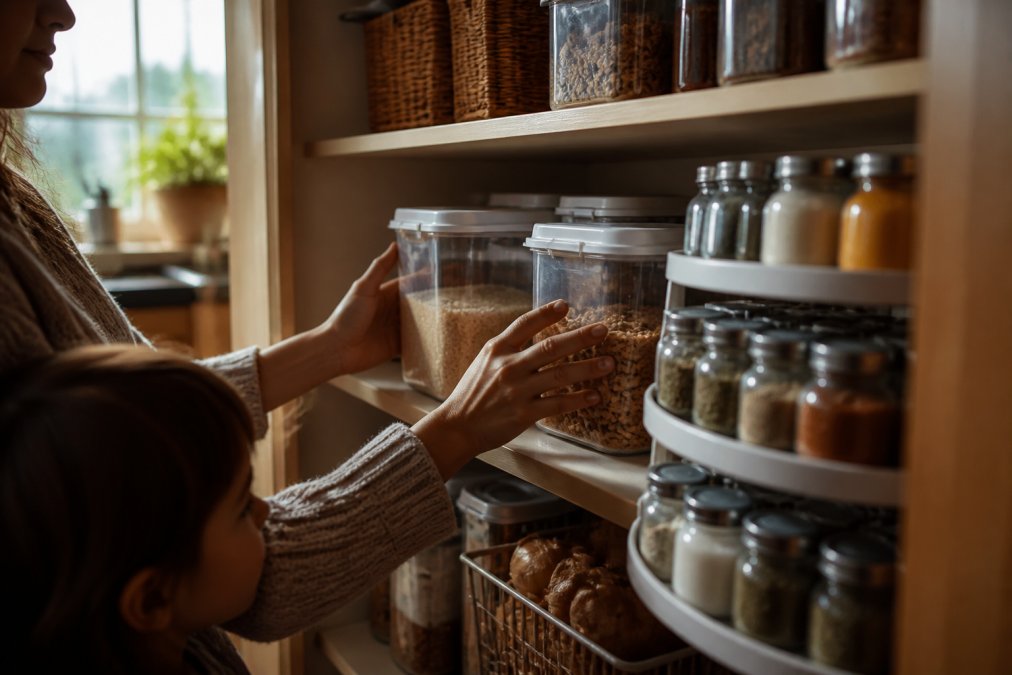
The Vertical Storage Fix for Deep Shelves
If you have a shelf that is 24 inches deep, you need a way to access the back 12 inches. The most effective fix for organizing deep pantry shelves is to use vertical storage solutions that bring the back row forward. Clear, stackable bins with handles allow you to pull the entire bin out to see what is inside. For cans, use tiered risers so you can see every label at a glance.
Labeling and Food Rotation Systems That Work
Once you have items in bins, you must label them. A label maker is the gold standard, but masking tape and a sharpie work just as well. The key is to label the bin, not the item. Use a simple food rotation system: new items go to the back, older items move to the front.
Kitchen Organization Hacks for Busy Families
The best kitchen organization hacks for busy families are the ones that work with human behavior, not against it. A hack is useless if it requires a 15-minute reset every night. The strategies below focus on reducing friction and building habits that stick, including one angle most guides ignore entirely: designing for the way your family's brain actually works.
Hack 1: The After-School Snack Station
Designate a specific bin in the fridge and a shelf in the pantry as the "Snack Station." Fill it with pre-portioned bags of fruit, cheese sticks, yogurt, and crackers. When the kids come home hungry, they grab from the station without rummaging through the entire fridge. This keeps the mess contained to one area and teaches kids independence.
The upgrade competitors miss: Make the snack station work for all ages by adding a visual cue system. Use a small whiteboard or a set of colored clothespins on the bin, green for "grab anytime," yellow for "ask first," red for "parent only." For families with children who have ADHD or autism, this visual structure reduces the cognitive load of choosing a snack and prevents meltdowns over unexpected restrictions.
Hack 2: Assign a Home for School Paperwork
The kitchen counter is the default landing zone for permission slips, homework, and school flyers. Instead of fighting this, give it a designated home. Use a wall-mounted file organizer or a specific drawer tray labeled "Inbox" and "To Sign."

The mechanism most guides skip: Paperwork systems fail because they lack a weekly purge ritual. Add a recurring Sunday evening task, set a 5-minute timer, recycle anything outdated, file anything completed, and move anything pending to the front of the "To Sign" slot. Pair this with a simple rule: no paper stays on the counter overnight.
Hack 3: Design for Neurodivergent Workflows (The Underserved Angle)
Most kitchen organization advice assumes a neurotypical workflow: out of sight is out of mind, and a tidy cabinet is a functional one. But for families with ADHD, autism, or sensory processing differences, the opposite is often true. Visual clutter creates mental noise, but hidden items can become "nonexistent" items.
- Use transparent containers for daily-use items. If a child with ADHD can't see the cereal, they won't eat breakfast, they'll grab a granola bar instead. Clear bins for breakfast staples, snack bags, and lunch components reduce the friction of "finding" food.
- Create a 'low-stimulation' corner. If your family includes someone sensitive to noise or light, designate one drawer or cabinet for quiet items, no crinkly bags, no rattling lids. Store paper plates, silicone cups, and cloth napkins there. This small gesture can significantly reduce mealtime stress.
- Label with pictures, not just words. For pre-readers or children with language processing differences, a photo of the item (or a simple icon) on the bin label is more effective than text alone. A cheap label maker with symbol options, or even printed photos taped to bins, works well.
This approach isn't just inclusive, it's practical. By designing for the actual users of your kitchen, you create a system that requires less nagging, less reminding, and less cleanup.
Hack 4: The One-Minute Rule for Daily Resets
The "one-minute rule" is simple: if a task takes less than one minute, do it immediately. For the kitchen, this translates to a nightly reset. Set a timer for 10 minutes to load the dishwasher, wipe down the sink, and return stray items to their zones.
The trade-off most guides ignore: The one-minute rule only works if you have a clear stopping point. Set a physical timer, and when it goes off, stop, even if the counters aren't perfect. The goal is consistency, not perfection.
Decluttering Countertops and Cabinets for Workflow
Countertop efficiency is directly tied to how much stuff you leave out. The goal is to keep only the daily-use appliances visible. If you haven't used the stand mixer in three months, it belongs in a high cabinet, not on the counter. This is where the The Kitchen Reset bundle shines, as it targets the two worst clutter spots in a kitchen: the spice cabinet and the under-sink area.
For cabinets, the enemy is often the "junk drawer." Instead of one large drawer for everything, use drawer dividers to create specific homes for batteries, rubber bands, and takeout menus. When you systematize the chaos, you reduce the mental friction of finding a pen. This decluttering process is not about minimalism; it is about making room for the items you actually use daily. A clear counter signals to the family that the kitchen is ready for action, not a storage unit. If you are looking for a structured approach to reducing household waste, EPA guidelines on sustainable management of food offers resources that align well with a more organized pantry.
A Maintenance Schedule That Keeps the Kitchen Organized
Organization is not a one-time event; it is a maintenance cycle. Without a schedule, even the best system degrades back into chaos within a month.
- Daily (10 minutes): Run the dishwasher, wipe counters, and put away any stray items that have migrated.
- Weekly (30 minutes): Check the fridge for expired food, wipe down the inside of the microwave, and take out the trash.
- Monthly (1 hour): Rotate pantry stock, wipe down shelves, and purge any items you haven't used in the last 90 days.
This schedule prevents the "everything goes back to chaos" problem that plagues many families. By scheduling a regular pantry inventory check, you also become aware of what you are actually consuming, which reduces impulse buys at the grocery store.
Sustainable and Budget-Friendly Organization Choices
You do not need a custom-built pantry or a $200 container haul to have an organized kitchen. The most sustainable option is the one you already own, and the most budget-friendly system is the one you can maintain without buying replacements every six months.
The Repurpose-First Method: What to Use and How
Before buying anything, do a 15-minute audit of your home. Walk through each room and collect items that can serve a second life in the kitchen.
- Glass jars with lids (pasta sauce, salsa, jam): Wash thoroughly, remove labels with a mixture of warm water and baking soda, and use for dried goods, leftovers, or as a utensil holder. For pantry storage, use them for items you buy in bulk, rice, beans, oats, cereal. The clear glass lets you see the fill level at a glance, which is a simple inventory management trick.
- Shoeboxes or shipping boxes: Wrap them in contact paper or leftover wrapping paper to create sturdy, attractive shelf dividers. They work well for categorizing snack bags, baking supplies, or lunchbox components. The key is to cut them to the correct height, measure your shelf depth first.
- Egg cartons: Use them to organize small items in drawers, rubber bands, hair ties, batteries, or spice packets. They fit neatly in most standard drawers and are free.
- Muffin tins: If you have an old one, use it as a desk organizer for paper clips, pushpins, and rubber bands, or as a fridge organizer for small condiment packets.
- Clean takeout containers: Use them for freezing leftovers or organizing craft supplies. The clear plastic lets you see contents, and they stack well.
The mechanism competitors miss: The repurpose-first method fails when you keep items that don't fit your space. Before you commit to a repurposed item, measure the space it will occupy. If it doesn't fit perfectly, recycle it or find another use.
The 'Buy Once, Cry Once' Rule for Purchases
When you do need to purchase storage, prioritize quality over quantity. A sturdy, well-designed organizer that lasts for years is more sustainable than a cheap plastic bin that cracks in six months. This is where the value of The Reset Aisle becomes clear.
The cost-per-use calculation: A $30 spice rack that lasts 5 years costs $0.50 per month. A $10 spice rack that cracks in 6 months costs $1.67 per month. When you compare on cost-per-use rather than upfront price, the durable option is almost always the budget-friendly choice.
The Maintenance-Focused Budget System
Most budget guides stop at the initial setup. But the real cost of a disorganized kitchen isn't the containers, it's the food you throw away when you can't find the canned beans, or the duplicate purchase of olive oil because you forgot you had a full bottle in the back of the pantry.
- Monthly 'Use-It-Up' Challenge: Pick one week per month to cook exclusively from your pantry and freezer. This forces you to rotate stock, discover what you actually have, and reduces food waste. It also saves money on groceries that week.
- The 90-Day Purge Rule: Every 90 days, go through your pantry and fridge. If you haven't used an item in that time and it's not a staple (flour, sugar, spices), donate it if unopened or compost it if expired. This prevents the accumulation of half-used jars and forgotten cans.
- The 'One In, One Out' Rule for Containers: When you buy a new storage container, recycle or donate one old one. This prevents container creep, where your cabinet fills with mismatched lids and orphaned bases.
When DIY Isn't the Answer
There are two situations where repurposing fails and a purpose-built product is worth the investment:
- Safety-critical storage: Under-sink cleaning supplies, sharp knives, or medications need child-proof or specific containment that DIY solutions can't reliably provide. Don't risk a shoebox for bleach.
- High-friction daily items: The spice rack you use every morning, the under-sink organizer you access twice a day, these need to work flawlessly. A DIY solution that jams, tips, or falls apart will cause you to abandon the system entirely.
For these cases, The Reset Aisle's The Kitchen Reset bundle targets the two worst clutter spots in a kitchen: the spice cabinet and the under-sink area. Both are built to survive daily use by a busy family.
If you are looking to reduce your environmental footprint, the USDA's food loss and waste FAQ provides useful context on how better home storage can reduce household waste. The EPA's sustainable management of food resources also offer a framework for thinking about food waste prevention that aligns well with a more organized pantry.
Conclusion: Start With One Zone, Not the Whole Kitchen
Efficient kitchen organization for families is a journey, not a destination. The biggest mistake is trying to overhaul the entire room in one weekend. Instead, pick the zone that causes the most daily friction. By focusing on one manageable area, you build momentum and prove to yourself that the system works.
An organized kitchen is a calmer kitchen. It reduces morning stress, makes meal prep faster, and teaches children that their home has a rhythm. At The Reset Aisle, our mission is to help you make the items you already own work more effectively for your lifestyle. For a quick win, consider The Kitchen Reset bundle, which pairs the Double-Layer Rotating Spice Rack with the Under Sink Organizer to handle two of the worst clutter spots in one afternoon. Start your reset today and turn chaotic areas into peaceful, efficient environments that serve your family for years to come.
Frequently Asked Questions
What is the most efficient way to organize a kitchen for a large family?
The most efficient approach is zone-based organization. Group items by task: prep and cooking near the stove, cleaning supplies under the sink, and snacks in a low cabinet kids can reach. This cuts down on cross-kitchen traffic and makes unloading the dishwasher faster because everything lands within arm's reach of its zone. Start with the three busiest areas: the main prep counter, the pantry, and the sink cabinet.
How do you organize a kitchen with kids in mind?
Create a dedicated snack station at a child's eye level. Use clear, lightweight bins for individual portions and keep breakable items on higher shelves. Store heavy pots and small appliances in lower cabinets to prevent dangerous reaching. A labeled drawer for kid-safe cups and plates lets younger children help themselves, which builds independence and reduces the morning rush bottleneck at the counter.
What are the best storage solutions for deep pantry shelves?
Deep shelves waste space because items get pushed to the back and forgotten. Use pull-out sliding shelves or clear, stackable bins with labels facing forward. A double-layer rotating turntable works well for spices, sauces, and small jars, letting you spin the back row to the front. Vertical storage, like tiered risers for cans, doubles the usable space without a major remodel.
How do I maintain kitchen organization with a busy schedule?
Schedule two maintenance windows: a 5-minute daily reset and a 30-minute weekly tidy. The daily reset means clearing the counter and loading the dishwasher right after dinner. The weekly session covers one drawer or one pantry shelf, checking for expired food and returning stray items to their zones. Attach these tasks to existing habits, like wiping counters after breakfast, so they stick.
How can I organize my kitchen on a budget?
Skip custom systems and focus on a few high-impact purchases. Clear storage containers and a spice rack deliver the biggest daily payoff for the lowest cost. For the rest, use free solutions first: repurpose shoeboxes for drawer dividers and mason jars for bulk goods. Buy only after you have measured your shelves, so you avoid spending on organizers that do not fit your actual space.