

Table of Contents
- What Makes a High-Quality Closet Organization System
- Best Materials for Closet Shelving and Storage
- Closet System Installation Cost: DIY vs. Professional
- Durable Storage Bins for Kids and Family Organization
- Top High-Quality Closet Organization Systems
- Customization and Modularity: Finding Your Perfect Fit
- Maximizing Small Closet Spaces
- Conclusion
Last Updated: August 27, 2026
What Makes a High-Quality Closet Organization System
A high-quality closet organization system combines durability, smart design, and practical functionality to transform chaotic spaces into efficient storage. The best systems maximize vertical space, prevent items from shifting, and make it easy to find what you need without dismantling everything. They adapt to your actual closet dimensions rather than forcing you to work around rigid designs.
When evaluating systems, consider how well they handle daily use. Cheap materials warp under weight, shelves sag, and plastic bins crack. A well-built system uses reinforced materials, includes weight-bearing specifications, and withstands real household wear and tear.
The Reset Aisle solves these exact problems by making existing belongings work more effectively through thoughtful organization tools. Rather than forcing a complete overhaul, their products target specific pain points: too many pants taking up rod space, small items scattered across drawers, and lack of shelf organization.
Best Materials for Closet Shelving and Storage
Solid Wood vs. Laminate vs. Wire Shelving
Material choice determines both longevity and appearance.
Solid wood shelving offers high durability and aesthetic appeal. It handles heavy loads without sagging. The tradeoff: solid wood costs significantly more and requires careful installation. It's ideal for walk-in closets storing heavier items like winter coats or shoe collections.
Laminate shelving provides a middle ground. Modern laminate resists moisture better than older versions and costs far less than solid wood. However, laminate can chip or peel with rough handling. Laminate works well for reach-in closets with lighter loads.
Wire shelving maximizes visibility and airflow, making it practical for humid climates or basements. Wire systems are lightweight, affordable, and easy to adjust. The downside is significant: wire shelves offer lower weight capacity and items can slip through gaps. Wire works best for lightweight storage like folded sweaters or small bins.
Choose material based on your actual storage needs, not just aesthetics. A reach-in closet holding light seasonal items suits laminate or wire. A walk-in closet bearing a full wardrobe demands solid wood or reinforced metal supports.
Durability and Weight Capacity Considerations
Weight capacity isn't just a specification, it's a safety issue. Most residential closet shelves are rated for 25-50 pounds per linear foot (fema.gov). A 36-inch shelf might safely hold 75-150 pounds total, depending on material and support structure. Exceeding these limits causes permanent sagging.
Distribution matters as much as total weight. Concentrated loads stress shelves far more than the same weight spread across the shelf. Quality closet organization systems include reinforced support brackets every 16-24 inches to handle concentrated loads (fema.gov).
Laminate and particleboard shelves lose strength over time as moisture and weight stress the material. Solid wood and metal shelving maintain integrity longer. If you're building a system for 10+ years, the material investment pays off through durability.
Check load ratings for hanging systems too. Closet rods need support brackets every 24-36 inches. A single closet rod typically handles 35-50 pounds total (fema.gov). If you're storing winter coats or leather jackets, you're approaching that limit quickly.
Closet System Installation Cost: DIY vs. Professional
Installation represents a significant part of your total closet organization system investment. The choice between DIY and professional installation depends on complexity, your skill level, and how much you value your time.
DIY installation costs nothing beyond tools you may already own. If your closet has standard dimensions and you're installing a modular system with adjustable shelves, DIY is straightforward. Most homeowners can install basic shelving in 2-4 hours. The risk: improper installation leads to sagging shelves, misaligned rods, or wall damage.
Professional installation typically costs $300-800 depending on closet size and system complexity. For a walk-in closet with custom shelving, professionals ensure proper weight distribution, level shelves, and secure wall anchors. They also handle awkward dimensions, sloped ceilings, or non-standard wall types that make DIY installation difficult.
Consider professional installation if your closet has sloped ceilings, plaster walls instead of drywall, existing damage, or very deep shelving. These complications make proper installation much harder and mistakes much more costly.
The Reset Aisle's products are designed for straightforward assembly. Their Fabric Drawer Organizers require no installation, they fold flat and fit directly into drawers. The Space Saving Pant Hanger attaches to an existing rod with no tools needed. Their Closet Reset Bundle combines these elements, minimizing installation complexity.

Durable Storage Bins for Kids and Family Organization
Durable storage bins for kids need to survive repeated opening, closing, dropping, and overstuffing. Cheap plastic cracks under pressure. Quality bins have reinforced corners, thick plastic or fabric, and secure lids that stay attached.
Look for bins made from high-density polyethylene or polypropylene, which resist cracking and fading. Fabric storage bins with internal bracing hold their shape better than unsupported fabric. Avoid thin plastic bins marketed as "durable", they typically fail within a year in active households.
Weight capacity matters for family storage. A bin rated for 15 pounds will collapse when filled with books or toys. Quality bins specify weight limits and include reinforced bottoms to distribute load evenly. For kids' closets, aim for bins rated 25-40 pounds minimum.
Stackability is crucial for small closet spaces. Bins that stack securely without sliding prevent accidents and maximize vertical space. Look for bins with interlocking features or flat tops that prevent shifting.
The Fabric Drawer Organizers from The Reset Aisle address the specific challenge of small-item chaos in kids' closets. With sectioned compartments, they keep socks, underwear, and accessories separated without requiring multiple bins. The high-quality stitching ensures they hold up through years of daily use.
Top High-Quality Closet Organization Systems
The Closet Reset Bundle
The Closet Reset Bundle from The Reset Aisle combines three complementary products into a cohesive closet organization system designed to solve the most common storage frustrations: overcrowded rods, tangled drawers, and wasted vertical space.
This bundle includes one Space Saving Pant Hanger (holds 40 pairs) and two Fabric Drawer Organizers. The pant hanger reclaims rod space by consolidating 40 pairs of pants or leggings onto a single hanger using 10 strong clips. Instead of five hangers taking up 18 inches of rod space, this system uses just 3.6 inches. For a standard closet rod, that's meaningful recovery of hanging space for jackets, dresses, or other items.

The two Fabric Drawer Organizers transform chaotic drawers into organized compartments. Each organizer includes multiple sections for socks, underwear, bras, ties, or scarves. Rather than digging through a tangled pile, everything has a designated spot. The meticulous stitching and high-quality polyester blend ensure these organizers maintain their shape through years of daily use.
Priced at $56.99, the bundle costs less than purchasing the items separately. For most closets, this bundle addresses 60-70% of organization challenges without requiring installation, wall anchors, or tools.
Space Saving Pant Hanger for Maximizing Rod Space
Pants and leggings consume disproportionate closet rod space. A standard hanger takes up 1.5-2 inches of rod width. Stack five hangers of pants together and you've used 7.5-10 inches of rod space for items that could consolidate onto one hanger.
The Space Saving Pant Hanger solves this with 10 strong clips that hold up to 40 pairs. Each pair hangs vertically from its own clip, creating a compact bundle that occupies the same space as a single hanger. The clips grip fabric securely without creasing or damaging delicate materials.
At $19.99, this single hanger recovers enough rod space for 4-5 additional hanging items. For closets with limited width, that's a transformative efficiency gain. The hanger works equally well for pants, leggings, skirts, or lightweight scarves.
Fabric Drawer Organizers for Small Items
Drawer chaos stems from small items shifting and tangling. Socks disappear. Underwear gets mixed with scarves. Finding matching pairs becomes impossible.
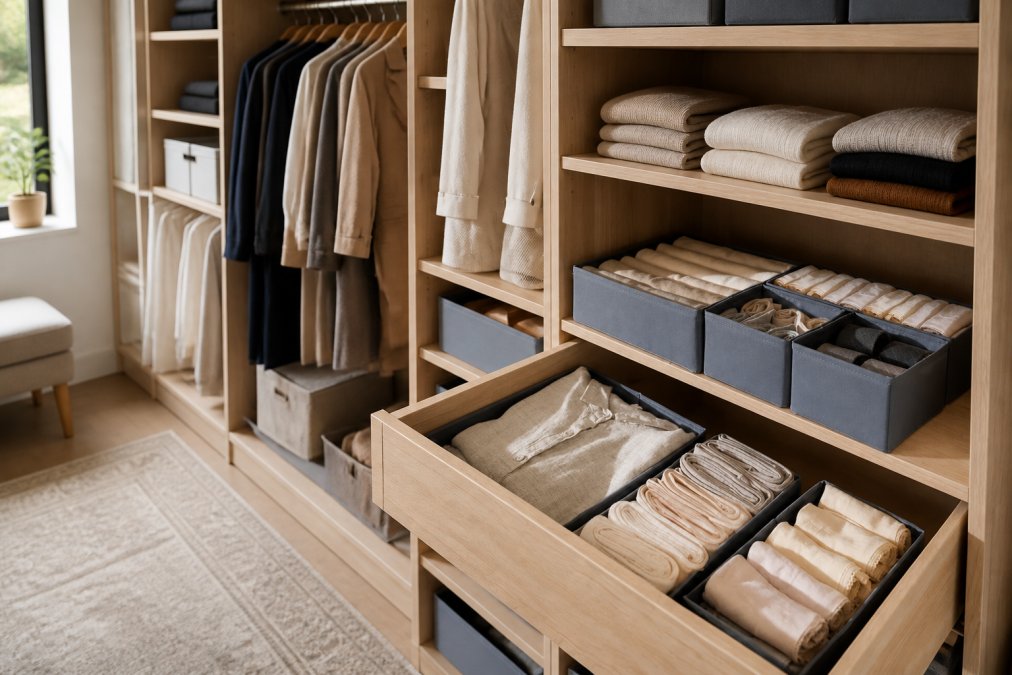
The Fabric Drawer Organizers from The Reset Aisle address this with sectioned compartments that keep small items separated. Each organizer includes multiple sections sized for different items and fits standard bedroom drawers without taking up excessive space.
Built from a high-quality polyester blend with internal support structure, these organizers maintain their shape even when fully loaded. The stitching is meticulous, designed to withstand years of daily use.
At $22.99 per organizer (or $45.98 for a pair), they're affordable enough to outfit multiple drawers. These organizers work best for items that benefit from separation: socks, underwear, bras, ties, scarves, and belts.
Customization and Modularity: Finding Your Perfect Fit
A closet organization system that can't adapt to your changing needs becomes obsolete. The best systems include adjustable shelves, modular components, and expandable options.
Adjustable shelving lets you change shelf height as your storage needs evolve. A shelf spaced 12 inches apart works for folded sweaters but wastes space if you later want to store shoe boxes. Systems with adjustable brackets every 1-2 inches let you optimize spacing without replacing components.
Modular systems let you add components incrementally. Rather than committing to a complete system upfront, you can start with basic shelving and add drawer units, hanging organizers, or accessories as needed. This approach reduces upfront cost and lets you discover what actually works for your household.
The Reset Aisle's product approach emphasizes modularity. You can purchase individual components or the bundle, and add pieces later. This lets you address your most pressing organization challenge first, then expand as budget allows.
Compatibility matters for modular systems. Components from different brands rarely work together seamlessly. A closet organization system where all pieces are designed to work together ensures consistent quality and proper function.
Maximizing Small Closet Spaces
Small closets demand ruthless efficiency. Every inch of space must work. Vertical storage is non-negotiable in small closets. Wall space above hanging rods, above shelves, and along side walls can hold bins, hooks, or additional shelving. A reach-in closet with 3 feet of width can support 4-6 feet of vertical storage if you use the space strategically.
Double-hanging rods (one above the other) instantly double your hanging capacity. The lower rod should be positioned 36-42 inches from the floor, low enough for pants and skirts, high enough to hang above lower shelves.
Slim hangers reduce rod space consumption by 25-30% compared to standard hangers. This small change frees up significant rod length in tight closets. Combine slim hangers with a space-saving pant hanger and you've recovered enough space for 8-10 additional items.
Over-the-door organizers add storage without consuming floor or shelf space. Shoe racks, hanging organizers, and hooks on the back of closet doors can hold 20-30 items depending on configuration.
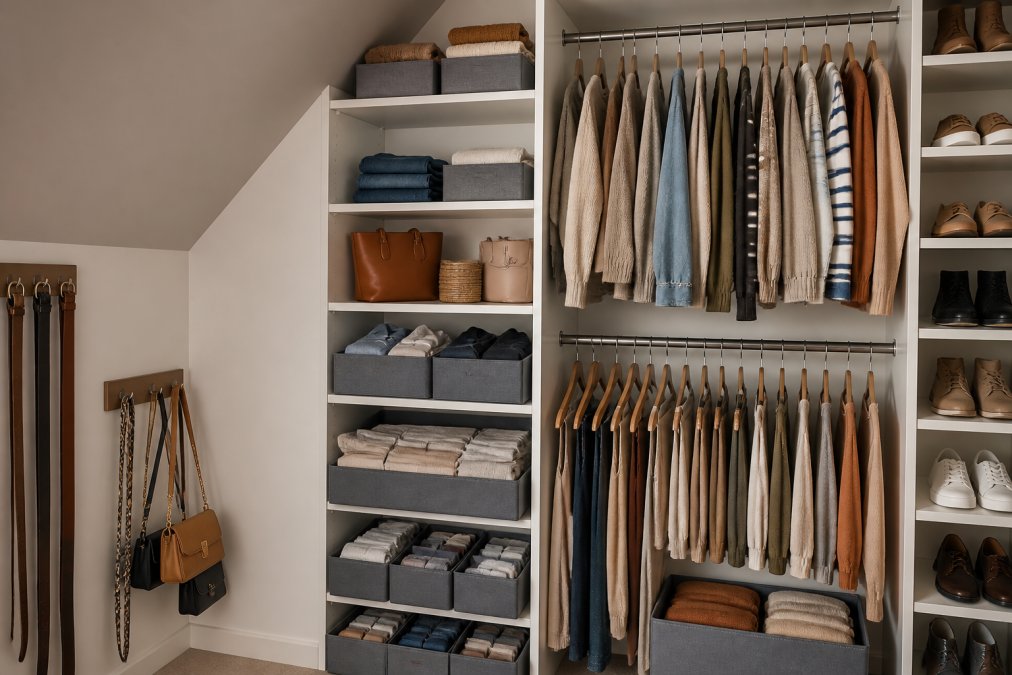
Corner space is often wasted. Angled shelving, corner-specific organizers, or rotating carousel systems can reclaim this awkward space. Even 10-15 inches of recovered corner space makes a difference in small closets.
Seasonal rotation is essential in small closets. Store off-season clothing in bins under the bed, in the garage, or in another closet. This keeps your daily-use closet focused on current-season items, reducing crowding and making everything more accessible.
The Closet Reset Bundle works particularly well in small closets. The space-saving pant hanger alone recovers enough rod space for 4-5 additional items. The drawer organizers eliminate the need for multiple small bins, freeing up shelf space. Together, they create meaningful capacity gains in tight spaces.
A high-quality closet organization system isn't about luxury, it's about function. The right system transforms a frustrating closet into a space that works for you, saves time every morning, and keeps your belongings protected.
Start with The Reset Aisle's Closet Reset Bundle. It addresses the two biggest organization challenges, overcrowded rods and chaotic drawers, without requiring installation, tools, or permanent changes. The Space Saving Pant Hanger and Fabric Drawer Organizers are built for durability and designed to work together seamlessly. For most closets, this bundle creates immediate, meaningful improvements in organization and accessibility.
Frequently Asked Questions
What should I look for in a high-quality closet organization system?
The best closet organization systems combine durable materials with flexible configurations. Look for adjustable shelving that accommodates different item heights, hanging rods with solid weight capacity, and accessories like drawer dividers and shelf liners. Your system should adapt to your closet's specific dimensions, whether it's a walk-in or reach-in, and handle daily use without sagging or deteriorating. Quality hardware and stitching (if fabric components are included) signal products built to last.
How much does it cost to install a closet system professionally versus DIY?
Professional closet system installation typically costs $300 to $800 depending on closet size and complexity, while DIY kits start around $56.99 for bundled solutions like The Closet Reset. DIY installation requires basic tools and a few hours of work but saves labor costs. If your closet has unusual dimensions, slanted ceilings, or you lack confidence with installation, professional help ensures proper load-bearing and longevity. Many homeowners choose a hybrid approach: buy a modular system and hire help only for heavy lifting or mounting.
Are durable storage bins for kids worth the investment in a family closet system?
Yes. Durable storage bins designed for kids' items, toys, seasonal clothing, shoes, prevent clutter from spreading and teach organization habits early. Quality fabric or plastic bins with secure handles withstand frequent opening, dropping, and restocking. They're especially valuable in shared closets where multiple family members access the space. Look for bins with clear labels and compartments so kids can find and return items independently, reducing daily overwhelm for busy parents.
What's the difference between wire, laminate, and wood shelving for closets?
Solid wood offers durability and aesthetic appeal but costs more and requires maintenance. Laminate is budget-friendly, moisture-resistant, and lightweight, making it ideal for renters or temporary setups. Wire shelving maximizes vertical space and air circulation, making it perfect for small closets, though it has lower weight capacity. Choose based on your closet's humidity, load requirements, and how long you plan to stay in your home.
This article was written using GrandRanker