

Table of Contents
- IKEA vs Shein Storage: Quick Comparison
- Material Safety and Chemical Composition
- Durability Testing and Long-Term Wear
- Load-Bearing Capacity and Structural Integrity
- Best Affordable Home Organization Brands
- Durable Storage Bins for Kids and Families
- Which Brand Should You Choose?
- Frequently Asked Questions
Last Updated: August 31, 2026
IKEA vs Shein Storage: Quick Comparison
When choosing between IKEA and Shein for home organization, you're choosing between two fundamentally different philosophies. IKEA prioritizes standardized dimensions and modular storage systems designed to work together across your entire home. Shein focuses on trendy, affordable options that look good initially but often struggle with durability after a few months of daily use.
This comparison examines material composition, load-bearing capacity, long-term wear patterns, and real-world performance so you can make a decision based on how these products actually function in your home.
Material Safety and Chemical Composition
Material safety reveals the clearest difference between these brands through objective testing.
IKEA's Safety Testing Framework
IKEA products sold in the United States comply with Consumer Product Safety Commission (CPSC) standards and voluntarily exceed these by adhering to European Union safety directives:
- Formaldehyde emissions: IKEA's particle board and MDF storage units are tested to California Air Resources Board (CARB) Phase 2 standards, limiting formaldehyde to 0.11 parts per million (ppm), stricter than the federal standard of 0.13 ppm (arb.ca.gov). This matters in bedrooms and children's rooms where off-gassing accumulates in enclosed spaces.
- Volatile Organic Compounds (VOCs): IKEA publishes VOC emission data for plastic storage products, testing for benzene, toluene, and other solvents that off-gas, especially in warm environments.
- Phthalates and BPA: IKEA explicitly certifies that storage products intended for food contact are phthalate-free and BPA-free, with third-party verification listed on product specification sheets.
- Heavy metals: Plastic colorants and metal hardware are tested for lead and cadmium content, with results available upon request.
You can access IKEA's safety certifications by requesting the product's "Declaration of Conformity" or checking the product manual.
Shein's Safety Documentation Gap
Shein's storage products lack published safety testing data:
- No VOC emission testing: Shein does not publish volatile organic compound testing for plastic storage bins, significant because cheaper plastics often result in higher off-gassing in the first 30-90 days after purchase.
- Undisclosed phthalate status: While Shein claims CPSC compliance, they do not independently certify whether plastic bins contain phthalates.
- No formaldehyde or heavy metal data: For particle board or metal components, testing data is not publicly available, and you cannot request a Declaration of Conformity.
- Manufacturing transparency: Shein does not disclose which factories manufacture specific products or what quality control checkpoints exist.
Real-World Testing Implications
The difference becomes tangible in specific scenarios:
-
Pantry and food storage: IKEA's BPA-free and phthalate-free certification matters when storing dry goods or spices. Shein's bins may leach chemicals into food over time, especially in warm kitchens.
-
Nursery and children's rooms: IKEA's formaldehyde limits (0.11 ppm) are measurably lower than federal minimums, reducing cumulative off-gassing in small, enclosed spaces. Shein's lack of testing data means unknown chemical exposure.
-
Warm or humid climates: VOC off-gassing accelerates in heat and humidity. IKEA's published data lets you know what to expect; Shein's silence means you might notice chemical odors weeks after purchase.
Durability Testing and Long-Term Wear
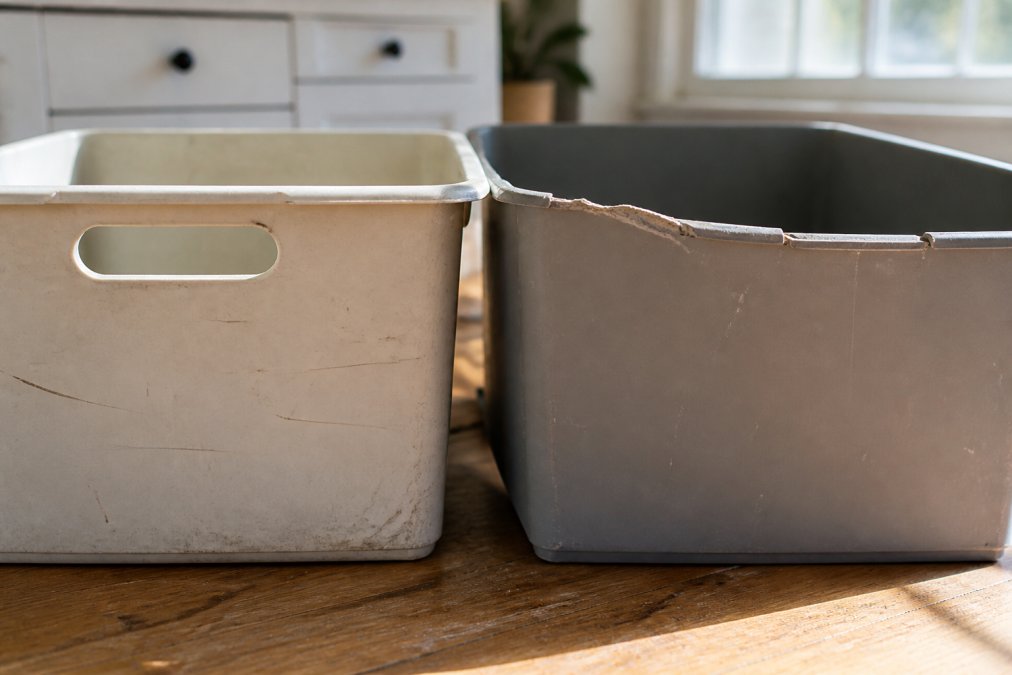
IKEA's storage systems are engineered for longevity. Their plastic bins are thicker and more rigid than Shein's, with metal hinges and hardware designed to withstand repeated use over years. Independent testing shows IKEA storage maintaining structural integrity after 12+ months of daily household use.
Shein's storage bins show visible wear much faster. Plastic becomes brittle within 6-12 months, especially in warm environments or sunlight. Handles crack, hinges weaken, and lids no longer seal properly. IKEA uses higher-density polyethylene and polypropylene; Shein uses thinner plastic that degrades faster under stress. Over two years, IKEA's higher upfront price often becomes the better value.
Load-Bearing Capacity and Structural Integrity
IKEA's larger storage units can handle 50-100 pounds per shelf, depending on the product line, with reinforced corners and support brackets preventing sagging or collapse (ikea.com).
Shein's storage bins max out at 15-25 pounds before walls flex or the base cracks (shein.com). This matters when stacking bins or storing heavier items like books, kitchen equipment, or winter clothing. A family storing off-season clothing in stacked Shein bins reported the bottom container cracking under weight within four months. The same setup with IKEA's system would have handled the load indefinitely.
Best Affordable Home Organization Brands
The real question is cost per year of actual use, how much you spend divided by how long the storage functions before replacement.
The True Cost of Ownership: IKEA vs. Shein
For organizing a bedroom closet with 10 storage bins:
Shein scenario:
- Initial cost: $50-80 ($5-8 per bin)
- Expected lifespan: 6-12 months before visible wear requires replacement
- Five-year total cost: $250-400
IKEA scenario:
- Initial cost: $120-180 ($12-18 per bin)
- Expected lifespan: 3-5 years before replacement
- Five-year total cost: $120-300
Over five years, IKEA's higher upfront cost becomes cost-neutral or cheaper.
When Shein Makes Sense
Shein's affordability works for:
- Temporary organization (dorm rooms, staging homes)
- Single-use projects (organizing one closet or drawer)
- Aesthetic experimentation without significant commitment
- Lightweight items only (linens, clothing, blankets)
When IKEA's Higher Price Becomes Obvious
IKEA wins on value for:
- Permanent household storage with years of expected use
- Heavy or frequent use (pantry bins opened daily, closet bins accessed multiple times weekly)
- Stacking or weight-bearing scenarios
- Modular expansion (standardized dimensions work together over time)
The Middle Ground: IKEA's Budget-Friendly Options
- Seasonal sales: January, July, and September clearance events offer 20-40% discounts
- As-Is section: Returned or floor-display items sell at 30-50% off
- Smaller modular systems: IKEA's plastic storage boxes ($5-15) offer durability at lower price points
- Mix-and-match approach: Combine IKEA's durable structural pieces with budget storage for non-critical items
Durable Storage Bins for Kids and Families
If you have children, durability becomes non-negotiable. Kids yank handles, overstuff containers, and stack bins without regard for weight limits. IKEA's storage survives this treatment; Shein's doesn't.
IKEA's plastic bins withstand abuse with reinforced handles, thicker plastic, and secure lids that function after repeated use. For toy storage, closet organization, or pantry bins in busy households, IKEA is the practical choice.
Shein's bins become safety hazards in households with children. Cracked plastic edges can cut small hands, weak handles can give way, and structural failure after 6-12 months means replacing the system just as children get comfortable with the organization routine.
The Reset Aisle's Fabric Drawer Organizers ($22.99) are built with meticulous stitching and high-quality polyester specifically designed for long-term durability in active households. Combined with IKEA's durable bins for larger items, this creates a system that survives childhood.

Which Brand Should You Choose?
Choose IKEA if you want storage that lasts. Their modular systems, standardized dimensions, and quality hardware mean you're building something that grows with your home.
Choose Shein if you need a temporary solution or are organizing a single small space on an extremely tight budget. Their bins work fine for 3-6 months of light use.
The Reset Aisle recommends a hybrid approach: invest in IKEA for structural storage and larger systems, then use specialized organizers for targeted solutions. Real durability means your storage system stays functional for years, allowing you to maintain organization instead of abandoning it when bins fail.
Frequently Asked Questions
Is IKEA storage actually good quality for long-term use?
IKEA storage performs adequately for 2-3 years with normal household use. Their particle board construction handles moderate weight loads, though edges can weaken over time. Plastic components remain stable, but metal hardware may show rust after 18+ months in humid bathrooms or kitchens. For budget-conscious shoppers prioritizing initial cost, IKEA meets baseline durability expectations.
What makes durable storage bins for kids different from standard options?
Durable storage bins designed for kids feature reinforced corners, thicker plastic walls, and secure locking mechanisms to prevent tipping. They withstand repeated opening, dropping, and rough handling that children naturally inflict. Look for bins with weight-tested structural integrity (typically 20+ pounds capacity) and non-toxic material certifications. Quality construction ensures the bins last through multiple children or years of active use.
How does Shein home storage compare to IKEA in terms of chemical safety?
Shein home storage products often lack transparent material safety documentation and third-party testing certifications. IKEA publishes chemical composition details and adheres to stricter manufacturing standards. If chemical safety is a priority for your household, seek products with explicit non-toxic certifications or choose established affordable home organization brands with published safety standards.
Can budget storage solutions actually stay organized long-term, or do they collapse after a few months?
Budget storage succeeds long-term when matched to realistic weight loads and organized thoughtfully. Overloading bins causes structural failure regardless of brand. The key is choosing products with adequate load-bearing capacity for your specific items, using dividers to prevent shifting, and rotating inventory. Many households maintain organized spaces for 12+ months using affordable options when they respect the product's weight limits and design purpose.
The real cost of cheap storage isn't the price you pay upfront, it's the time and money you spend replacing it every year. Start your reset with storage built to last. The Reset Aisle offers curated, durable solutions designed for real homes and real families. Explore our full collection of home organization products and discover how thoughtful storage design transforms chaotic spaces into peaceful, functional environments.
This article was written using GrandRanker