

Last Updated: October 24, 2026
Quick Summary
Toy rotation means keeping only a small set of toys available at any time and storing the rest out of reach, then swapping the sets on a schedule. Most families do well swapping toys every two to four weeks, and a swap should take about five minutes, not a full room overhaul.
- Sort toys into three piles: Keep, Store, and Donate, starting with one room.
- Keep out 4-6 items for under 2s and 6-10 items for ages 2-4.
- Choose open bins over lidded boxes so kids can see and return toys.
- Swap one set at a time and store the outgoing set before the new one comes out.
- Rotate when your child ignores a set for several days in a row.
Table of Contents
- Why Toy Rotation Beats Buying More Storage
- Step 1: Sort Every Toy Into Keep, Store, and Donate
- Step 2: Decide How Many Toys to Keep Out
- Step 3: Choose Toy Rotation Bins That Fit Your Space
- Step 4: Build a Toy Rotation Schedule You Can Keep
- Step 5: How Often to Rotate Toys Without Overthinking It
- Step 6: Store the Rest So It Stays Out of Sight
- Common Mistakes That Undo the System
- Frequently Asked Questions
Why Toy Rotation Beats Buying More Storage
A playroom floor covered in toys is not a sign your child has too much to play with. It is a sign they have too much to look at. Learning how to rotate toys to reduce clutter starts with one hard truth: more bins, more shelves and more cube organizers just give you more places to pile things up.
Parents buy storage to solve clutter, and the storage becomes clutter too.
Toy rotation is the practice of keeping only a small set of toys available at any time and storing the rest out of reach. You swap the sets on a schedule. The result is a playroom that resets itself, and kids who actually play with what they own.
Here is the part most guides get wrong. Rotation is not about deprivation or making your child own less. It is about attention. A child with five toys in front of them can focus. A child with fifty cannot decide where to start.
Below, we walk through eight steps to build a rotation system you can keep running, even on a busy week.
Step 1: Sort Every Toy Into Keep, Store, and Donate
Start with one room and one pile. Do not try to sort the whole house in one afternoon.
Make three piles on the floor: Keep, Store, and Donate. Here is how we would sort:
- Keep: toys your child played with in the last two weeks
- Store: toys they love but have outgrown for now
- Donate: broken items, duplicates, and toys nobody has touched in months
Be honest about the donate pile. A common mistake is keeping a toy because it was a gift. Guilt is not a storage system.
Get your child involved for a few minutes, then finish alone. Kids get attached to everything in the moment, and that stalls the whole process.
Step 2: Decide How Many Toys to Keep Out
The right number of toys to keep out is small enough that your child can see all of them at once. For most families, that means one moderate set per child, not a packed shelf.
Think in sets, not single items. A set of blocks, a set of cars, a set of art supplies. That makes swapping easy later.
A Workable Number by Age
There is no official rule, but these ranges work well in practice:
| Age | Toys Out at Once | Notes |
|---|---|---|
| Under 2 | 4-6 items | Large, safe, easy to grasp |
| Ages 2-4 | 6-10 items | Include one pretend-play set |
| Ages 5-7 | 8-12 items | Add building and craft sets |
| Ages 8+ | 10-15 items | Let them help choose |
Watch out: too few toys can backfire with older kids who need more variety. Adjust up if you see boredom, down if you see chaos.
Step 3: Choose Toy Rotation Bins That Fit Your Space
Pick bins that match your shelf, not bins you saw online and hope will fit. Measure first, then buy.
For rotation, we favor open bins over lidded boxes. Kids can see what is inside and put things back without help. Clear or labeled bins work well for stored sets.
A few practical tips:
- Use one bin per toy set, not one giant bin for everything
- Keep bins light enough for a child to pull out
- Match bin height to your shelf depth to avoid wasted gaps
If you want to browse storage options that fit small spaces and rotation setups, you can explore home organization products built for exactly this. And once your bins are set, DIY toy storage labels for kids make the system stick so everyone knows where things belong.
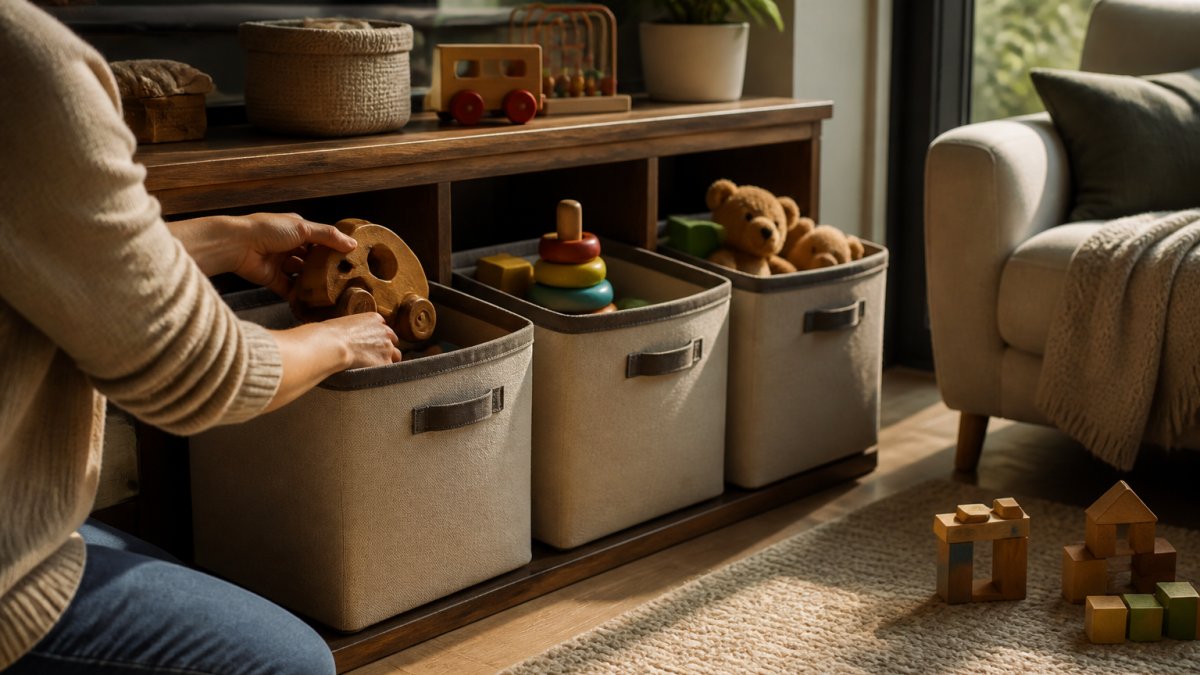
Step 4: Build a Toy Rotation Schedule You Can Keep
A toy rotation schedule is a simple calendar of when you swap sets. Keep it boring and repeatable.
Here is how we would set it up:
- Pick a swap day that already exists, like Sunday evening
- Write it on the fridge or set a phone reminder
- Swap one set at a time, not the whole room
- Store the outgoing set in its bin before the new one comes out
The goal is a five-minute task, not a deep clean. If your schedule needs an hour, it is too complicated.
Step 5: How Often to Rotate Toys Without Overthinking It
Most families do well swapping toys every two to four weeks. That is often enough to feel new, and rare enough to stay manageable.
How often to rotate toys depends on your child. Some kids stay engaged for a month. Others need a fresh set every two weeks.
Try this rule: rotate when you notice your child ignoring a set for several days in a row. That is your signal, no calendar math needed.
Step 6: Store the Rest So It Stays Out of Sight
Stored toys should be out of sight but easy to reach when swap day comes. A closet shelf, a labeled bin stack, or under-bed storage all work.
Keep stored sets organized by type, not by date. That way you can grab a puzzle set when your child asks for one.
For soft goods like stuffed animals, dress-up clothes and spare blankets, vacuum storage bags compress bulky items so they take up far less room. You can shop vacuum storage bags that seal flat and stack neatly on a high shelf.
If your closets are tight, space saving closet organization ideas can help you carve out room for rotation bins without losing hanging space.
Common Mistakes That Undo the System
The biggest mistake is rotating too many toys at once. A full room swap overwhelms kids and takes too long, so the system dies within a month.
Other traps we see often:
- Buying bins before measuring. Measure your shelf first, then buy.
- Keeping broken toys "for later." They just take up space.
- Skipping the donate pile. Without it, clutter simply moves around.
- Making it a chore. If rotation feels like punishment, kids resist.
- No labels. Unlabeled bins turn into mystery boxes and get dumped out.
Watch out: if you store toys in a damp garage or basement, fabric and wooden toys can pick up odors and moisture damage. Keep rotation bins in a dry, climate-controlled spot.
Clutter builds back the moment a system gets too complicated to run. We built The Reset Aisle to make the simple version easy: practical bins, space-saving storage, and labels that keep every set in its place. Our curated organizers help you make the toys you already own work harder, and our space-saving designs bring order to small rooms without adding more furniture. Ready to reset the playroom for good? Get started with The Reset Aisle and build a rotation system your family can actually keep.
Frequently Asked Questions
How do you start a toy rotation system?
Gather every toy in one room and sort it into three piles: keep out, store away, and donate. Pick a small number to stay on the shelf, usually 8 to 12 items depending on your child's age, and pack the rest into labeled bins. Put the bins somewhere your child cannot reach, like a closet or garage shelf. Then set a reminder on your phone for the first swap. You can adjust the numbers after the first week.
How often should you rotate toys?
Most families do well with a swap every two to four weeks. Watch for signs instead of sticking to a strict calendar: if your child walks past the shelf without touching anything, it is time for a change. Younger toddlers often need a faster cycle, closer to every two weeks, while older kids can go a month. A toy rotation schedule that matches your laundry or trash day is easier to remember than one you have to look up.
How many toys should you leave out at a time?
A common starting point is 8 to 12 toys on the shelf for toddlers and 10 to 15 for older children, including books and a few open-ended items like blocks. Fewer toys out means each one gets more attention, and cleanup takes minutes instead of an hour. If your child seems bored, add one or two items rather than emptying a whole bin. You can always adjust the number after a week of watching how play actually goes.
Does toy rotation help reduce clutter?
Yes, because it caps how much is visible at once. The floor, shelf, and play area hold a small, manageable set, while the rest waits in toy rotation bins out of sight. That cuts the daily pickup job and makes it easier for kids to put things back, since every item has a clear spot. It also means you can skip buying more shelving, because the system works with the storage you already have.
