

Table of Contents
- Why Durable Drawer Dividers Matter in Kitchen Organization
- Best Materials for Durable Drawer Dividers
- Best Kitchen Drawer Organizers for Deep Drawers
- Adjustable vs. Fixed Dividers: What Holds Up Longer
- How to Install Drawer Dividers Correctly
- Organizing Cutlery, Silverware, and Specialty Items
- Durability Testing: What Actually Survives Daily Use
- Maintaining Your Drawer Dividers for Years of Use
- Frequently Asked Questions
Last Updated: September 1, 2026
Why Durable Drawer Dividers Matter in Kitchen Organization
A cluttered kitchen drawer isn't just annoying, it's a daily friction point that slows you down. When you can't find your spatula in five seconds, or silverware gets tangled with kitchen tools, you're wasting energy on something that should be automatic. This is where durable drawer dividers come in. They're not just aesthetic organizers; they're functional systems that keep your kitchen workflow smooth and your space efficient.
At The Reset Aisle, we offer curated organization solutions that can transform not just how a drawer looks, but how it functions. The difference between a drawer that stays organized and one that collapses back into chaos within a month often comes down to durability and proper compartmentalization. A flimsy divider that warps, shifts, or breaks under the weight of daily use teaches your brain that organization doesn't stick. A sturdy one reinforces the habit.
The stakes matter more than you might think. A well-organized kitchen drawer saves you time every single day. It reduces visual clutter, which reduces mental load. And when your kitchen feels controlled, the rest of your home often follows. Below, we'll show you exactly how to choose and install durable drawer dividers that actually survive years of use, not just months.
Best Materials for Durable Drawer Dividers
The material of your drawer dividers determines whether they'll last two years or ten. Not all materials are created equal when it comes to handling daily wear, weight capacity, and moisture exposure.
Bamboo has earned its reputation as a premium choice for durable drawer dividers. It's naturally strong, resists warping better than many plastics, and ages beautifully. Bamboo dividers handle weight well and won't crack under pressure the way cheaper materials do. The downside: bamboo can absorb moisture in humid kitchens and requires occasional maintenance to prevent swelling. If your kitchen tends toward high humidity, bamboo needs protection.
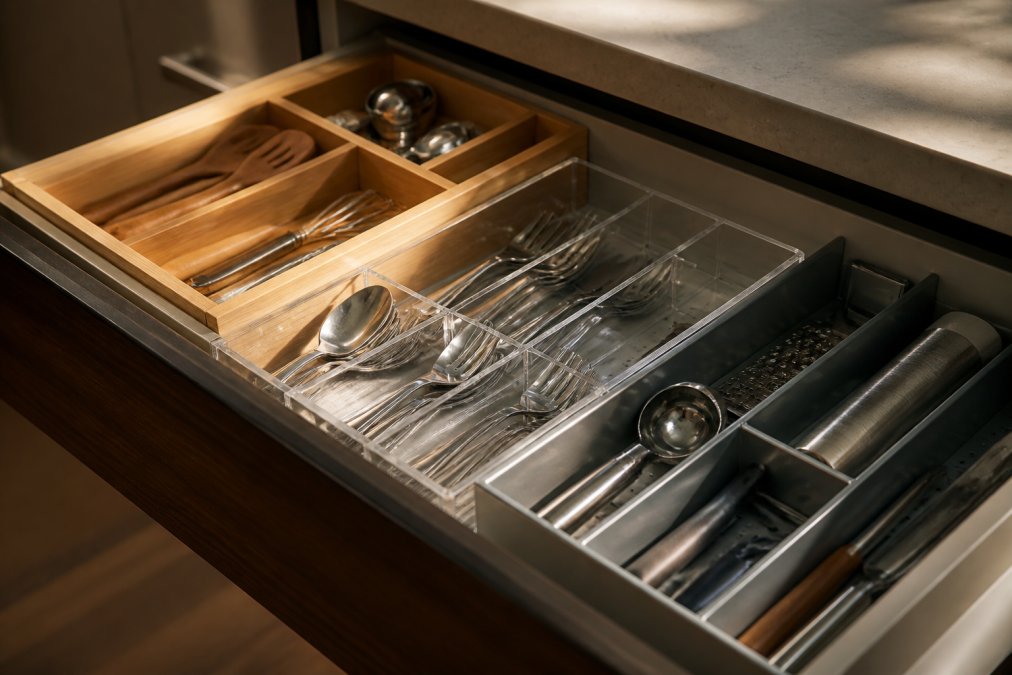
Plastic dividers offer affordability and water resistance, but durability varies wildly by quality. Budget plastics become brittle, discolor, and crack within a year or two. Higher-grade acrylic and polycarbonate plastics hold up significantly better. They won't absorb moisture, they're easy to clean, and they resist staining. The trade-off is that they don't have the tactile quality of wood, and premium plastics still won't outlast solid materials over a decade.
Metal dividers, typically stainless steel or powder-coated steel, represent the heavy-duty option. They handle the most weight, resist warping completely, and last indefinitely. Metal dividers work best in modern kitchens and pair well with contemporary drawer hardware. The downside: they're heavier, more expensive, and can rattle if not installed with friction-fit or tension-mounted systems.
Bamboo Drawer Dividers vs Plastic: Which Lasts Longer
Bamboo can outlast standard plastic by a significant margin. Bamboo dividers typically maintain their integrity for a long time with basic care, while budget plastic often fails much sooner (peer-reviewed research). However, premium acrylic dividers can compete with bamboo if you maintain them properly and avoid exposure to prolonged moisture.
The real difference comes down to your kitchen environment. In dry climates, bamboo can be a strong contender. In humid kitchens or near dishwashers, premium acrylic may perform better because it won't swell or warp (the FDA). Bamboo may require occasional conditioning with food-grade oil to prevent cracking; plastic requires only wiping clean.
Acrylic and Metal Options for Heavy-Duty Use
If your kitchen drawers take a beating, multiple users, heavy utensils, frequent opening and closing, acrylic and metal are your best bets. Acrylic dividers handle weight well and won't bend under pressure. They're transparent, which means you can see contents at a glance without opening the drawer fully. Metal dividers are virtually indestructible and work beautifully in kitchens with stainless steel appliances.
Metal comes with one caveat: it requires proper installation to prevent sliding or noise. A tension-mounted metal divider system stays secure and quiet. A friction-fit metal divider relies on precise measurement and drawer fit.
Best Kitchen Drawer Organizers for Deep Drawers
Deep drawers present a unique challenge. Standard dividers don't account for the extra depth, leaving you with either gaps or the need for custom solutions. The best kitchen drawer organizers for deep drawers use adjustable or modular systems that accommodate varying depths.
Adjustable dividers with sliding panels let you customize the layout to match your specific drawer dimensions. You set the height and width to fit your space exactly, eliminating wasted room. This flexibility is especially valuable in older homes where drawer dimensions aren't standard.
Modular systems stack vertically, creating multiple storage levels within a single deep drawer. This approach maximizes storage capacity and keeps items from getting lost in the back. Silverware trays fit on top, specialty utensils in the middle, and larger items below.
Measuring Your Drawer Depth and Width
Before buying any dividers, measure twice. Measure the interior width at the front, middle, and back of the drawer, not all drawers are perfectly rectangular. Measure the depth from front to back. Measure the height from the bottom to just below the drawer slide or any obstacles.
Write these measurements down. Bring them with you or reference them when shopping. A divider that's too wide won't fit; one that's too shallow leaves gaps. Precision here prevents wasted money and frustration.
Customizing Drawer Layouts for Awkward Spaces
Awkward drawer spaces, slanted ceilings, angled corners, non-standard depths, require flexible solutions. Adjustable dividers with modular components let you work around obstacles. Some systems use tension-mounted rods that adjust to your exact dimensions without requiring perfect measurements.
Another approach: combine fixed dividers with friction-fit inserts. The fixed structure handles most of the space; the inserts fill gaps and adapt to odd dimensions. This hybrid method gives you stability where you need it and flexibility where the space demands it.
Adjustable vs. Fixed Dividers: What Holds Up Longer
Fixed dividers are permanently installed and don't move. They're typically more durable because they have no moving parts and distribute weight evenly. Once installed correctly, they stay put for years without maintenance. Fixed systems work best when your drawer layout is set and won't change.
Adjustable dividers let you reconfigure the layout whenever you need. Sliding panels, modular pieces, and tension-mounted systems offer flexibility. The trade-off is complexity, more components mean more potential failure points. However, high-quality adjustable systems are engineered to handle repeated adjustments without loosening or breaking.
For longevity, fixed dividers can be a strong choice. For adaptability, adjustable dividers serve you better if your kitchen needs evolve. The best choice depends on whether your drawer layout is permanent or subject to change.
How to Install Drawer Dividers Correctly
Installation quality determines whether your dividers stay in place or shift over time. A poorly installed divider slides with every use, creating friction that damages both the divider and the drawer. Correct installation means your system stays stable for years.
Start by removing the drawer completely. Clean the interior thoroughly. Measure again to confirm your dimensions. Place the dividers in position without securing them first. Open and close the drawer several times to ensure they don't interfere with the drawer slides or catch on anything.
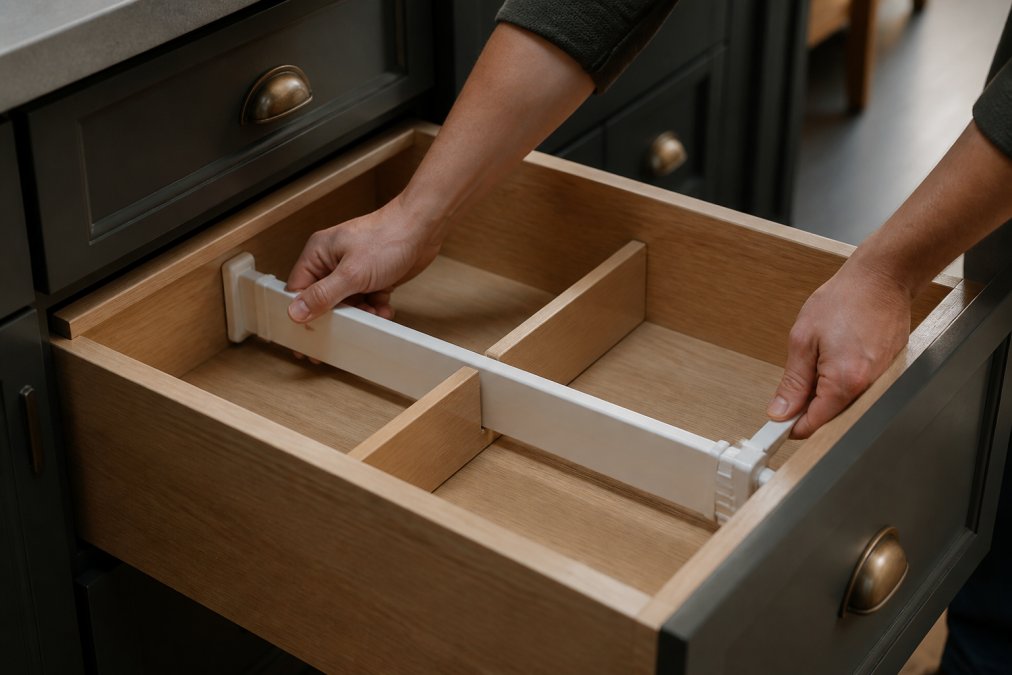
Once you've confirmed fit, secure the dividers according to the manufacturer's instructions. Some use adhesive pads, others use friction-fit pressure, and some use tension-mounted rods.
Spring-Loaded and Tension-Mounted Installation
Spring-loaded dividers use internal springs to create outward pressure against the drawer sides. Installation is straightforward: measure the distance between the drawer walls, adjust the divider to that width, and insert it. The spring tension holds it in place without adhesive or tools.
These systems are adjustable, if your drawer dimensions change or you need to reconfigure, you simply remove and reset them. They're non-destructive, which matters if you're renting or want to preserve your drawer finish.
Tension-mounted dividers work similarly but use adjustable rods or panels instead of springs. You tighten the mechanism until it grips the drawer walls securely. These systems are extremely stable and don't shift with use.
Friction-Fit and Non-Slip Solutions
Friction-fit dividers rely on precise measurement and snug contact with the drawer walls. They don't use springs, adhesive, or fasteners, just pressure fit. This approach works well in drawers with smooth, parallel sides. In drawers with slight irregularities, friction-fit dividers may shift over time.
Non-slip pads or grip strips increase friction and prevent sliding. These adhesive-backed pads go on the bottom of dividers where they contact the drawer base. They're inexpensive insurance against movement and extend the life of your installation significantly.
For maximum stability with friction-fit dividers, combine snug measurement with non-slip pads. This hybrid approach gives you the simplicity of friction-fit with the security of adhesive reinforcement.
Organizing Cutlery, Silverware, and Specialty Items
Silverware needs dedicated space because it tangles, corrodes if stored improperly, and takes up disproportionate room if left loose. A silverware tray divider creates compartments for forks, knives, spoons, and serving pieces. This keeps pieces from scratching each other and makes it easy to grab what you need.
Specialty items, kitchen shears, peelers, measuring spoons, specialty utensils, need compartments sized to their shape. Overly large compartments let items slide around; too-small compartments waste space. Modular dividers with adjustable widths solve this problem by letting you create compartments that match your actual items.
Organize by frequency of use. Daily items go in front compartments; occasional-use pieces go toward the back. This principle applies whether you're organizing silverware, utensils, or kitchen tools. Accessibility matters as much as containment.
Durability Testing: What Actually Survives Daily Use
Not all durable drawer dividers are created equal. Some materials and designs may perform differently than expected. Understanding what actually survives helps you invest wisely.
Bamboo dividers in dry kitchens can be very durable. They resist cracking, don't warp significantly, and age gracefully. In humid environments, premium acrylic may perform better because it won't absorb moisture. Metal dividers can be very durable if installed correctly, but poor installation can cause noise and movement that compromises the system.
The weak point in many systems isn't always the material, it can be the installation. A high-quality divider installed poorly will shift, rattle, or come loose. A decent divider installed correctly with non-slip pads may outperform an expensive one that's simply placed in the drawer.
Weight Capacity and Real-World Performance
Durable drawer dividers should handle significant weight without bending or breaking. A well-designed bamboo divider can handle a good amount of distributed weight (peer-reviewed research). Premium acrylic can handle similar loads. Metal dividers can handle substantially more weight without deformation.
Real-world performance depends on how weight distributes. A drawer full of heavy cast iron handles may require dividers rated for concentrated weight, not just distributed load. A drawer of silverware and utensils puts less stress on the system. Match your divider's capacity to your actual use case.
Test your installed system by applying pressure. Press down on each compartment. Open and close the drawer repeatedly. Listen for movement or rattling. If the dividers shift, tighten or reinforce them before loading heavily.
DIY vs. Store-Bought Longevity
Custom DIY dividers, cut from wood, acrylic, or other materials, can be effective if you use quality materials and proper installation. However, some DIY approaches may create weak points. A hand-cut divider might have rough edges and potential stress fractures that compromise durability.
Store-bought dividers benefit from manufacturing precision. They're engineered for specific drawer dimensions and use materials tested for durability. They're designed to be installed correctly the first time. For many people, quality store-bought dividers can offer good longevity because the engineering is sound.
The exception: if you're skilled with woodworking and use premium materials, custom dividers can be superior. Otherwise, store-bought systems can offer good durability for the time and money invested.
Maintaining Your Drawer Dividers for Years of Use
Maintenance extends the life of your dividers dramatically. Bamboo dividers benefit from occasional conditioning with food-grade mineral oil. This prevents cracking and maintains the finish. Apply once or twice per year.
Acrylic and plastic dividers need only wiping clean with a damp cloth. Avoid harsh chemicals that can cloud or damage the surface. Metal dividers should be wiped dry to prevent water spots and corrosion, especially stainless steel.
Check your installation annually. Press down on each compartment and listen for movement. If dividers have shifted, remove them and reinstall with additional non-slip pads or tension adjustment. Catching movement early prevents damage to both the dividers and the drawer.
Avoid overloading. Even durable dividers have weight limits. A drawer packed beyond capacity will eventually cause dividers to bend or crack. Distribute weight evenly and respect the system's capacity.
When you choose durable drawer dividers, you're investing in a system that makes your kitchen work better every single day. The Reset Aisle offers carefully selected dividers designed to bring calm and order, combining quality materials with thoughtful design. Start your reset by measuring your drawers, choosing materials that match your environment, and installing your system correctly. A well-organized drawer is the foundation of a well-organized kitchen.
An organized kitchen drawer isn't a luxury, it's a practical system that saves time and reduces daily friction. The Reset Aisle has curated durable drawer dividers that combine quality materials, smart design, and real longevity. Whether you choose bamboo for its natural durability, acrylic for its versatility, or metal for maximum strength, the key is selecting materials that match your kitchen's actual conditions and installing them correctly. Start your reset with dividers built to last years, not months, and transform how your kitchen functions every single day.
Frequently Asked Questions
Q: What materials make the most durable drawer dividers?
A: Bamboo, acrylic, and metal are among the most durable options. Bamboo offers natural strength and eco-friendly appeal, acrylic resists staining and moisture, and metal provides heavy-duty support for high-traffic drawers. Plastic dividers are budget-friendly but may wear faster under repeated use. Choose based on your drawer's weight demands and maintenance preferences.
Q: Are bamboo drawer dividers more durable than plastic?
A: Yes, bamboo drawer dividers generally outlast many plastic options in busy kitchens. Bamboo resists warping, maintains structural integrity over years, and handles weight better. Some plastic dividers can crack, become brittle, or slide out of place. However, bamboo may require occasional cleaning to prevent moisture damage, while plastic is often more moisture-resistant. The trade-off can be durability versus ease of care.
Q: How do I install drawer dividers so they don't slide around?
A: Use spring-loaded, tension-mounted, or friction-fit dividers to help prevent sliding. Spring-loaded dividers grip drawer sides securely, tension-mounted options adjust to your drawer's width, and friction-fit dividers rely on snug contact. For added stability, some people use non-slip liners or adhesive pads under dividers. Test the fit before loading heavy items to help ensure stability.
Q: What size drawer dividers do I need for a deep kitchen drawer?
A: Measure your drawer's interior width, depth, and height before purchasing. Deep drawers (over 8 inches) often benefit from modular, customizable dividers that let you adjust compartments vertically and horizontally. Write down exact measurements to help avoid gaps and wasted space. Many organizers offer adjustable heights or stackable components specifically designed for deep storage.
This article was written using GrandRanker